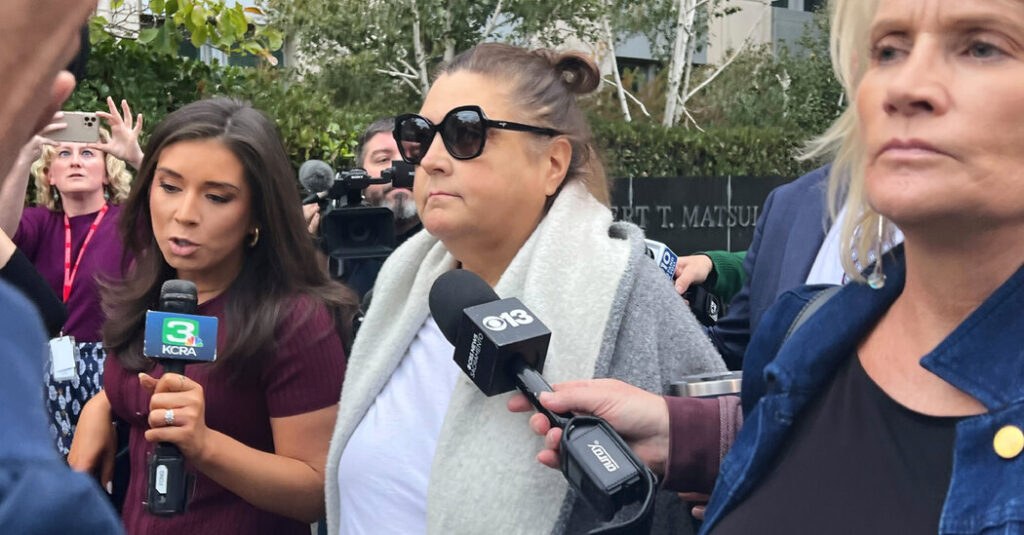
One of California’s most influential power brokers is expected to plead guilty to three felonies on Thursday in a corruption case that has reverberated through the State Capitol and spurred attacks on a Democratic front-runner in the volatile race for governor.
That powerful figure, Dana Williamson, is scheduled to appear in federal court in Sacramento, where she is expected to accept reduced charges and plead guilty to lying to the F.B.I., filing a false tax return and conspiracy to commit bank fraud and wire fraud, court records show.
Ms. Williamson, 53, has been at the center of influence in Sacramento as a former chief of staff to Gov. Gavin Newsom and a former political adviser to Xavier Becerra, who has emerged as a top Democratic contender for governor in recent weeks.
While her case prompted speculation in November about whether her acts were tied to her work in Mr. Newsom’s office, there has been greater scrutiny this month on her connections to Mr. Becerra because of his unexpected surge in the governor’s race.
Ms. Williamson was indicted late last year on 23 charges stemming from a plot to skim $225,000 from one of Mr. Becerra’s campaign accounts.
Two other political operatives, who were charged as her co-conspirators, pleaded guilty last year. The operatives, Sean McCluskie, Mr. Becerra’s former chief of staff, and Greg Campbell, a Sacramento lobbyist, admitted that they had participated in a scheme to siphon money from Mr. Becerra’s dormant campaign account to pad Mr. McCluskie’s income.
The plea deal, as laid out in court filings, would dramatically reduce the number of charges against Ms. Williamson. In exchange, she would pay more than $500,000 in restitution, the agreement says, and could face time in prison, to be determined at a sentencing hearing later this year.
Ms. Williamson’s plea agreement comes as Californians have begun voting in the wide-open race to replace Mr. Newsom, who cannot run for re-election because of term limits. Mr. Becerra, a leading Democrat on the June 2 primary ballot, has not been charged with any crimes and has described the betrayal by his former advisers as a “gut punch.”
Nonetheless, the case has become fodder for numerous attacks by Mr. Becerra’s opponents in the hotly contested race. Tom Steyer, a Democrat who is polling near Mr. Becerra, is running an ad that invokes the criminal case and says Mr. Becerra is “part of a broken system.” Antonio Villaraigosa, another Democrat in the race, and Steve Hilton, the top-polling Republican, have confronted Mr. Becerra about the corruption case in recent debates.
And Katie Porter, a Democratic former congresswoman, used an appearance on CNN this week to argue that the investigation made Mr. Becerra a risky choice for voters. She said the Trump administration could try to indict Mr. Becerra after the primary to damage the only Democrat in the general election for governor.
“We just don’t know where this is going,” she said on Monday. “It’s still an open issue.”
Mr. Becerra responded by telling reporters hours later that he had cooperated with federal prosecutors in their investigation of his aides.
“We are moving forward,” he said at a campaign stop in Sacramento. “I was not involved in those actions.”
It is unclear if Ms. Williamson’s guilty plea will fundamentally rearrange the dynamics in the governor’s race, which has grown unusually turbulent in recent weeks. Mr. Becerra had languished so much in the polls in March that he didn’t qualify for a televised debate late that month.
But after Eric Swalwell was accused of sexual assault in April and dropped out of the race, Mr. Becerra’s campaign was resurrected, with many in the Democratic establishment looking for an experienced candidate who seemed to be a steady choice.
The plea deal, as described in the filing, does not include any new information about Mr. Becerra, nor does it include an agreement that Ms. Williamson will cooperate with the prosecution. Under federal sentencing guidelines explained in the agreement, Ms. Williamson could face 30 to 36 months in prison, but the ultimate decision would be left up to a judge.
The federal Department of Justice has a custom known as the 60-day rule in which it avoids taking actions within two months before an election that could influence how people vote. Asked why the case against Ms. Williamson is moving forward so close to the primary, a spokeswoman for the U.S. Attorney’s Office in Sacramento said that the investigation began in 2022 and that the charges had been public since November.
“No candidate running for governor has been implicated in any charging document,” said Lauren Horwood, a spokeswoman for the office.
The scheme to take money from Mr. Becerra’s state campaign account took place from 2022 to 2024, when he was the health and human services secretary for President Joseph R. Biden Jr. The account had funds that Mr. Becerra, a former California attorney general, had raised in case he planned to run for another state office.
Mr. Becerra has said that he paid campaign aides to manage the account because his role in the federal government prohibited him from doing political work.
When Mr. Becerra was the state attorney general, Mr. McCluskie served as his chief of staff. Mr. McCluskie then took a pay cut to follow his boss to Washington to serve in the Health and Human Services Department. Court records say that the scheme to take money from Mr. Becerra’s campaign account was designed to cover Mr. McCluskie’s expenses in traveling coast to coast while his family remained in California.
Ms. Williamson’s plea agreement says that she helped Mr. McCluskie steal the money “at Mr. McCluskie’s request” by billing Mr. Becerra for political consulting services. She then funneled the payments through multiple business entities before it landed in an account controlled by Mr. McCluskie. The agreement says that Ms. Williamson and her co-conspirators must pay a total of $225,000 in restitution for the money they stole from Mr. Becerra’s account but does not specify how much each will pay.
Ms. Williamson must also pay more than $500,000 in restitution to the Internal Revenue Service for taxes she owes from filing tax returns that claimed improper business deductions, the agreement says. She deducted payments to family members for “purported wages,” the agreement says, as well as an array of personal expenses, including car payments, vacations and food delivery services.
The agreement says that Ms. Williamson lied to F.B.I. agents during an interview in November 2024 that was “an investigative step in multiyear public corruption and fraud investigations related to the California Capitol.” It describes two parts of the interview in which she was accused of not being truthful.
The first involved questions about payments to Mr. McCluskie and conversations Ms. Williamson had about their scheme. Prosecutors said that she lied in the interview, based on different statements she had made in private conversations that the F.B.I. had secretly recorded days beforehand.
The other concerned information about the state government that Ms. Williamson had access to while working in Mr. Newsom’s office. Before Ms. Williamson became the governor’s chief of staff in 2023, she ran a consulting business doing public affairs work for numerous clients. The plea agreement says that she gave her former business partner confidential information about state litigation that involved one of their clients and then lied about it when questioned by the F.B.I.
The agreement does not name the client, but details in the indictment align with a sex-discrimination lawsuit that California regulators filed in 2021 against the video game maker Activision Blizzard, which had been a client of Ms. Williamson’s consulting business.
Laurel Rosenhall is a Sacramento-based reporter covering California politics and government for The Times.
The post Strategist Tied to Becerra and Newsom Is Expected to Plead Guilty to 3 Felonies appeared first on New York Times.