The evening before Pearl’s senior year began, Michelle Villemaire watched her daughter unravel. The school hadn’t released her class schedule yet, Pearl complained. She knew there were logistical complexities to operating a 2,400-student high school in a retrofitted department store, but couldn’t they get just this one thing right? And how could it take so long to get back to their real campus?
In the next breath, she started pressing Michelle about the status of their smoke-damaged home in the Pacific Palisades, a mile and a half from the school’s grounds. Why wasn’t Pearl allowed to go pick up a dress that was still hanging in her closet there? Wasn’t there a way to wash the toxic metals off?
Michelle could see the frustration and grief swirling in her daughter’s eyes. It had been seven months since they had gotten word that, after one of the most destructive wildfires in Los Angeles history, their home and Pearl’s high school — though badly damaged — still stood. There was talk of the community rising from the ashes, carrying on with resilience. Pearl and her classmates were told that, soon enough, life would return to normal.
But the house repair was moving slowly, and school administrators had pushed back the expected date of return. Now it was August, and Pearl was starting the last year of her childhood in an Airbnb more than an hour away, tears streaming down her face.
Oh, god, Michelle thought. Maybe there was more riding on the return to campus than Michelle had realized.
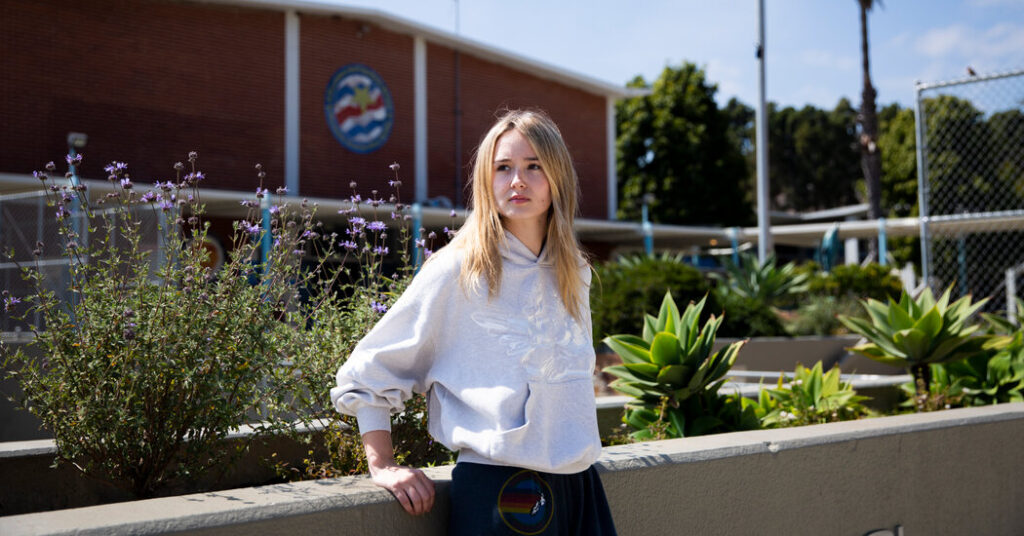
Palisades Charter High School, or Pali High, had always been an idyllic campus — Hollywood’s set for “Carrie,” “Teen Wolf” and “Freaky Friday,” among other films — with its dolphin mascot and sprawling quad and stipples of palm trees against the Pacific. Pearl had arrived there as a nervous freshman in the wake of Covid and had flourished into a 17-year-old who helped start an environmental club and took college-level classes.
Now Pearl was commuting to an abandoned appliance showroom beside I-10, where there were no lockers or lunch tables or science labs or even grass. Most of her classrooms were windowless, their doors made of shower curtains and cardboard. The restrooms were trailers in the parking lot. School administrators called the building “Pali South.” Students just called it Sears.
Privately, Michelle was relieved that Pearl would be starting the school year there. She and other parents had been pressing the administrators all summer for details about post-fire cleanup at the main campus, but they had heard almost nothing. Michelle knew about the types of toxins that lingered in smoke-damaged Palisades buildings, and she worried about new contaminants wafting in from an entire town of debris. Maybe Sears was better.
Michelle tried to reassure her daughter that school officials were probably doing their best; that their home restoration was underway; that maybe Pearl could borrow a dress similar to her own from a friend. Then she sighed.
“I know, honey, it’s everything at once,” Michelle said. “It’s trauma soup.”
By the following morning, Pearl seemed excited — at least she would be seeing her friends — but as she drove off, Michelle returned to a text thread in which Palisades moms were discussing whether fresh coats of wall paint were sufficient to trap carcinogens. A familiar anxiety settled into her chest. It was a psychic fear playing out for people across large swaths of Los Angeles: Did anybody really know the extent of the health risks that lingered after an urban fire?
She posted on Instagram a local news article in which the Pali High principal said she was optimistic that the school would return to its campus in a matter of months.
“Will it be safe?” Michelle wrote in her Instagram caption. “I need data.”
A few days later, Michelle stood in the driveway of her Palisades house, once again donning her hazmat shoe covers and respirator.
She was here at the behest of an insurance adjuster who wanted an itemized list of every porous object, where invisible toxins had most likely burrowed deep inside. She lingered in the doorway, taking in the view of their lives on hold: half-folded laundry on the kitchen table; a sink of dishes draped in a blanket of ash — remnants of her neighbors’ incinerated Tesla batteries, PVC piping and furniture that had blown through the gaskets on the Santa Ana gusts. Her monstera plant drooped dead by the window. She had been advised not to touch a thing.
On Michelle’s side of the street, hers was the only house left. It looked as though the wind had whipped the embers all the way up the block, consuming her fence but then abruptly changing course. People with surviving homes were often considered the lucky ones, but when Michelle had gotten the news, she was devastated. It felt like “a toxic ex-boyfriend showing back up,” she said, a chamber of charred memories and dangerous chemicals that she was forced to stay and reckon with.
Michelle was an actress and a community organizer, the type of woman who had a black belt in karate and went on national television to encourage women to use power tools. So she took up the Palisades house as her newest crusade, taking photographs of each drawer’s contents, requesting estimates from vendors and coordinating plans with more than a dozen adjusters and inspectors. She tried not to talk about the visits with Pearl or her 14-year-old sister, Vivi, or even Michelle’s husband, Jonathan.
“It’s like I’m in ‘Severance,’” she said, looking at her masked reflection in the window. “I call this my innie.”
California had no agreed-upon standards for restoring homes and schools that had been exposed to urban wildfire smoke. Instead, insurance companies chose which substances to test for, typically sticking to the ones they knew how to remove. That meant Michelle had to train herself as an expert on beryllium and cadmium and hexavalent chromium nanoparticles — attending seminars with Harvard researchers and reading dozens of academic articles to determine which tests were important enough to pay for out of pocket.
Unlike a traditional wildfire, the blaze had consumed more than trees and brush; it had burned thousands of structures, vehicles and household plastics, releasing a novel list of pollutants that even experts were struggling to grasp. Research projects around the city were uncovering new threats by the week. Scientists reported that levels of volatile organic compounds, or V.O.C.s, were actually higher after the fires than during the active burning. Heavy metals derived from electronics had coated indoor surfaces with dangerous neurotoxins. A report over the summer revealed the presence of chromium-6: an invisible, carcinogenic particle more than a thousand times smaller than the width of a human hair, tiny enough to enter into individual cells and circulate throughout the body. Researchers estimated that chromium-6 could travel for miles.
But it was impossible to figure out what any of this would mean for Pearl. Past studies on chromium-6, for example, had found that industry workers exposed to the particle were five times more likely to develop nasal and sinus cancers than people who didn’t work with it, and that workers exposed to relatively low levels still had a significantly higher rate of lung cancer than those who weren’t exposed at all. No one could say whether that data meant anything in the context of the Palisades fire. If Michelle wanted anything definitive, she would have to wait for the results of the city’s 10-year health study. Even then, some cancers can take more than two decades to show up.
Maybe that’s why a large segment of Pali High parents seemed on board with what Michelle called a “Pollyanna approach.” Whenever someone expressed worry about toxins in the school’s parent WhatsApp chat — called “Riding the Wave” — other parents chimed in to say that “the air feels super fresh” in the Palisades, or that “the hills are green” again. Eventually, worried parents were sent to a separate WhatsApp group chat called “Environmental Concerns.” One mother shared a list of 20 technical questions she had sent to district officials, who said many of them “cannot be answered at this time.” Several parents reported submitting formal public records requests, though they never resulted in meaningful data. Another uncovered a report about soil testing on the campus baseball field, but the most recent samples were more than five months old.
“It’s almost comical that this would be sufficient,” Michelle wrote to the “Environmental Concerns” thread one morning. “Kids will be coming from bus stops, walking into town, tracking around the same toxic dust that is all over our streets.”
Michelle didn’t want to be paranoid, but she knew it was her job to protect Pearl. Michelle herself was living with bothersome lung infiltrates that her doctors believed might have resulted from pollution she was exposed to as a child, when her family lived in the Middle East and Asia.
“There needs to be regular testing all over town,” she messaged the group. “Anyone know when the next town hall (or other appropriate gathering) is so we can make noise?”
As autumn wore on, Michelle decided to email fellow members of her Y.M.C.A. board. They were some of the most well-connected people in town; maybe they would know what was going on. “As Pali High gears up to return to campus,” she wrote, “many of us are craving more information about what toxins could possibly impact our kids.”
Within 10 minutes, a fellow board member replied that, while she had no data, she believed the school district had gone “above and beyond” with its testing, and that she had recently gone to pull weeds on a roadway median near the school.
“The plants are growing well,” she added.
When Michelle initially learned that Pali High would temporarily relocate to a department store, her first priority had been to hype Pearl for the challenge.
“It’s going to to be epic,” she had told Pearl. “Your kids are going to ask you what it was like to go to high school at Sears.” She started texting Pearl 1970s Sears catalog covers as outfit inspiration: sharp collars, tailored trousers, cerulean Fair Isle sweaters with matching high socks. Pearl replied with elongated “Looool”s.
But over time, Michelle could see that the novelty of the Sears experience was wearing thin. Pearl’s A.P. psychology class was in the freezing cold basement. Literature was upstairs, which was somehow broiling hot. Thousands of students tried to jam through labyrinthine stairwells between periods, Pearl said, and without real doors or ceilings or even walls, a cacophony of voices bellowed from 90 different makeshift classrooms.
Pearl was already dealing with the typical stressors of senior year — SATs, college applications — plus the losses from the fire. But now there was an added layer of isolation. At first, she and Michelle had known plenty of families living near their Airbnb in the South Bay, but gradually, each had returned to remediated homes in the Palisades or had moved away. Now, Pearl drove to school by herself, leaving before seven o’clock if she wanted to be on time for her first class at 8:30. She rarely stayed after school to see friends, since the traffic home would grow worse by the minute.
Michelle watched as Pearl seemed to disappear behind thriller novels and pour herself into her application to her dream school, Syracuse University. She wanted to study neuropsychology, she wrote in her essay, so she could help people cope with what they could not control. One sentence explained that she had lived with a fear of wildfires since age 7, but she did not mention that it had come true.
The day before Pearl’s 18th birthday, Michelle idled in her car after spending the day at their Palisades house. She FaceTimed Pearl to probe a bit.
“We’ve been living our lives, but we’ve stopped talking about the emotional impact,” Michelle said delicately. “I’ve been curious to know how you’ve been feeling about the fires specifically.”
Pearl, who was curled up at the foot of her friend’s bed in the Palisades, was silent.
“I haven’t thought about it that much,” she said finally. “I haven’t really had time to even think about it.”
Michelle pushed harder. Surely, she said, Pearl wanted — or maybe needed — to share.
Pearl bit the side of her lip and said the obvious: She wanted to be back at Pali High. “Everything is just delayed, delayed, delayed — it’s all so uncertain,” she said. “This is supposed to be my last year of everything. The only thing distracting me from being sad is being angry.”
Michelle couldn’t fall asleep that night. She lay in bed wondering whether her concern for Pearl’s physical health should really outweigh that for her mental health. She remembered the Covid lockdowns, when Pearl was in sixth grade, and everyone seemed to be promising students that things would soon return to normal. In the end, Pearl had spent seventh grade in her bedroom and eighth grade in a mask — and in a way, it felt like Pearl was still trying to catch up, even now. In retrospect, adults had been obsessed with making sure students didn’t go back to school too early; they did not seem to realize that there was such a thing as too late.
One morning just before Christmas, Michelle stood in a Thrifty-Wash, watching her seven loads of laundry tumble and spin. The machine at the Airbnb had broken and flooded the place. It had been a blessing, in a way — Michelle needed this time alone to think.
The night before, Los Angeles Unified School District officials had hosted a Zoom webinar for parents, in which they had promised to present all the evidence that campus was safe. Michelle had gone in with high hopes, maybe even optimism. Afterward, she called it “the Zoom from hell.”
The officials had opened the meeting by announcing that Pali High’s students would go back to campus at the end of January. Michelle had peered at the screen, squinting to make sense of their color-coded maps, charts and checklists as district officials and their third-party contractors used wonky terms to describe what sounded to Michelle like rudimentary decontamination methods: “visual inspections,” “glove tests,” “subjective evaluations for smoke odor” and the copious use of wet wipes.
The “Environmental Concerns” WhatsApp group began pinging with live commentary. “It’s like they’re all hanging out with my insurance company,” one mother typed. “Transparency my a$$,” wrote another.
During the question-and-answer portion, parents flooded the submission box: Why weren’t the porous ceiling tiles removed? (“We did our best to remove any surface contaminants that we could see visually,” one contractor replied.) Did they realize that lithium had been detected in smoke-damaged homes near the school? (“Lithium, we determined, was not going to be a high-priority metal for us,” another contractor explained.) And why hadn’t they tested for benzene, carbon tetrachloride or perchloroethylene — some of which had been found in other Palisades buildings after the fires?
Michelle had a hunch she knew the answer, but she assumed no official would ever admit it. Then the project manager for one of the contractors came on the screen.
“There are hundreds — literally — of different compounds that could be produced during a fire,” he said, “and there are analytical methods that can be very, very precise in sampling for those.” But the problem, he said, was that it “lacks specificity in what we can actually deal with … ”
Michelle had shaken her head in disbelief. The project manager interrupted himself. “That was the wrong way to put that,” he muttered.
This morning, Michelle had waked to some parents on the “Environmental Concerns” chat talking about putting their kids in virtual learning. Others were hoping to transfer. Michelle was fantasizing about protesting the return to campus, even dreaming up the picket signs: “Lead should only be in pencils,” or maybe, “Test on the school, not on the kids.”
But as she sat amid the whirring dryers and the scent of detergent, she faced it: Nothing was ever going to make the aftermath of a wildfire seem normal. Pearl was never going to get her clothes back from their Palisades house; she would probably never live in that home again. Maybe the spring semester at her high school was the only thing left. In the fall, Pearl would be across the country, at Syracuse. She was 18 now — officially an adult — and this was her decision to make. She had been clear with Michelle for months that all she wanted was to be back on campus. Michelle had to be OK with that.
Michelle reminded herself that the matter had been settled as the next few weeks passed. But the day before Pearl returned to campus, Michelle panicked. Independent specialists enlisted by other parents to examine the school’s cleanup protocol had released a letter addressed to district officials, warning them against skipping testing for a host of V.O.C.s.
“Without this level of rigor,” the specialists wrote, “the potential for ongoing exposure to harmful substances cannot be fully ruled out.”
Michelle spent the day reviewing the independent critique, the school’s official rebuttal and an array of articles about other schools’ remediation protocols. She had so much data but still no firm conclusions.
That evening, as she watched Pearl pack her bag for school, she texted a group of mothers she had known from the local preschool, whom she had been meeting with since Pearl was just 15 months old. They had children set to return to Pali High the next day too.
“I def wish they had done more testing, taken out their stupid ceiling tiles, etc.,” Michelle wrote. “So much unknown.”
Immediately, there was a reply from Melanie, a nurse whose house burned down. Her eldest was also a senior at Pali High. “We can try to be as safe as possible and eliminate danger but we just don’t know,” she wrote. “I can’t live worrying over everything all the time. It’s exhausting and impossible.”
The other mothers chimed in with agreement. Michelle took a deep breath. She had been waiting for some definitive sign, she realized. Maybe this was the closest she was going to get.
The sunrise was still pink the next morning when Pearl came into the kitchen. She had breakfast beside her dad, pulled her hair back into a clip and hugged her parents goodbye.
“I’m so happy for you,” Michelle said.
Pearl smiled. “Thanks.”
Michelle decided to go to the school, too. Hundreds of parents, alumni and neighbors were going to line the entrance, waving blue pompoms and cheering for the students’ return. She wasn’t going for Pearl so much as for herself. Maybe Michelle would be able to absorb the crowd’s joy.
She drove by Pearl’s elementary school (gone), her favorite frozen yogurt shop (gone), their go-to pizza restaurant (gone except the chimney). She passed charred telephone poles and wild mustard flowers; bluffs of leveled lots and some with new Tyvek wrap.
Soon she could see the school in the distance, where yellow caution tape still surrounded part of the quad and the bottom halves of the palm trees were still blackened from flames. Pearl’s first class would be in a portable where the baseball field used to be, but the scorched railings along the walkways had been replaced, and the dolphin mascot statue was sparkling in the sun.
Michelle danced to the bubbly playlist that was blaring through the speakers. She coaxed her eyes away from the debris that had collected along the berms and fought not to notice the prickly feeling in her lungs. Pearl was happy, she reminded herself. This is what her daughter wanted.
So when Pearl turned onto the campus driveway, Michelle was right in the front, not with a protest poster, but with one scribbled in Sharpie that said, simply, “Welcome back.”
Emily Baumgaertner Nunn is a national health reporter for The Times, focusing on public health issues that primarily affect vulnerable communities.
The post Will Her Daughter Be Safe at Pali High After the Wildfire? appeared first on New York Times.