Frank Bruni: Well, Bret, as panicked as our president must be over his falling approval ratings, he has at least one great consolation: He’s not Keir Starmer. What do you make of — and what can be learned from — the British prime minister’s spectacular implosion?
Bret Stephens: I’m sad about Sir Keir. I had hopes that he could exemplify the adeptness and stability of a centrist leader in the mold of Tony Blair, his most successful predecessor as a Labour prime minister. And that he could rid Labour of the ghost of Jeremy Corbyn, his far-left, antisemitic predecessor as party leader. Instead, he’s turned out to be just another overmatched politician. And he’ll probably be remembered as the man who, through sheer ineptitude, pushed British voters to the extreme left and extreme right.
Frank: I’m worried about what his failure means not only for Britain but also for America — specifically, how it will color the debate among Democrats about whether to fight President Trump and MAGA with ardent progressivism or with a more moderate approach. To me, Starmer’s failed centrism isn’t proof that a politician’s policy prescriptions must be unusually bold or revolutionary. But those ideas must show consistency and conviction — his didn’t — and they must be sold by someone less crushingly phlegmatic. I’ve been more inspired by the instructions for assembling an IKEA night stand than by most of Starmer’s public remarks.
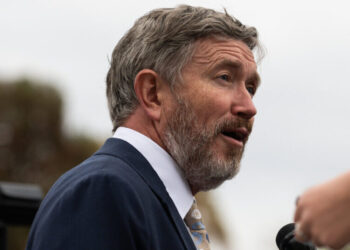
Bret: You’re putting your finger on the biggest challenge in Western politics today: Competence and sanity generally lie toward the ideological center of politics, but charisma tends to take root at the extremes, whether it’s someone like Zohran Mamdani on the left or, well, Donald Trump on the right. Charisma at the center is hard to find, though I think I may have located it last week in the person of Jake Auchincloss, the sort-of-young and very bright Democratic congressman from Massachusetts.
Who else?
Frank: There are more than a few Democratic politicians who, I think, are trying to solve precisely this riddle — how do you make reasonableness compelling and good-sense sexy — and are rehearsing their acts. That’s what Elissa Slotkin is doing, and it explains her arrestingly blunt language. It’s what Pete Buttigieg is doing, and it explains his beard. Ruben Gallego. To some extent, Josh Shapiro. The way Shapiro talks about his Jewish faith, in fact, assures voters that a politician of great practicality can also be a person of deep feeling. Raphael Warnock, an actual reverend, sometimes does something similar along Christian lines.
Bret: I just hope we haven’t reached the stage where Shapiro’s faith and his old-fashioned support for Israel aren’t politically disqualifying as far as a critical mass of Democratic primary voters is concerned. It’s been depressing to witness the speed with which the progressive critique of Israel has shifted from fair and reasonable criticisms of Benjamin Netanyahu to an unhinged conviction that Israel is a rogue state — no better, if not actually worse, than terrorist groups like Hamas and Hezbollah. I don’t think it serves Democrats well when they sound as crazy on this subject as Tucker Carlson or Candace Owens.
Frank: I’m glad you brought up Carlson and Owens; before you did, I was chomping at the bit to remind you that Democrats — some Democrats — aren’t the only ones portraying Israel in such nefarious terms. The prevalence of right-wing figures doing that is causing one of the greatest schisms in the MAGA movement. In fact, what puts Israel in such a dangerous position and at such a consequential crossroads is condemnation from people across the entire political spectrum.
Bret: My people are just where we want to be: Everyone hates us.
Frank: Not everyone. Not me. I can feel revulsion at Netanyahu’s actions, have urgent questions about how Israel is comporting itself and still be a supporter — and, in fact, huge admirer — of Jewish people. Part of what I hate so much about the current discussions of Israel and, really, all political discourse is the seeming prohibition on nuance, on complexity, on fine-grained distinctions. This actually relates to our examinationof Starmer’s fate in today’s political environment. Everything is operatic emotion and bitter grievance. Politicians fail to recognize and adjust for that at their peril.
Bret: “Operatic emotion and bitter grievance” is a line to remember. Speaking of which, did you watch Kash Patel’s testimony to Congress?
Frank: Bits of it. As much as I could bear. He was doing a Pam Bondi imitation, right? Let me put that in terms he’d appreciate. She was rye on the rocks. He was bourbon straight up.
Bret: Careful now, lest we become his next gin and tort.
Frank: He’s litigious, our Kash. Excuse me: Ka$h. What a ridiculous man, which is to say he’s a perfect fit for this administration. Even so, hauling around cases of specially made bottles of Woodford Reserve bourbon with his and the F.B.I.’s name on them and then handing them out as gifts because … nothing says law and order like a manhattan or an old-fashioned. I shouldn’t dwell on him. Now I need a drink.
Bret: Remember when Bill Barr, one of Trump’s attorneys general in his first term, said that Patel would be appointed as deputy F.B.I. director “over my dead body” and that Trump’s mere consideration of the move showed the president’s “shocking detachment from reality”? Well, here we are. My guess, though, is that Patel will stay in the role because, if there’s one thing that our teetotaler president hates more than insobriety, it’s moral sobriety. And Patel is exactly the lackey he needs to ensure that the bureau never tries to stop his abuses of power.
Frank: While we’re traipsing down memory lane with Keystone Kash, as his critics love to call him, let’s remind readers of a bit of his background that gets lost in the buffet of mortifications. He actually, honest to goodness, you can’t make this stuff up, wrote a trilogy of children’s books, “The Plot Against the King,” about groundless investigations into King Donald and a truth-seeking wizard named Kash (Kash the Distinguised Destroyer, in fact) and an evil nemesis identified as — wait for it — Hillary Queenton. Needless to say, Bret, none of the three books won the Newberry Medal.
Bret: A professor I know once said that “A” leaders surround themselves with “A” advisers but “B” leaders surround themselves with “C” advisers. In Trump’s case, the advisers are mostly “F’s,” and I don’t just mean “failure” or “flattery.”
Frank: So that makes him — what? — a D president? If so, he’s benefiting from the kind of grade inflation at the elite universities he has been working so assiduously to eviscerate.
Bret: Remember what Alexander Hamilton said about the kinds of advisers he expected a president to nominate? A president, he wrote in Federalist 76, “would be both ashamed and afraid to bring forward, for the most distinguished or lucrative stations, candidates who had no other merit than that of coming from the same state to which he particularly belonged, or of being in some way or other personally allied to him, or of possessing the necessary insignificance and pliancy to render them the obsequious instruments of his pleasure.”
Well, so much for the promises and obligations of the American Constitution. But, sticking to the subject, any thoughts about the forced resignation of the F.D.A. commissioner, Marty Makary?
Frank: I’m not trying to be snarky, Bret, when I say that I can’t figure out whether Makary was a blessing or a curse in the context of the Axis of Quackery that comprises Robert F. Kennedy Jr., Mehmet Oz and a lengthening parade of failed surgeon general nominees. These are the showboats we’d have to trust if the cruise-ship hantavirus cases became a full-blown outbreak.
The MAHA movement has devolved into the HAHA movement. It’s a terrifying joke, and I’m not sure if Makary was comedian or punchline. Illuminate me?
Bret: Punchline, mostly. I actually supported his nomination to the F.D.A. because I figured that a cancer surgeon from Johns Hopkins probably had the intellectual chops for the job. I was glad he finally flipped the old food pyramid that urged us to load up on carbs. And he was right to oppose the approval of fruit-flavored e-cigarettes, which obviously are aimed at hooking children on nicotine. But he was also an obstacle to the approval of promising medicines for rare and fatal diseases when what desperate patients often need is what’s called the “right to try.” And there are questions about whether he lied to Congress.
Now, whether we can hope for someone better at an F.D.A. that’s overseen by R.F.K.? I sorta doubt it.
Frank: Yeah, that’s my point. That’s why I can’t figure out whether to cheer Makary’s departure. As for fruit-flavored e-cigarettes: Are we as a society intent on corrupting children?
Bret: Uh, yes.
Frank: Jim VandeHei and Mike Allen had a sobering assessment in Axios on Tuesday about all the vice that’s more easily within children’s reach than ever before. Online betting. Online porn. Legalized marijuana. I don’t mean to be doing some Carrie Nation drag act here, but have we entered an era of florid amorality? Is it just radiating outward from the White House?
Bret: Carrie Nation? You mean the “hatchet granny” of the pre-Prohibition temperance movement?
Frank: Well, I certainly don’t mean Carrie Bradshaw, who liked her cigarettes and loved her cosmopolitans.
Bret: Henry Kissinger once wrote that the problem with American foreign policy was its “disastrous oscillations between overcommitment and isolationism.” I’d add a corollary: The problem with American society is its disastrous oscillations between priggishness and promiscuity, prohibition and permissiveness. The political surprise here is that it’s now Democrats who you hear making the case for morality, limits, guardrails, and Republicans who have become the party of have-at-it libertines.
Frank: It’s called seizing a big, fat opportunity. Between Trump’s disgraced former labor secretary, disgraceful health secretary, demented F.B.I. director and bottomlessly avaricious brood of children, it’s like all the president’s minions are staging some opera buffa about the Seven Deadly Sins, with different cast members jockeying for different depredations. I call gluttony! You’re doing envy.
Bret: Pete Hegseth alone could audition for wrath, lust, pride and verbal flatulence.
Frank, let’s not end on this unhappy note. How’s Regan — your dog, I mean, not the former Treasury secretary?
Frank: Thanks for the clarification, Bret. She’s wonderful but, at almost 12½, slowing down. Which is among the reasons I was so moved by the sportswriter Joe Posnanski’s recent tribute to his poodle, Westley, who’s closing in on 14. Posnanski explained that he has positioned a piece of furniture in front of the staircase because Westley struggles with steps, but Westley “will press his head against that bench and try to move it, like he’s Hercules trying to push aside a boulder in front of a cave.”
Posnanski wrote: “He’s stretched out right now at my feet, sleeping the sleep of angels, and every now and again, he will look up at me in that familiar way as if to say, ‘Come on, man, you should have finished that writing by now.’”
I know that look, Bret. Regan gives it to me every day. And I wish those days could stretch to eternity.
The Times is committed to publishing a diversity of letters to the editor. We’d like to hear what you think about this or any of our articles. Here are some tips. And here’s our email: [email protected].
Follow the New York Times Opinion section on Facebook, Instagram, TikTok, Bluesky, WhatsApp and Threads.
The post In Some Other Universe, This Might Be Funny appeared first on New York Times.