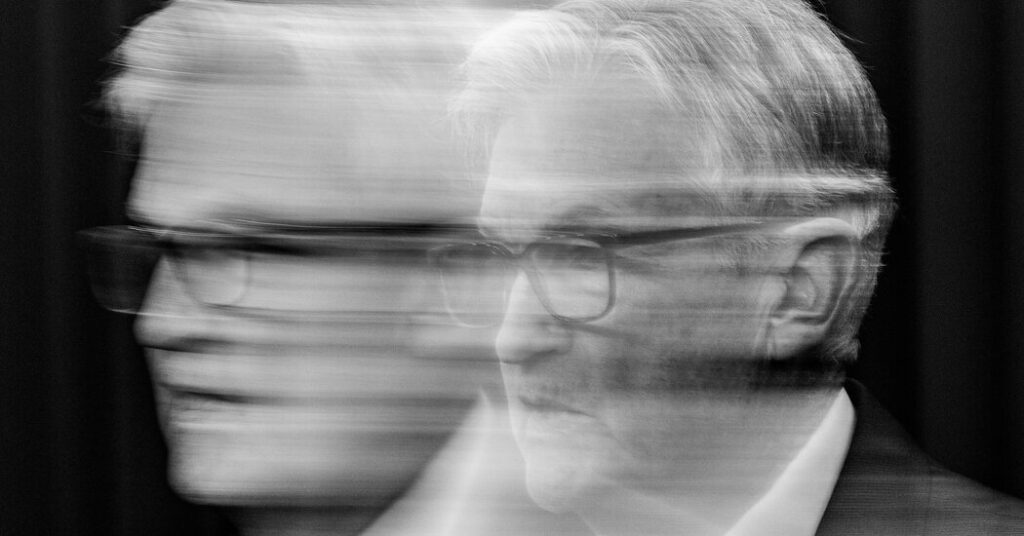
I first met Jerome Powell, the departing head of the Federal Reserve, in late 2011. I was working for Barack Obama, and Mr. Powell was interviewing for a job as one of the Fed’s governors. He was not our first choice. To be honest, he wasn’t even our second.
Republicans had already made it clear that we had to rule out any Democrats or else none of our other Fed nominees would get through, which would leave the institution dangerously short-handed.
Our first choice for the Republican slot, a respected macroeconomist, dropped out at the last minute, and we were back to square one. I reached out to several other right-leaning economists, but none of them were interested. Nor did they have other ideas for us.
Then someone at the Treasury Department suggested we consider Jay Powell. I didn’t mind having to pick a Republican — I am not a deep-rooted political partisan. But a lawyer with no formal academic training in macroeconomics? That strained my deep-seated economist partisanship. Mr. Powell had something more valuable than academic credentials, though. He had a demonstrated record of integrity and courage. Little did any of us realize how important these qualities would prove to be.
A decade and a half later, Mr. Powell’s tenure as Fed chair is coming to an end. In normal times, this would be the moment to look back at his policies and performance. We’d be noting that under his leadership, the Fed succeeded in keeping the pandemic from turning into a financial crisis but failed to avoid 7 percent inflation. But these are not normal times, and Mr. Powell’s policy successes and failures are not what he’ll be remembered for.
At the time Mr. Powell was recommended to me, Washington was locked in a battle over the federal debt limit. Republicans were threatening not to raise it unless they got their way on the budget. Some even argued that if Mr. Obama wanted more money, he should just sell the gold in Fort Knox — or default on our debt to China or find the money in some other way. It fell to Mr. Powell, who was working at the Bipartisan Policy Center, to explain with patience and clarity that these measures were either extremely damaging or outright impossible. That message didn’t win him many friends.
President Obama nominated him, unlocking the logjam of Senate approval, and Mr. Powell joined the Board of Governors. He learned on the job, deepening his understanding of monetary economics, soaking up academic research, Federal Reserve analysis and even what was then known as EconTwitter.
In 2017, President Trump broke with recent precedent and chose not to reappoint Janet Yellen, the Fed chair who had been appointed by Mr. Obama. Instead the president went with Mr. Powell, who he apparently thought would be more faithful to Mr. Trump’s own agenda.
Fortunately for our economy, Mr. Trump could not have been more wrong. At various times the policies that Mr. Trump was trying to impose on Mr. Powell, most of all drastically slashing interest rates, would have damaged the economy and made inflation even worse. But more important, they would have diminished the credibility of the institution itself. In a world where we give the Fed unlimited power to print as much money as it wants, we need confidence it will not abuse that power — otherwise we get higher inflation, lower economic growth, less job creation and more expensive loans for our homes and our businesses. Mr. Powell focused on what the economy needed, not what the president wanted. That infuriated Mr. Trump.
In his first term, Mr. Trump took the remarkable step of tweeting, “who is our bigger enemy, Jay Powell or Chairman Xi?” By chance I was sitting a few feet away from Mr. Powell at that very moment, at a Federal Reserve conference in Jackson Hole, Wyo. I was amazed to see how he took it in stride, something I would never have been able to do. Mr. Powell has continued to tune out the noise. He hasn’t backed down; he hasn’t joined the resistance. He just kept doing his job, even as the president threatened to fire him or even prosecute him. In 2024, after so many years of public intimidation, he was asked at a news conference if President Trump had the power to fire him. Mr. Powell responded with a single word: “No.”
He’s made mistakes, some of them serious. During the Covid years, the Federal Reserve continued stimulating the economy even as inflation rose and rose. Given the impact of the Biden administration’s stimulus package and the scale of the global supply-chain disruptions, there’s a limit to how much impact the Fed could have had. But at a minimum it could have better grasped the problem, instead of Pollyannaishly insisting it was all transitory. That would have helped a bit.
The case for the independence of central bankers in general, and Mr. Powell in particular, is not that they are always right. It is that they are willing to learn and change course. That is what the Fed did in 2022 when it raised rates much further and faster than just about any of its critics, including myself, thought was practical or wise. By the end of 2024, inflation was closing in on the Federal Reserve’s 2 percent target without triggering a recession, a rare so-called soft landing. Critical to enabling this was Mr. Powell’s personal credibility. Trust in his leadership kept inflation expectations from rising. Businesses could slow their price increases knowing that other businesses would be doing the same. Throughout it all, Mr. Powell was crystal clear about the need to avoid being drawn into political controversies and to keep the Fed’s decision making truly independent.
In January, the Trump administration significantly ratcheted up the pressure, as the Justice Department opened a criminal inquiry into Mr. Powell himself, relating to cost overruns in the renovation of one of the Federal Reserve’s buildings. In economics departments, they teach you how to handle the situations central banks are likely to find themselves in: excessive inflation, financial crises, runs on the banks. But no one teaches you how to handle a situation like this. Mr. Powell wrote his own playbook. He posted a plain-spoken two-minute video addressing the American public. “No one — certainly not the chair of the Federal Reserve — is above the law,” he said. But the president’s “unprecedented action should be seen in the broader context of the administration’s threats and ongoing pressure.” He vowed to continue performing his duties “without political fear or favor.”
Within 24 hours, former Fed chairs of both parties, leading Republican members of Congress and the business community had lined up behind him. Mr. Trump’s gambit had completely backfired.
President Trump nominated Kevin Warsh, a former Federal Reserve governor, to replace Mr. Powell. Mr. Warsh is well above the bar in terms of both knowledge and experience. His most immediate task will be to finish the job Mr. Powell was doing, bringing inflation down to the Fed’s 2 percent target. He will succeed only if he follows through on the promise he made in his confirmation hearing to maintain the Fed’s operational independence.
Mr. Powell has shown him — and the rest of us — how that is done.
Jason Furman, a contributing Opinion writer, was the chairman of the White House Council of Economic Advisers from 2013 to 2017.
The Times is committed to publishing a diversity of letters to the editor. We’d like to hear what you think about this or any of our articles. Here are some tips. And here’s our email: [email protected].
Follow the New York Times Opinion section on Facebook, Instagram, TikTok, Bluesky, WhatsApp and Threads.
The post He Was Good at Steering the Fed, but He Was a Genius at Ignoring Trump’s Threats appeared first on New York Times.