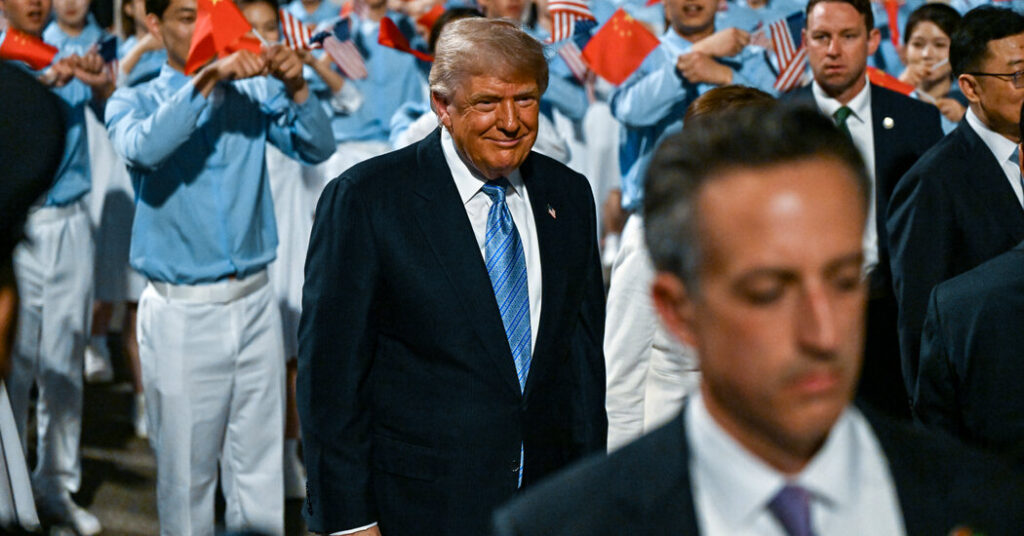
The summit between the leaders of the United States and China in Beijing this week represents a pivotal moment for a global economy that has been upended by war and trade tension over the past year.
President Trump and China’s top leader, Xi Jinping, will have a full agenda to cover, as the world’s two largest economies look for ways to cooperate on geopolitical matters and tamp down differences over tariffs, export controls, Taiwan, sanctions and purchases of American farm products.
Mr. Trump will be seeking to open China’s market to American businesses. But he also wants China to use its leverage over Iran as a top customer for the country’s oil to compel Iranian leaders to reopen the Strait of Hormuz. Mr. Xi will most likely be seeking more tariff relief from the United States, a softening of American sanctions targeting Chinese buyers of Iranian oil and a retreat from the U.S. policy of supporting Taiwan’s independence.
Here are some of the key areas of tension between the world’s largest economies.
China’s trade practices
China’s efforts to build up domestic industries have put competitors around the world out of business. That continues to anger American businesses and policymakers.
In a lengthy report put out earlier this week, the U.S. Chamber of Commerce and the Rhodium Group documented how China’s industrial policy has only increased in recent years, growing from a focus on building up industries of the future, like car batteries and solar panels, to an “industrial policy of everything,” including raw materials and technologies like A.I. China’s dominance in a variety of industries prevents other countries from diversifying away from the country, or setting up key industries of their own.
It’s unclear whether those issues will be in focus at the president’s summit this week. After pressing China on those issues in Mr. Trump’s first term, the administration appears resolved that the country will not change.
Jamieson Greer, the U.S. trade representative, said at a conference in April in Washington that the United States would no longer “pretend” that China was going to become a market economy. “They’re not going to put their hand on Mao’s Little Red Book and swear that, ‘We’re not going to be communists.’”
Tariffs
Mr. Trump’s tariffs on Chinese products have been a key source of friction between the two nations. They have also been dramatically in flux in recent months because of legal battles in the United States.
Before the Supreme Court declared Mr. Trump’s sweeping global tariffs invalid in a ruling in February, China had been subject to a 20 percent tariff, in addition to other preexisting levies, including from other trade cases and Mr. Trump’s first-term China trade war.
After the Supreme Court decision, the Trump administration issued another global 10 percent tariff, which affected China as well. But last week, a trade court declared that tariff to be illegal too, a decision the administration immediately appealed.
The Trump administration has other tariffs coming that can take their place. It has opened two trade cases that are expected to result in tariffs this summer. One is related to forced labor laws and the other to industrial production, both issues that the United States has linked with China in recent years.
Chinese officials are likely to press for lower tariffs in the talks. But the administration may not have that much space to reduce its tariffs on China, without having them drop below the rates paid by other countries. That could be seen as unfair, given that China is widely perceived as America’s biggest trade rival.
Farm purchases
The fallout from trade fights between the United States and China tends to land on American farmers.
China has a history of retaliating against U.S. tariffs by boycotting purchases of American farm products. China is one of the biggest customers of American agricultural exporters, and soybean growers in particular have been hit hard over the past year as China shifted its buying to countries such as Brazil.
China tends to target American farmers because they are a politically powerful group that is largely supportive of Mr. Trump’s agenda.
When the United States and China reached a trade truce last October, China agreed to resume purchases of American soybeans. China agreed to purchase 12 million metric tons of soybeans from the United States in 2025 and at least 25 million metric tons in each of the next three years.
Mr. Trump says that he regularly nudges Mr. Xi to increase China’s purchases of American agricultural products, and he is likely to look for a way to bring home a win for U.S. farmers.
Rare earths
China dominates global production of rare earth minerals and magnets that are needed by a variety of U.S. companies making everything from cars and weaponry to power tools. Over the past year, those minerals have become a key bargaining chip in the U.S.-China relationship.
Starting last year, China enacted export controls that allowed it to withhold supplies of rare earths and magnets made from them, forcing Mr. Trump to walk back his tariffs. U.S. officials have been focused on trying to ensure a steady supply of the minerals ever since.
While China’s exports of minerals have gone up again since last year, U.S. companies remain very concerned about long-term supplies. Trump administration officials are expected to press China to ease its controls and extend the duration of rare earth licenses.
Militaries in the Pacific
This issue, the single-biggest enduring source of tension in relations, encompasses Taiwan, China’s territorial ambitions in the South and East China Seas, and American cooperation with allies and partners.
Years ago, Chinese officials concluded the United States had a policy of containment toward China, and toward its military buildup and activities in particular. In the eyes of many of them, it is the dominant U.S. military presence in the Asia-Pacific region that prevents the Communist Party from taking over Taiwan or expanding operations beyond what they and American officials call the “first island chain.”
Chinese officials have talked about pressing Mr. Trump to use firm language saying he does not support or, more strongly, opposes Taiwanese independence. And Mr. Xi has pushed Mr. Trump to stop selling weapons to Taiwan. The Trump administration has delayed or halted the announcement of an approximately $13 billion package approved by Congress; some lawmakers and aides have accused administration officials of trying to placate Mr. Xi with this freeze before the summit.
But China is also concerned about other aspects of U.S. military activities and cooperation in the region, including American surveillance flights off the Chinese coast, missiles being sent to Japan and the Philippines, and a nuclear submarine agreement with Australia. However, the Pentagon has had to divert substantial resources from the region for use in the U.S.-Israeli war against Iran.
Iran and Russia
Mr. Trump could press China to try to push both of those countries, partners of Beijing, toward diplomacy with the United States. In the case of Iran, China has in recent weeks nudged Iran toward the table, though the initial round of high-level talks in Pakistan did not lead to more face-to-face negotiations. Instead, the United States and Iran are trading proposals.
The Chinese economy, like many others around the world, has suffered from surging oil prices and a U.S. naval attempt to blockade Iranian ports, from which oil is shipped to China. So China has incentive to push for an end to the war. But the Chinese government is also allowing some companies to export dual-use and possibly military equipment to Iran, which Mr. Trump has remarked on.
Russia is China’s most powerful partner, and Vladimir V. Putin and Mr. Xi have formed a close bond. Both are invested in curbing American global power and restoring their own countries to, in their eyes, former imperial glories. For Russia, that has meant carrying out a full-scale invasion of Ukraine since 2022. Mr. Trump and his envoys have sought to have Russia and Ukraine agree to a peace settlement, but have so far failed, and so the American president could ask for Mr. Xi’s help.
Sanctions
As part of the American campaign to cripple Iran’s economy, the Trump administration has in recent weeks been targeting independent Chinese oil refineries with sanctions.
That has opened up a new flashpoint. China has invoked a domestic policy to shield Chinese firms from the sanctions and has essentially told the refineries to ignore them. The clash comes as China has been separating itself from the Western financial system and promoting broader international use of its currency, the renminbi.
U.S. business concerns
China’s treatment of American businesses will also be a contentious topic.
U.S. companies are also deeply concerned with other Chinese regulations allowing Beijing to investigate and punish foreign companies that stop using Chinese suppliers in response to foreign pressure. U.S. firms also complain about other trade practices coming from China, but haven’t seemed confident that these issues will be the focus of the upcoming summit.
The Chinese government said last month that it would require the unwinding of Meta’s acquisition of Manus, a Singapore-based artificial intelligence company with Chinese founders, in a move that could chill other Chinese entrepreneurs from seeking links with foreign partners.
That came after Chinese officials had said in January that they were investigating whether Meta’s acquisition of Manus late last year violated the country’s rules on foreign investment.
And a representative from a Chinese think tank approached officials from Anthropic at a meeting in Singapore last month to insist that the company change its stance and give Beijing access to its powerful new artificial intelligence model.
Alan Rappeport is an economic policy reporter for The Times, based in Washington. He covers the Treasury Department and writes about taxes, trade and fiscal matters.
The post What to Watch at the High-Stakes U.S.-China Summit appeared first on New York Times.