Some 59,000 years ago, a Neanderthal developed a toothache.
What happened next was, in many ways, astonishing.
This individual figured out the source of their pain, deep inside a molar. They probably sought help to plan an invasive medical intervention. Then, they opened wide — no numbing gels or cotton wads to help — just a pointy rock grinding against a throbbing tooth.
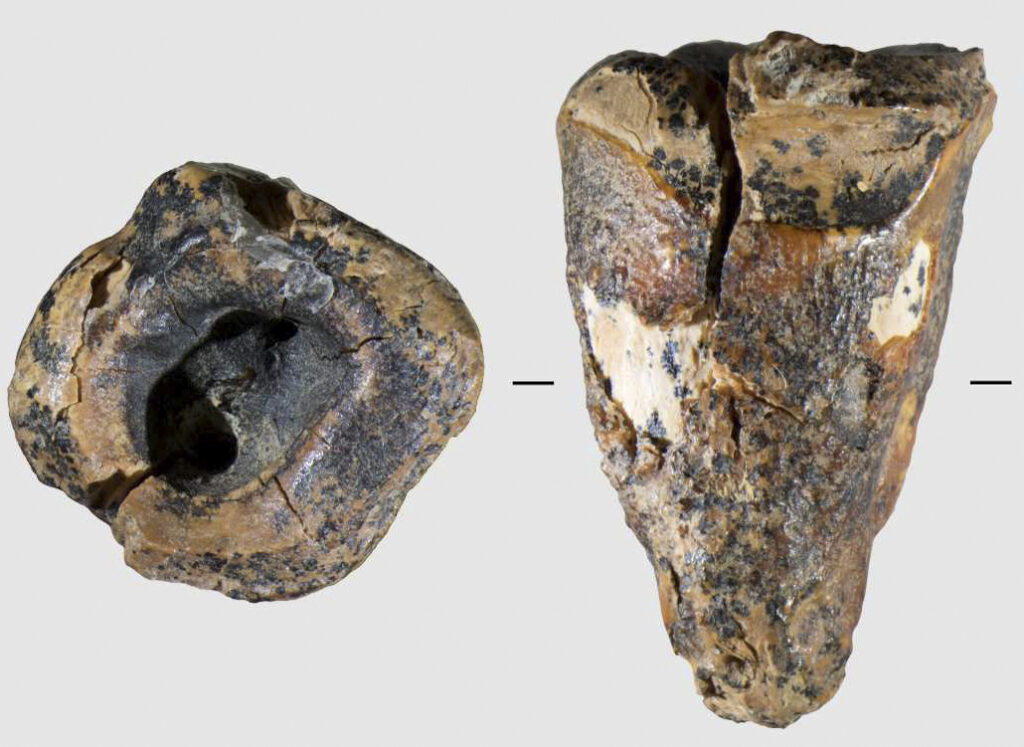
This painful prehistoric dentistry saga unfurls from an ancient molar with a circular drill hole, discovered in a cave once inhabited by Neanderthals in southwestern Siberia. In a study published in PLOS One on Wednesday, scientists rule out other explanations for the hollowed-out hole, pushing back the known history of human dentistry by about 40,000 years.
Bones and stones left behind by prehistoric humans leave much up to the imagination. But the find is a visceral reminder to anyone who has felt an ache in their jaw of the sophistication of Neanderthal minds and culture. It is the latest in a string of evidence that explodes the myth of our unique cognitive and social abilities and deepens the mystery of why we are the only species of human left on the planet.
Our close human cousins had diagnostic abilities. They had social and community support to carry out medical procedures. They must have been able to deploy complex cognitive skills, such as foresight, abstract reasoning and trust.
They would have had to understand that the acute short-term agony from someone drilling a hole deep in their mouth would, in the long run, be helpful.
It “requires a level of reasoning that goes far beyond instinct. It involves what we might call causal thinking: recognizing the source of pain (the decay inside the tooth), understanding that removing the damaged tissue will stop the infection, and accepting short‑term suffering for a future benefit,” Andrey Krivoshapkin, an archaeologist at the Russian Academy of Sciences, wrote in an email, on behalf of the scientific team behind the paper. “This is not simply self‑medication like we see in other primates chewing on medicinal plants. It was a deliberate, planned therapeutic act.”
Drilling down to the pulp
At Chagyrskaya Cave in southwestern Siberia, where the tooth was recovered, the Neanderthals ate a diet heavy on meat, such as bison and horse. Cavities, or caries, are uncommon in the fossil record before the development of agriculture. Cavities are caused by bacteria that feed on sugars.
What was common was incredible wear and tear on the teeth. The enamel — the hard outer layer of the teeth — often wore off, exposing the softer dentin tissue. What the scientists found in the telltale tooth was evidence that the cavity had progressed so deeply that it had reached the pulp chamber. In addition to the circular pit used to remove the decaying tissue, they found microscopic V-shaped grooves and striations on the surface that suggested a rotating drilling procedure.
John Hawks, a paleoanthropologist at the University of Wisconsin at Madison who was not involved in the study, said the find was very striking.
“The concept of ‘This hurts, and I’m going to work on it, because if I get this out of here it’s going to feel better eventually.’ That’s something where you’re going to tolerate quite a lot of intervention in your mouth,” Hawks said. “We have people who don’t want to go to the dentist today and do this.”
John Ruby, a retired dentist who taught and performed research as a professor of pediatric dentistry at the University of Alabama at Birmingham, said that from a modern dental perspective, he thinks what the Neanderthals did was closer to a root canal.
“You would have had to have a support group around you, either holding you down or stabilizing your head — and they had the wherewithal from these small scrapers, or whatever they were, to go down in where the pulp was infected — and by God, they found two out of three canals,” Ruby said. “That’s pretty good.”
Rethinking Neanderthals
Despite the persistence in the popular imagination of Neanderthals as brutish, primitive cave people, it has become increasingly clear over the last few decades that the idea of our modern human uniqueness is in many ways a myth.
Neanderthals lived in complex social groups. They buried their dead. They created and used tools. They carved objects with symbolic meaning. They built fires. They interbred with humans.
“The dental intervention fits perfectly into this picture, it is one more piece of evidence that the cognitive gap between Neanderthals and Homo sapiens is smaller than traditionally assumed,” Krivoshapkin said.
In 2015, researchers published evidence of a 14,000-year-old dental procedure. Stefano Benazzi, director of the laboratory of osteoarchaeology and paleoanthropology at the University of Bologna, who led that work, said the new study pushes back the timeline, with compelling evidence of Neanderthals trying to remove an infection from the tooth.
He praised the research team for carrying out modern lab experiments using stone tools and teeth — both a proof of concept and evidence that the procedure would work and leave the other minute marks they found on the ancient tooth.
But beyond showing dentistry is even older than we knew, he said it reveals how the incomplete fossil record can be used to prop up the prevailing biases of the moment. With more evidence, those stories turn out to be more complicated than people thought.
“New discoveries, as well as new analyses of previously known remains using more advanced methodologies, continue to reveal an increasingly complex history of Neanderthals: a history that, for a long time, we tended to attribute almost exclusively to Homo sapiens,” Benazzi wrote in an email.
The post A Neanderthal with a cavity opened wide for a stone drill appeared first on Washington Post.