In nearly 14 hours of congressional testimony in recent weeks, Gen. Dan Caine was repeatedly asked versions of the same two questions: How had the world’s most powerful military allowed the Iranians to cut off the flow of oil through the Strait of Hormuz, and what could it do to get ships moving again?
The answers General Caine delivered highlighted the tightrope he walks. As the chairman of the Joint Chiefs of Staff, he is obliged to stay out of the political fray inflamed by the war in Iran. But he works for a president who demands absolute loyalty.
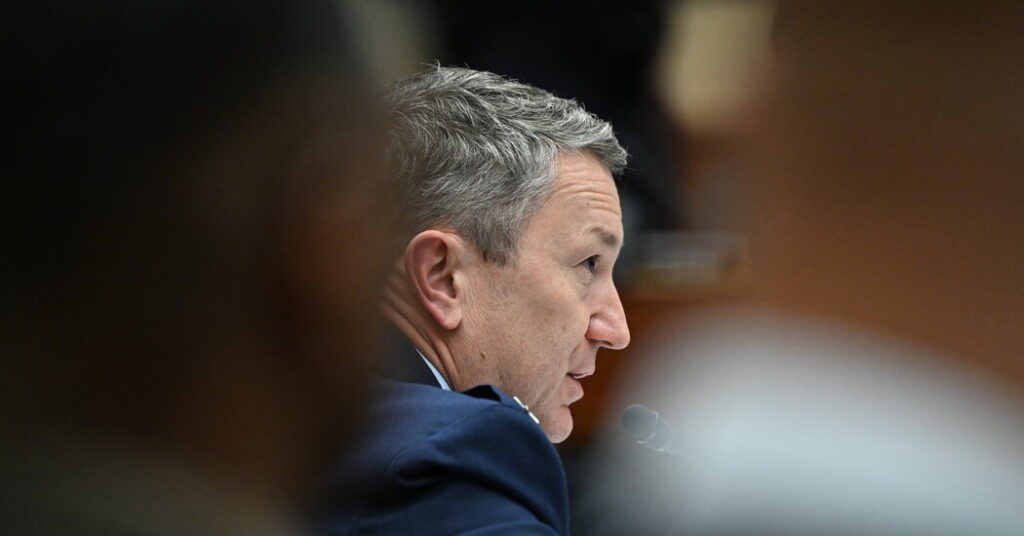
In public, General Caine has defined the military’s mission in narrow terms, an approach he took on Tuesday as frustrated Democratic and Republican lawmakers pressed him and Defense Secretary Pete Hegseth to explain their plans to open the strait and end the war.
“Our military objectives have been clear the whole time,” General Caine said. He talked about “targeting Iran’s ballistic missile systems,” destroying its Navy and defense industrial base and stopping Iranian forces from threatening the U.S. military and allies in the region. He repeatedly praised the dedication of U.S. troops over the course of the war.
But he avoided any discussions of the broader U.S. military strategy.
“Did you anticipate the closure of the Strait of Hormuz and the resulting impact on oil supplies for many countries, including here in the United States?” asked Senator Susan Collins, Republican of Maine.
“We have an incredible staff over at the Pentagon,” he said, “and we always look at the range of military branches and sequels. I won’t comment on any particular one because that gets to whatever advice I may or may not have given to the president.”
Senator Jack Reed, Democrat of Rhode Island, tried again a few minutes later. “Have you been surprised by the resistance of the Iranians?” he asked.
“I always assume an enemy is going to resist,” General Caine said. He declined to say whether he had conveyed those assumptions to President Trump before he launched the war.
General Caine has been similarly evasive on the damage to the Iranian military’s missile and drone capabilities, a key indicator of the effectiveness of the U.S. bombing campaign and the progress of the war. “All our battle damage assessment matters are classified, and it would be inappropriate for me to comment,” he said on Tuesday.
He elided reports that U.S. forces had burned through stockpiles of costly weapons, such as long-range stealth cruise missiles built for a war with China. Asked about such shortfalls on Tuesday, General Caine responded: “We have sufficient munitions for what we’re tasked to do right now.”
General Caine’s most telling public exchange came two weeks earlier when Senator Gary Peters, Democrat of Michigan, asked him to define the “center of gravity” in the war with Iran.
The term is rooted in U.S. military doctrine and the Prussian military theorist Carl von Clausewitz, who defined it as the enemy’s primary source of strength, “the hub of all power and movement on which everything depends.”
In the 1991 Persian Gulf War, as the United States sought to expel Iraqi forces from Kuwait, Gen. Colin Powell, the chairman of the Joint Chiefs of Staff, defined the center of gravity as Iraq’s elite Republican Guard troops.
Twenty years later, as the Obama administration was struggling to carry out a new strategy in Afghanistan, Adm. Mike Mullen, also the chairman, defined it as building an Afghan government that had the support of its citizens.
“What’s really critical is that we put the Afghan people in the center, and that they become the center of gravity,” he said.
General Caine declined to define for Mr. Peters the center of gravity in the Iran war, saying that the decision should be made by U.S. political leaders.
Some of his reticence is a product of working for Mr. Trump, who has sought to preserve his negotiating flexibility by not locking his administration into binding war aims beyond ensuring that Iran never acquires a nuclear weapon.
Mr. Trump’s mercurial nature — his willingness to change his mind on an almost daily basis — also puts military leaders in a difficult spot. To speak publicly about war strategy risks being countermanded by the commander in chief.
Mr. Peters, a Navy veteran, offered his own diagnosis. The center of gravity, he said, was the Strait of Hormuz through which about 20 percent of the world’s oil supply flows.
“We’re not going to bring this war to an end until we seize control of the straits in a way that opens them back up,” he said.
In White House Situation Room meetings with the president in the lead-up to the war, General Caine was more forthcoming, though still cautious, U.S. officials have said. He raised the prospect that an extended war with Iran would drastically deplete stockpiles of some critical American weapons, U.S. officials said. And he flagged the risks of Iran blocking the strait.
But he also has said that as the top military adviser to the president, it is his job to present options to Mr. Trump, not take a firm stand or make policy.
Some military analysts praised General Caine’s approach. “On the whole I think he has been remarkably discreet, and appropriately so,” said Eliot Cohen, a historian and senior State Department official during the wars in Iraq and Afghanistan. “It’s up to his political bosses to decide how they want to talk about it.”
Others said he was ceding too much ground. Concepts like the enemy’s center of gravity are “normally understood as a military determination, not a presidential prerogative,” said Stephen Biddle, a professor of international affairs at Columbia University and a frequent adviser to the Pentagon.
One risk of General Caine’s relative silence is the signal it sends to other officers, said Heidi Urben, a retired Army colonel and the associate director of the security studies program at Georgetown University. “When military leaders only talk about tactics, it reinforces this fallacy within the ranks that they don’t need to worry about strategy, that other people will take care of that stuff,” Ms. Urben said.
In the hearings on Tuesday, Republican and Democratic lawmakers complained about the economic pressure the war was putting on Americans.
“Nothing matters more to our constituents than doing something about these spiraling gas prices, which are bankrupting families and farmers all across the country,” said Senator Chris Murphy, Democrat of Connecticut.
The senators pressed General Caine to explain how Iran, despite the damage it had sustained and its massive firepower disadvantage, was still able to maintain control of the strait and impose such pain on the global economy.
“It’s a complex situation ,” General Caine replied. “Some of this is on commercial traffickers.”
It was an answer that seemed to satisfy no one.
Senator John Hoeven, Republican of North Dakota, pushed General Caine and Mr. Hegseth to outline a military plan that could lead to a reopening of the strait.
“That relieves pressure on us and our allies,” Mr. Hoeven said. “And that’s what I’m asking for.”
Greg Jaffe covers the Pentagon and the U.S. military for The Times.
The post Gen. Caine’s Silence on Iran War Leaves Questions About Military Strategy appeared first on New York Times.