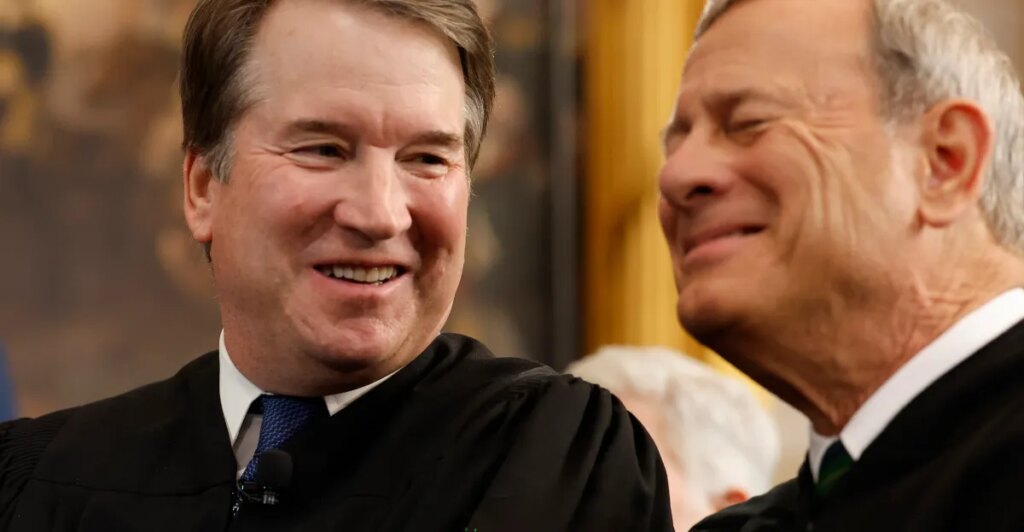
If you’re a Democrat, ask yourself a simple question: When was the last time something got better after Brett Kavanaugh put his hands on it?
Unfortunately, Jay Jones, the Democratic attorney general of Virginia, does not appear to have considered this question before he asked the US Supreme Court to get involved in his state’s fight over gerrymandering. If the Court actually buys one of Jones’s arguments, they will leave Democrats in a much worse position than if Jones had never filed this case in the first place.
Earlier this year, Virginia voters approved a referendum to amend their state’s constitution — and to approve new congressional maps that were intended to give Democrats four additional seats in the US House of Representatives. The map was also intended to counterbalance Republican gerrymanders in states like Texas.
Last week, however, the Virginia Supreme Court handed down a surprising decision invalidating that referendum, and reinstating the state’s previous congressional maps. The state supreme court’s decision in Scott v. McDougle was wrong. It rested on a claim that Virginia voters were denied the right to weigh in on whether to amend their constitution. This claim is absurd because, again, the redistricting amendment was submitted to the state’s voters and approved by them in a referendum.
But the fact that the state supreme court’s decision was wrong does not mean that the US Supreme Court has any business getting involved in this case. While the federal justices have the final word on all questions of federal law, state supreme courts have the final say on how to interpret their own state’s law and their own state’s constitution.
This means that, if the Virginia Supreme Court misreads Virginia’s constitution, then Virginia voters are stuck with that interpretation. But it also means that if the Wisconsin Supreme Court, which will soon have a Democratic supermajority, rejects a Republican attempt to overturn an election, then the US Supreme Court cannot interfere with that decision either.
Jones’s brief to the justices in the Scott case asks the federal justices to upend this balance. Among other things, Jones relies on a discredited legal theory known as the “independent state legislature doctrine” (“ISLD”) to argue that the US Supreme Court should overrule Virginia’s highest court on a question about Virginia’s own election law.
Jones, in other words, wants to give a Republican US Supreme Court the final word on state election law disputes. There is simply no way that ends well for Democrats.
Jones’s terrible legal arguments
Jones’s brief makes two separate attacks on the state supreme court’s decision, one of which is wrong but trivial, and the other is outright dangerous.
The trivial argument relies on the fact that the state supreme court’s decision in Scott cites a US Supreme Court decision, Foster v. Love (1997), to justify its conclusion. The brief claims that the state supreme court misread Foster, and thus the US Supreme Court can get involved because the state court misread a federal case.
But this argument is a huge stretch. While it’s true that the state supreme court’s opinion includes several citations to Foster, the court also relied on state law sources in its opinion, as well as historical documents, dictionaries, scholarly sources, and the state justices’ false conclusion that Virginia voters were somehow disenfranchised.
As Jones acknowledges in his brief to the federal justices, the US Supreme Court may overrule a state supreme court decision when that decision is “interwoven with the federal law.” But when that state court merely cites a federal court decision, even if it reads that federal decision incorrectly, that is not enough to transform a state case into a federal case. State courts routinely cite cases from other states or from federal courts because they find those decisions persuasive, and a few citations to a US Supreme Court decision does not give the federal justices the right to overrule a state supreme court decision.
Jones’s worst argument, meanwhile, hinges on the ISLD.
The independent state legislature doctrine arises out of two provisions of the US Constitution which say that the rules governing federal elections should typically be determined by each state’s “legislature.” For more than a century, the US Supreme Court has understood the word “legislature,” when used in this context, to refer to whichever body has the power to make laws within a state — which may include the people themselves if the state’s constitution permits ballot initiatives or referendums.
The ISLD, however, claims that the word “legislature” must be read to refer solely to a state’s legislative branch. Thus, under the strongest version of the ISLD, a state governor cannot veto an election-related bill (because the governor is part of the executive branch and not the legislative branch), a state supreme court cannot interpret a state’s election law (because the judiciary is not the “legislature”), and a state may not alter its election laws through a ballot initiative or referendum.
Though the US Supreme Court rejected this strong form of the ISLD many times, in Moore v. Harper (2023), the Court flirted with a weaker form of the doctrine that would effectively permit federal courts to overrule a state court’s interpretation of its own election law. “State courts,” the US Supreme Court said in Moore, “may not so exceed the bounds of ordinary judicial review as to unconstitutionally intrude upon the role specifically reserved to state legislatures.”
Moore did not explain what it means to “exceed the bounds of ordinary judicial review,” and the US Supreme Court has never actually ruled that a state court did so. If it ever did so, however, that would be a massive transfer of power from state supreme courts (which are sometimes controlled by Democrats) to the US Supreme Court (which has a Republican supermajority for the foreseeable future).
By invoking Moore in his brief to the federal justices, in other words, Jones is asking the US Supreme Court’s Republican majority to seize total control over all disputes relating to federal elections, regardless of whether those disputes involve a question of state or federal law. It’s hard to imagine a more reckless request from a Democratic elected official.
The US Supreme Court is the reason why gerrymandering is out of control
Until fairly recently, US states typically only redrew their maps every 10 years. (The Constitution requires states to draw their legislative maps after each census.) And before this Court’s big redistricting rulings, maximal gerrymanders, like the 10-1 Democratic map at issue in Scott or the 30-8 Republican map recently drawn by Texas Republicans, were far less common than they are today.
What changed was two Supreme Court decisions, both joined exclusively by the Court’s Republicans, that eliminated virtually all federal legal safeguards against gerrymandering. Rucho v. Common Cause (2019) held that federal courts may do nothing to stop partisan gerrymandering. And Louisiana v. Callais (2026) abolished a 1982 amendment to the federal Voting Rights Act that prevented many states from drawing congressional maps that would only elect white Republicans.
But now Virginia Democrats are asking the GOP-dominated Supreme Court to correct the state supreme court’s error in a gerrymandering case. That’s like hiring Osama bin Laden to rebuild the World Trade Center.
No one has done more to supercharge gerrymandering, or to give Republicans an unfair advantage in congressional redistricting, than the Supreme Court’s six Republican justices. It is truly bizarre that an elected Democratic official now wants to give these six Republicans even more power over federal elections.
The post Virginia Democrats’ irresponsible new plan to save their gerrymander appeared first on Vox.