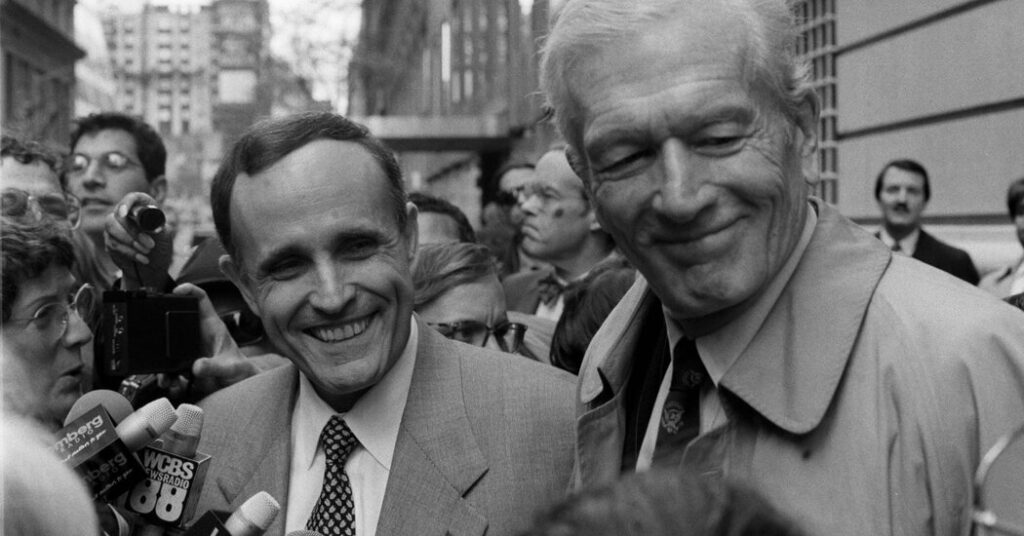
The former mayor wasn’t well. Mayor John V. Lindsay had cut a dashing figure during his tenure, but after he left office in 1973, his health declined precipitously, while his law career faltered. Help arrived from an unlikely source.
Rudolph W. Giuliani, the former prosecutor who led New York in the 1990s with a tough-on-everything approach that had rebuked Mr. Lindsay’s liberalism, was now the mayor. He would ensure that Mr. Lindsay could receive municipal health insurance coverage in the final years of his life.
“All of us were grateful for Rudy’s kindness,” said Steven L. Isenberg, who served as chief of staff to Mr. Lindsay. “The need was real.”
The episode is resonant today as Mr. Giuliani’s own health deteriorates, leading him to seek medical care covered by the World Trade Center Health Program for people affected by the Sept. 11, 2001, terrorist attacks.
Mr. Giuliani was in the final months of his mayoralty when the attacks happened. He was a frequent presence at ground zero, the site of the fallen World Trade Center towers, where the air was rife with toxic dust and smoke that have been linked to respiratory problems.
After Mr. Giuliani was hospitalized with pneumonia this month, his spokesman said that Mr. Giuliani had been diagnosed with restrictive airway disease, and that the condition stemmed from the attacks.
About 30 years earlier, Mr. Giuliani had helped Mr. Lindsay.
Mr. Lindsay was mayor from 1966 through 1973. In his post-City Hall years, he was diagnosed with Parkinson’s disease as well as heart problems. In 1994, Mr. Lindsay was hospitalized after becoming faint while waiting for a train at Grand Central Terminal.
“He had some bad luck,” said Vincent J. Cannato, author of “The Ungovernable City,” a political biography of Mr. Lindsay.
Though Mr. Lindsay’s health struggles were well known, his dire financial situation was not, Randy M. Mastro, a top adviser to Mr. Giuliani, said. Having learned of Mr. Lindsay’s plight, Mr. Giuliani committed to helping him. “It wasn’t like Rudy Giuliani and John Lindsay had any kind of special personal relationship,” Mr. Mastro said. In fact, Mr. Lindsay had endorsed David N. Dinkins, Mr. Giuliani’s rival in the 1989 and 1993 mayoral elections.
But for a moment, political differences paled before weightier concerns. Mr. Mastro said that Mr. Giuliani had urged his advisers to find a path to help Mr. Lindsay because of his public service. “I was very proud of him for doing it,” said Mr. Mastro, who had to figure out just how to help Mr. Lindsay.
The answer was to bring him back to government, if only in ceremonial fashion. In 1995, Mr. Giuliani appointed Mr. Lindsay as president of the Sister City program and as special counsel to the New York City Commission for the United Nations, Consular Corps and International Business. The first position was unsalaried, while the second paid $25,000 per year.
The appointments would allow Mr. Lindsay to enroll in the same health care plan as active city employees — benefits that he would have received in retirement if his city service had been longer than eight years.
When Mr. Lindsay became a municipal employee again, he could select from a number of health care plans covered by the city.
Other city leaders endorsed Mr. Giuliani’s move, according to a May 1996 article in The New York Times. “I don’t think the people of our city really want to see a former mayor with the absence of resources in the kind of circumstances in which one can find oneself,” Mr. Dinkins, who was mayor from 1990 through 1993, said at the time.
New Yorkers may have been surprised to learn that a Yale graduate who served in the U.S. House of Representatives and City Hall would need such help. “Two of his law firms went under, so he did not make as much money as one might have thought,” Dr. Cannato said. Despite Mr. Lindsay’s background, Dr. Cannato said, “his family money was pretty thin.”
Mr. Lindsay died in 2000 at age 79 of complications from pneumonia and Parkinson’s disease. Mr. Giuliani went on to be hailed as “America’s Mayor” after the Sept. 11 attacks and was an early front-runner for the Republican nomination in the 2008 presidential election before his campaign collapsed.
Later, Mr. Giuliani alienated many New Yorkers with his energetic support of Donald J. Trump and his quest to overturn the 2020 election. Mr. Giuliani now faces money troubles of his own.
Mr. Giuliani’s spokesman, Ted Goodman, said in a post on X on Wednesday that Mr. Giuliani had left intensive care but remained hospitalized. At a news conference last week, the city’s current mayor, Zohran Mamdani, called Mr. Giuliani a “fixture” and wished him a steady recovery.
The post Giuliani Once Helped a Predecessor Get Health Care appeared first on New York Times.