The Hotel Carter may have been jinxed from the start.
When it opened in 1930 as the Dixie Hotel, it loomed over Times Square. A tan, brick 24-story building, it boasted more than 600 rooms — each with a phone, shower and bath — and an underground bus terminal below the lobby that welcomed guests who came into Manhattan on the Short Line.
A year later, as the Great Depression set in, it went into default.
What would follow was nearly a century of financial decline, neglectful ownership and shocking violence — the beating death of an infant, a woman thrown out of a window, another woman’s beaten body found under a bed.
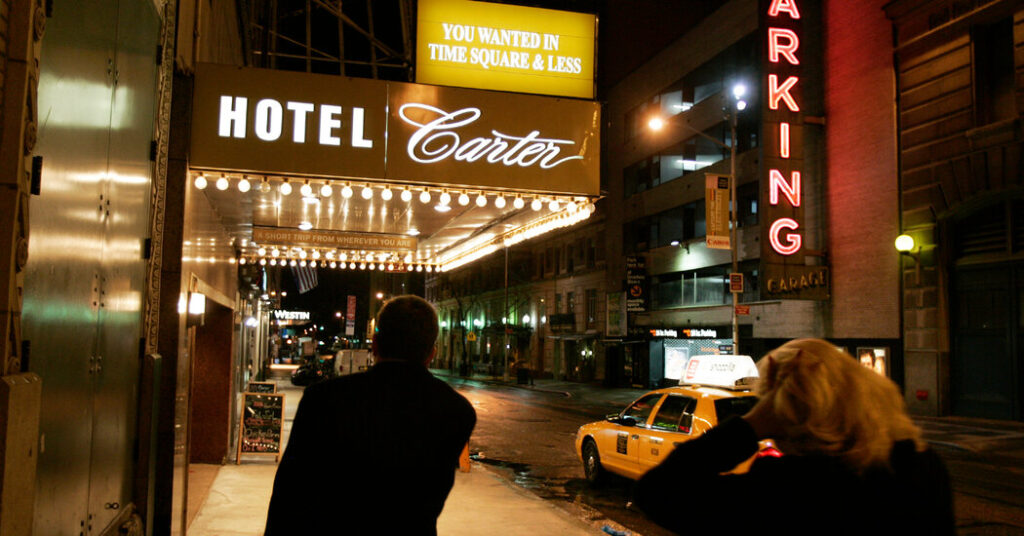
In the 2000s, it topped TripAdvisor’s list of “dirtiest hotels in America” three times thanks to a litany of complaints that included rats, bedbugs and bathroom sinks with mysterious brown stains. A bright yellow sign above the awning sent a confusing message: “You Wanted in Time Square & Less.”
“I think it would have been cleaner to sleep on the street,” one reviewer wrote in 2009.
Hopes that it could return to something hospitable — perhaps affordable housing for artists and theater workers — have been tied up in litigation that stretches back more than a decade. An auction to sell the building had been scheduled for May 6 but was canceled after the owners, two brothers with other properties around the city, convinced a judge to stop it.
Since 2015, it has been empty. The entrance that once gleamed in neon lights is now covered in plywood and torn green tarp, giving cover to people who sleep there or inject drugs. Rickety scaffolding stretches over the sidewalk, creating a dark, imposing tunnel.
Just before New Year’s Eve, members of the Times Square Alliance, which represents neighborhood businesses, bought industrial lights and hung them along the scaffolding to make it less forbidding. It sort of helped, said Tom Harris, the alliance’s president.
“It seems like Disney’s Tower of Terror was modeled after the Carter Hotel,” he said, referring to a theme park ride that includes a stomach-lurching drop.
1930 to 1976
‘Southern Hospitality’ in Times Square
The hotel never aimed for grandeur.
A newspaper ad in the 1940s promised rooms starting at $2.50 “in which you can really move around” and “deep soft beds that invite sleep.” Other ads featured the Confederate flag and offered “southern hospitality.”
In the 1930s, tourists came to Times Square for giant movie palaces.
In the ’40s and ’50s, they were drawn by the “honky tonk” feel of Times Square, which teemed with carnival barkers, flea circuses and penny arcades, said Lynne Sagalyn, a retired Columbia University real estate professor who wrote two books about Times Square.
The Dixie was part of the hoopla. There were beauty contests on Sunday nights to crown “Miss Times Square.” Musical acts like the bandleader Al Trace and his Silly Symphonists and Al Rando, “the blind wizard of the organ and piano” from the Jersey Shore, played in the Plantation Room, the Dixie’s lounge and bar.
“For the middle class, it was fun,” Ms. Sagalyn said of Times Square. “It was a playground for everybody.”
1976 to 1997
A Shelter and a Hellscape
In 1976, the Dixie was renamed the Carter. H.B. Cantor, the president of the Carter Hotel chain, which bought the Dixie in 1942, wanted to give the hotel a more corporate identity.
A year later, Tran Dinh Truong, a Vietnamese immigrant, bought the hotel and lived with his family on the third floor.
“I remember the rats and the roaches,” said Anthony Dinh Tran, one of Mr. Tran’s sons, a writer in his mid-30s who lives in Los Angeles. He also remembered playing football on 43rd Street on New Year’s Eve, when the city would close the street to cars between 7th and 8th Avenues. At night, his family would go to the roof and watch the ball drop, the glittering crystals reflected in the glass buildings around them.
His father was so proud he owned the Carter that he rebuffed offers to sell it.
“Part of the American dream is that you own a piece of America,” Mr. Tran said. “That was his way of keeping something.”
In the early 1980s, the city was paying hotels in Times Square to house homeless people. By 1984, there were 570 families and 1,271 children living in the Carter and five other hotels in the area. For the children, life at the hotel was terrifying, rife with robberies, fights and public drunkenness. Their only real escape was an eight-week day camp that took them to Philadelphia or the Bronx Zoo.
In 1985, the hotel started taking in more tourists again but violence remained. In 1987, a partially clothed woman with her hands tied behind her back was killed when she was pushed from the window of room 1604.
This was around when Times Square was so dangerous that five to six felonies were reported a day and women avoided it, said Carl Weisbrod, a former president of the 42nd Street Redevelopment Project.
“It had virtually every other kind of social disorder you can imagine,” Mr. Weisbrod said. “A lot of it was generated by transients from the Carter Hotel.”
But the hotel, and others like it in Times Square, gave a sense that New York was for everybody, said Mr. Tran.
“It’s also where artists and where families that couldn’t afford a place to live went,” he said.
1998 to 2012
Gwyneth Paltrow Comes to the Carter
As the city worked to revitalize Times Square in the 1990s — changing zoning laws that shut down peep shows and other adult businesses — the Carter remained unchanged.
In 1998, its seediness made it the perfect place to film scenes for “Great Expectations,” a Hollywood adaptation of the Charles Dickens novel.
Ethan Hawke plays an artist who eats Apple Jacks straight out of the box and dries his socks on a grimy sink inside the Carter. In another scene, Gwyneth Paltrow, playing a haughty social climber, comes into the room while Hawke’s character is sleeping and demands he paint her.
The Carter’s brush with Hollywood did not rehabilitate it.
In 1998, it closed temporarily after city inspectors found about 200 safety code violations. In 1999, the night manager of the hotel was stabbed to death in the lobby.
In 2005, Manny Fernandez, a New York Times reporter, wrote about his experience staying in a room for two nights. He told readers the phone was broken, the bathroom ceiling was moldy and the lobby had large insects of “unidentifiable species.”
“What do you expect for $99.23 a night?” he wrote.
2012 to 2026
Hope for a New Start
In 2012, Mr. Tran died. The hotel was put up for sale in 2014.
Joseph and Meyer Chetrit, brothers and real estate developers, bought it for more than $191 million with plans to rebuild it. But they defaulted on their loans, the renovations stalled and safety and public health complaints mounted.
The Chetrit brothers, who are embroiled in lawsuits and criminal complaints, declined to comment through a lawyer.
Several women interviewed in front of the vacant hotel on a recent afternoon said they speed-walk past it at night or avoid it altogether.
“If I didn’t have to go on 43rd Street, I wouldn’t,” said Rebecca Habel, managing director of the Roundabout Theater Company, which includes the nearby Todd Haimes Theater. In December, an 18-year-old New York University student got inside the shuttered hotel and died by suicide.
Mr. Harris, the president of the Times Square Alliance, has asked Mayor Zohran Mamdani to support converting the hotel into affordable housing. He said he has not gotten a response.
In a statement, Matt Rauschenbach, a spokesman for the mayor, said the city was committed to “working with communities to stabilize neighborhoods” and is monitoring the site and its potential for reuse.
Mr. Tran said it would be strangely poetic to see the hotel turned into housing for artists. It would, he said, be a return to what the hotel once was — a place for those who can’t afford New York.
Georgia Gee and Kirsten Noyes contributed research.
Maria Cramer is a Times reporter covering the New York Police Department and crime in the city and surrounding areas.
The post Can the Country’s ‘Dirtiest Hotel’ Get a Clean Slate? appeared first on New York Times.