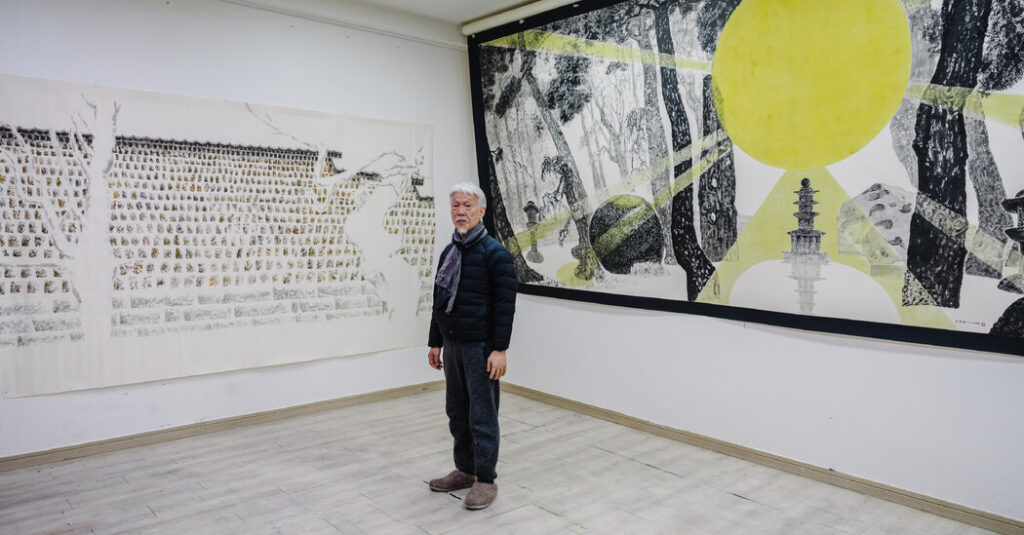
At nearly 81, the artist Park Daesung, considered by many to be the keeper of traditional hangukhwa painting, is having a bit of a celebrity moment. His large-scale ink landscape paintings of an almost mythical version of his country are part of recent, current and upcoming exhibitions, and he will be sponsored by Gana Art in Seoul at this year’s TEFAF New York.
Park’s works are part of “Korean National Treasures: 2,000 Years of Art” through July 5 at the Art Institute of Chicago, a show that will move to the British Museum in London (tentatively set to open in September). He was also featured in “Korean Treasures: Collected, Cherished, Shared” at the National Museum of Asian Art in Washington, D.C., which ended in February, and in a major solo show in 2023 at the Los Angeles County Museum of Art, which provoked interest among major museums from Berlin to Kazakhstan to Rome. Despite a lifetime of recognition in South Korea and abroad, this latest chapter has felt very much like a late-career renaissance.
“I came from nothing, and I’ve accomplished some fame and a lot of good opportunities, but this feels very overwhelming,” Park said during a recent interview in his Gyeongju studio, which is filled with decades of artwork. “Sometimes it feels like I’m in a dream.”
Park’s journey into the mountains and valleys of his homeland — and how he interprets those differently from all others with outsize and abstract objects rather than reverent and realistic depictions of nature and temples, pagodas, pottery and animals — is what has gained him a following for modernizing hangukhwa painting.
On a recent spring afternoon, as South Korea’s famous cherry blossoms were popping, Park talked in his studio in this southeastern city known for its medieval citadel. Dozens of canvases — some finished, some not — are mounted side by side, taking up nearly every wall, much like they do in museums and galleries, dwarfing the viewer. Paintbrushes and inkwells, many the size of Mason jars, were scattered about, and flecks of ink were spattered about the floor. Dressed impeccably, with a light-blue scarf and khaki trousers, he spoke, through a translator, about the present fame he is enjoying, the ups and downs of his life and his hopes for the future.
Born in nearby Cheongdo in 1945 as the Japanese were leaving the Korean Peninsula after 50 years of colonial presence and occupation, Park witnessed his father’s killing at the hands of a Communist soldier in 1948. He had just lost his mother to a chronic illness, and he and his father were sleeping when guerrillas from the north raided their home as they swept south across the peninsula. Park’s father was holding the 3-year-old when he was fatally struck with a sword, which also severed young Park’s left arm just below the shoulder. Park was left for dead, but was discovered by a neighbor. The youngest of eight brothers and sisters, Park was raised by his eldest brother and his wife.
That tragic event defined his life — and his art. Teased at school for his injury, he retreated into nature near the family farm and found solace in calligraphy and drawing, eventually becoming a pioneer in ink drawings that document the landscape of his country.
“I would help out my oldest brother and his wife by going out into the wilderness to collect wood, to bring back water and to do farming,” he said. “My world became the landscape and the mountains. I spent a lot of time alone and really connecting to nature. The mountains shifted and changed with the seasons, and I began to paint them.”
In the decades after the Korean War ended in 1953, Park married and had two daughters. He moved to the city of Daegu and eventually to Seoul before settling in Gyeongju about 20 years ago.
“I began to paint more and more and became very much involved in the art scene in the 1970s, and I started to meet older artists, and I learned a lot,” he said. “But I have always had a desire to do something new and different. I wanted to make something my own, more contemporary.”
Gana Art, a major gallery in Seoul, will take four of Park’s paintings to New York, all of which embody the kind of painting he made famous: hangukhwa, the traditional Korean method of ink painting on traditional mulberry paper, often with only minimal color flourishes and heavy on calligraphy of mostly Korean characters. But Park is known for turning hangukhwa on its head.
“Having calligraphy is normal in Asian painting, but Park writes it in his own style,” Jung Lee, executive director of Gana Art, said in a recent interview over coffee at the sprawling gallery in the affluent Seoul neighborhood of Pyeongchang. “It’s in Korean and Chinese, so people can still read it, but in traditional style artists follow the rules of the scales of the letters. But he plays with uppercase and lowercase. It’s more of a drawing than just writing letters.”
This will be Park’s debut at TEFAF New York (or any TEFAF fair), and he is the first artist that Gana Art signed when Jung’s father, Lee Hojae, founded the gallery in 1983. The gallery will also take works to TEFAF by the sculptor Choi Jongtae and the deceased painter Yoo Youngkuk, both considered pioneers in South Korean avant-garde art.
“Park breaks all of the rules of what traditional painting used to be because even though it’s scenery, he reimagines and re-sizes the images and what he sees as important,” Jung said. “Traditionally you would have a big mountain, and a valley and small houses. But he looks at objects and paints with his own imagination.”
One painting going to TEFAF New York is “Blue Mountain and White Cloud,” which is a scaled-down version (45.7 inches by 28.7 inches) of a mural-size painting featured prominently in the solo show — among his first in the United States — at LACMA in 2022-23. The massive four-layer mountain is rendered abstractly and dwarfs everything around it: two bright yellow orbs, a splash of clouds and sky, a pagoda at the base, crooked and quiet.
For Jung, so much of South Korean art during Park’s generation was rooted in modernism that challenged the military dictatorships that ruled this country for more than 30 years after the Korean War. Park was devoted to landscapes and calligraphy.
“He never had that luxury of having two hands, and he never had an assistant, though his wife helped him sometimes,” Jung said (Park has had a prosthetic arm for years). “He always was an outsider, and he was never with a political movement like many of the Korean painters of his generation.”
That connection to nature and his devotion to trying new approaches is what keeps Park focused on the future of South Korea, which he has seen emerge from the ashes of war to a global powerhouse of K-pop culture, electronics and wealth. It all comes back to nature: the world where he found solace and grace after early childhood tragedy.
“You can still see nature all around you and feel the soul of Korea, and that’s never really changed,” he said with the glimmer in his eye of a young boy. “Resilience is the most important word for me. It doesn’t really matter what you have gone through because nature never changes. The mountains will be there forever.”
The post Beyond Resilience: Park Daesung Is Suddenly Everywhere appeared first on New York Times.