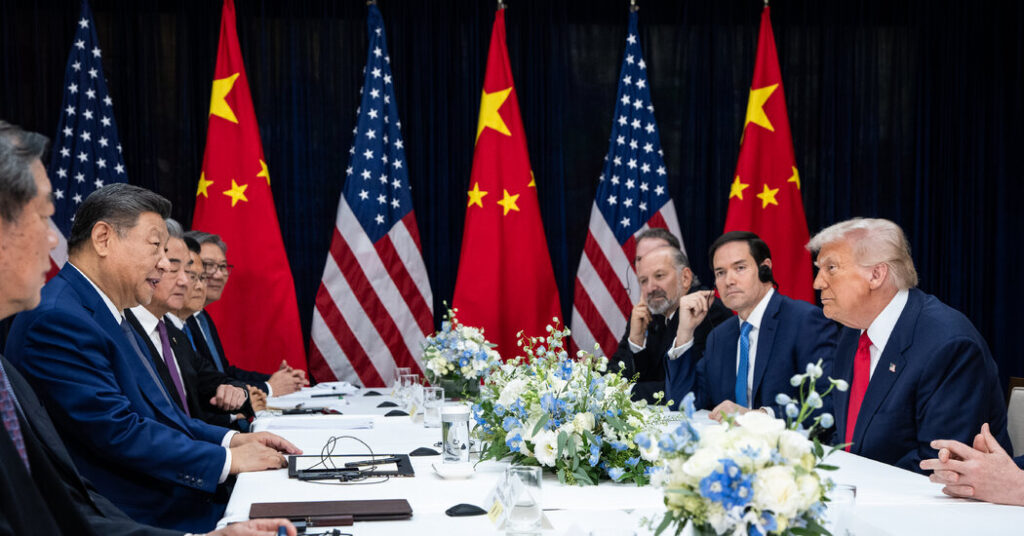
President Trump and China’s leader, Xi Jinping, are scheduled to meet in Beijing next week for a high-stakes summit that could shape the next stage of rivalry between the world’s two major powers.
Mr. Trump and Mr. Xi are expected to discuss the war in Iran, trade, Taiwan and other points of contention during a two-day summit beginning on Thursday. Mr. Trump and Mr. Xi last met in October in South Korea, where they agreed to pause a bruising trade war in which the U.S. imposed triple-digit tariffs on Chinese goods and Beijing threatened to throttle the global supply of rare earths.
The visit next week could determine whether an uneasy détente that has emerged since that meeting will hold.
A lot has changed since the two leaders last met. Mr. Trump is now embroiled in a war with Iran, China’s closest partner in the Middle East, that has led to a global energy crisis and diverted U.S. military assets from Asia. The war has also depleted U.S. munitions, raising doubts among some Chinese analysts about the United States’ ability to defend Taiwan, a close partner of Washington.
Mr. Xi faces his own challenges as he grapples with slower economic growth, higher energy prices and the possibility of a global recession that would hurt China’s export-reliant economy.
What is on the table?
Mr. Trump and Mr. Xi are likely to discuss trade, including possible investment in each other’s countries. Washington has been emphasizing what analysts call the “Five B’s.” These include Chinese purchases of Boeing airplanes, U.S. beef and soybeans, as well as the creation of a board of investment and a board of trade. Those two entities would carve out areas of economic exchange between the United States and China that do not raise national security concerns.
The Chinese have been emphasizing the “Three T’s”: tariffs, technology and Taiwan, which Beijing claims is part of China’s territory. Beijing is likely to push for an extension of last year’s trade truce and the loosening of export controls on advanced semiconductors that China needs to upgrade its industrial sector. Mr. Xi, who told Mr. Trump by phone in February that his country would “never allow Taiwan to be separated from China,” is likely to push Mr. Trump to dial back U.S. support for the self-governed island.
Mr. Trump is expected to call on Beijing to persuade Iran to reopen the Strait of Hormuz. The two sides are also expected to discuss cooperation on managing risk related to artificial intelligence.
Mr. Trump has said that he will raise the case of the Hong Kong democracy activist Jimmy Lai, who was sentenced in February to 20 years in prison for collusion and sedition. Other issues include the buildup of China’s nuclear weapons, security in the South China Sea and reducing flows of fentanyl into the United States.
What are the possible outcomes?
Mr. Trump has been boastful about his relationship with Mr. Xi, whom he calls “a friend,” and is keen to announce an increase in Chinese investment in the United States.
But expectations are not high that the two sides will reach a major economic deal or resolve their deep differences. A more likely outcome is a set of modest agreements on investment and an extension of last year’s temporary trade truce.
“We probably shouldn’t expect this meeting to have particularly substantial, major breakthroughs,” said Zhao Minghao, an international relations expert at Shanghai’s Fudan University, who said the meeting would serve as a starting point for more engagement. American officials have said that the two leaders could meet four times this year.
Analysts say the summit is also a way for both sides to buy themselves time to reduce reliance on the other country as competition continues. “Within China there is also still a deep sense of suspicion about the United States,” said Bonny Lin, director of the China Power Project and senior adviser at the Center for Strategic and International Studies.
What could go wrong?
Contention over the war in Iran could undermine the talks. Without naming Mr. Trump, Mr. Xi last month criticized the American president’s flouting of international law as a “return to the law of the jungle.”
While China is prodding Iranian officials to negotiate with the United States, it has held back from doing more to help resolve a war that Beijing sees as Washington’s problem. The Chinese foreign minister, Wang Yi, met his Iranian counterpart, Abbas Araghchi, this week in Beijing. Mr. Wang called for greater efforts to open the strait but also said China supported Iran’s “legitimate right to the peaceful use of nuclear energy.”
But Mr. Trump said Thursday that he believes China has not provided more support for the Iranian position out of respect for his relationship with Mr. Xi.
Both China and the United States have been strengthening their weapons of economic warfare. When the U.S. Treasury imposed sanctions on a Chinese refinery in April for buying Iranian oil, China ordered its companies not to comply and issued regulations giving authorities powers to investigate foreign companies and governments.
Pei-Lin Wu and Luke Broadwater contributed reporting.
Lily Kuo is a China correspondent for The Times, based in Taipei.
The post The World’s 2 Most Powerful Men Are Set to Meet Again. Here’s What to Know. appeared first on New York Times.