When I interviewed Helen Frankenthaler (1928-2011) at her Connecticut home in 2003, the famous painter spoke glowingly about her friend Anthony Caro (1924-2013), the accomplished British sculptor.
The peers met in New York in 1959 and formed a lifelong dialogue.
Caro’s ethos and career were touchstones for Frankenthaler. “I think Tony gets better and better and more and more daring,” Frankenthaler told me. “One is safe if one is still able to risk. I hope I can still do that.”
She also talked about trading art with a trusted fellow artist, something she did not do with just anyone.
“It has to be a comrade if it’s an exchange,” Frankenthaler said, recalling that she gave Caro a picture called “Swan Lake I” (1961). (She didn’t tell me what she got in return.)
Now the New York gallery Yares Art, which specializes in midcentury modernism, has an exhibition that explores their friendship, “Frankenthaler + Caro: Similitudes,” on view through July 11.
It is one of several shows of dynamic duos on view this spring in New York.
A two-person exhibition can take many forms and reveal new facets of both artists, as seen in two other concurrent shows besides “Frankenthaler + Caro”: one at an art institution that is among the world’s most visited, the Museum of Modern Art, and the other at a new venue, Brooklyn’s Center for Art and Advocacy.
At Yares, the collegial interplay between two modern masters is a chance to see one iteration of a creative duo, friends who push each other on to new heights.
Frankenthaler was a key figure in the transition from Abstract Expressionism to the Color Field movement — the “soak-stain” painting technique that she started using in the early 1950s is considered a great leap forward; her nonfigurative works often evoked a landscape.
Caro was known for his complex, abstract creations in steel that took a Cubist-like approach. But, as the art historian Rosalind Krauss put it, they also seem to present “the human form not as it looked from the outside, but how it felt from the inside.”
The Yares show is drenched in color and installed purposefully in the light-filled gallery, which is arranged, in most cases, to pair a painting by Frankenthaler with one of Caro’s painted steel sculptures; included are 16 works by Frankenthaler and 20 by Caro. Around two-thirds of the works are on loan for the show, and others are for sale.
Sometimes it is hard to believe they were made independently and years apart, given that the explorations of color and form rhyme so closely. Caro’s “Del Rio” (1970-71) and Frankenthaler’s “Mineral Kingdom” (1976) share the same earthy yellow, for instance.
“Swan Lake I,” the work Frankenthaler cited 23 years ago, made it into the show, too.
In the early 1970s, the work was damaged by smoke in its upper-right corner during an incident in Caro’s home involving his water boiler and heating system. But the work was restored so well that Frankenthaler called it a “miracle” in a letter to Caro; it is paired with his piece “After Emma” (1977-82).
But what happens when the artistic duo is married? Or, in the case of Mexican painters Frida Kahlo (1907-1954) and Diego Rivera (1886-1957), married, divorced and then married again?
The MoMA show “Frida and Diego: The Last Dream” is mostly drawn from its own collection. On view until Sept. 12, it reveals some aspects of their partnership in an unusual installation.
Both artists are well-known to museum-goers, in particular Kahlo, who is up there with Claude Monet, Georgia O’Keeffe and a handful of others as a major audience draw.
The twist is that the exhibition is a double duo — two artists and two institutions, given that it is being presented in conjunction with the Metropolitan Opera, which on May 14 is premiering “El Último Sueño de Frida y Diego,” an opera about their relationship and their art.
The installation was conceived by Jon Bausor, the set and costume co-designer of the opera, to provide a new perspective on six paintings and a drawing by Kahlo, as well as over two dozen works by Rivera, plus evocative photographs of the two artists.
The MoMA gallery is dimly lit with bursts of illumination, and has a huge red tree form that reaches up through a bed frame to a mirrored ceiling. The design gives a surreal feeling to the show and animates Kahlo’s paintings, notably the 1936 “My Grandparents, My Parents, and I,” a stylized version of her family tree.
The 1930 photograph “A Mexican Artist Records his First Impressions of San Francisco” shows Kahlo looking over Rivera’s shoulder as he is taking a photo, and something in the dynamic may feel familiar to anyone who has ever been part of a couple.
Their partnership was always complex and often fraught; at one point, Rivera had an affair with Kahlo’s sister. But they stayed together until her death, and the works they made have lived on.
At the nonprofit Center for Art and Advocacy — located in the Ocean Hill section of Bedford-Stuyvesant in Brooklyn, far from MoMA and the art world’s Manhattan hub — the two artists featured never even met, but a strong generational influence and a set of common interests come through.
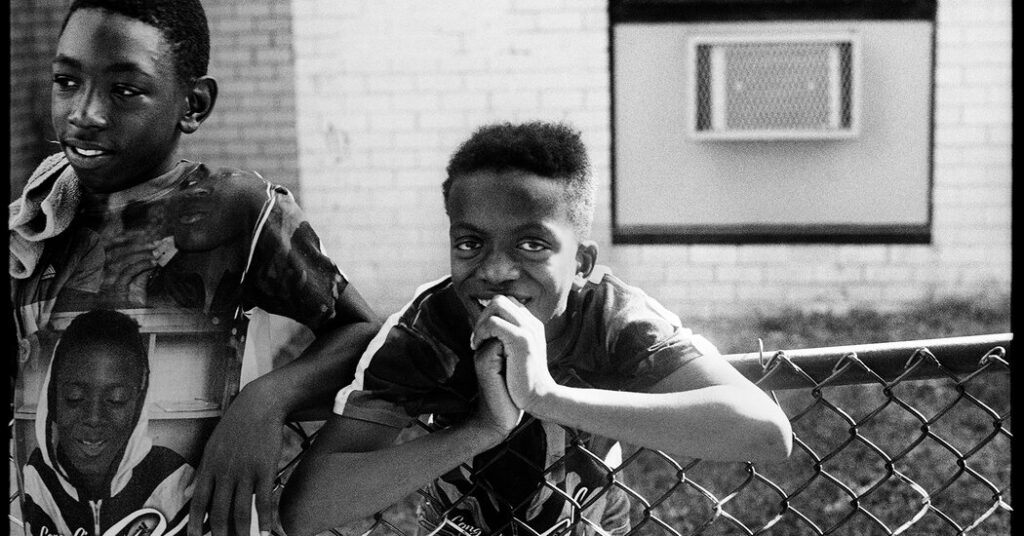
“A Language We Share: Beverly Price and Gordon Parks,” on view until June 19, brings together photographs by Parks (1912-2006), the well-known chronicler of 20th-century Black life, with Price, a contemporary artist who lives in Washington. Many of the images by both artists are in black-and-white, and many feature children.
The center, which has offered fellowships since 2017 and opened its exhibition space in March 2025, has as part of its mission statement a belief that there is “an abundance of uncultivated talent and exceptional creativity among individuals who share the lived experience of incarceration.”
Price was once incarcerated in a Washington jail where she could sometimes see out to the Anacostia neighborhood; she later moved there, and most of her 17 images in the show were taken there. Parks lived in Washington in 1942, during which time he took one of his most famous images, “American Gothic.”
Price did not start photographing in earnest until 2016, and she later received the center’s fellowship. “What made me pick up a camera was that I had a dream about four Black boys coming out of the ground, and they handed me a camera,” Price told me in an interview.
As in the Yares show, the organizers have tried to pair works by each artist.
“A Language We Share” was curated by Carly Fischer, the center’s deputy director, who has displayed Parks’s “Untitled, Anacostia, D.C.” (1942), a scene of dancing young Black girls, next to Price’s “Water Boys” (2016), showing two children playing with a gushing fire hydrant.
The images were not only taken in the same neighborhood, they both show children outside, in a state of pure playful joy. Price called it “a really special pairing.”
When done with care, a two-artist exhibition can even surprise one of the makers.
“I knew I loved Gordon Parks’s work,” Price said. But of its echo in her own work, she added, “I didn’t know it connected like that.”
The post Dynamic Duos are on Display in New York This Spring appeared first on New York Times.