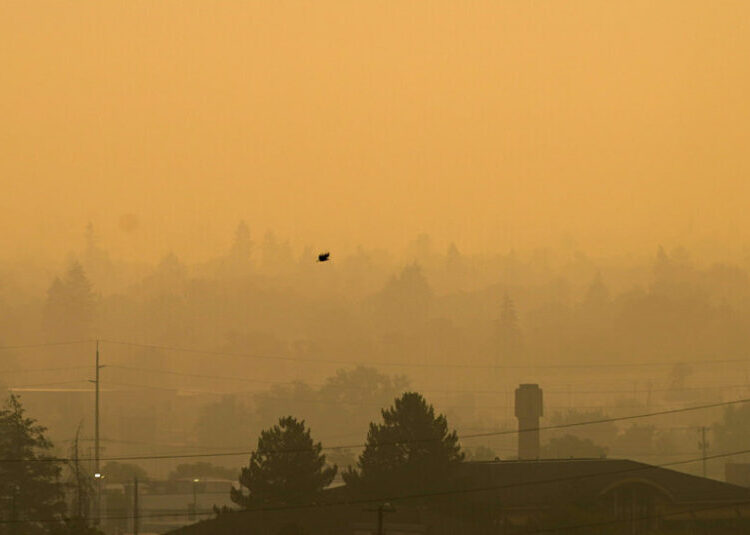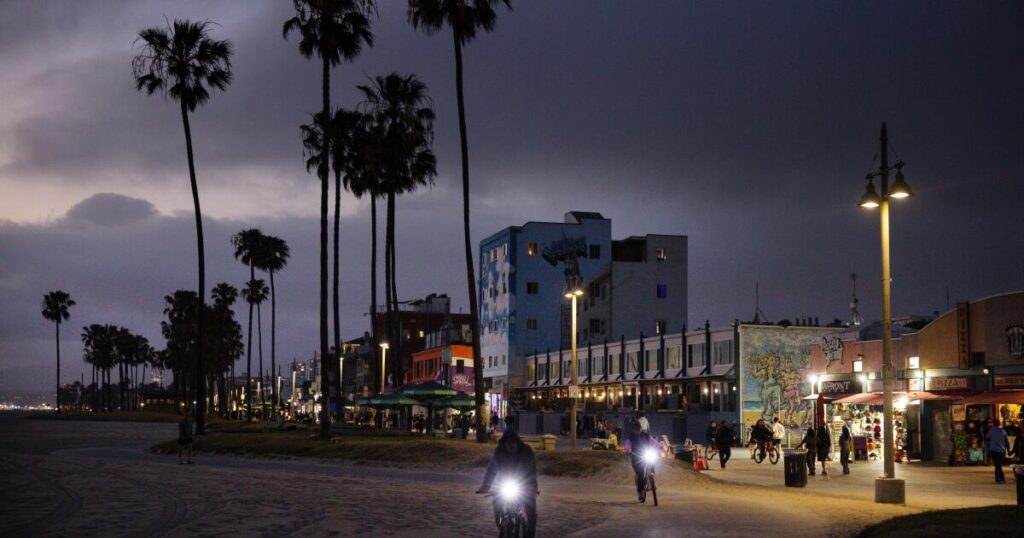
Light and Los Angeles are intrinsically linked.
It’s a light that elicits emotion and demands reaction. Filmmaker David Lynch said L.A.’s “muted golden sunshine” was the reason filmmakers flocked here. In the New Yorker, the writer Lawrence Weschler rhapsodized about the soft glow in the air here, day and night. When watching O.J. Simpson’s infamous car chase on television from across the country, Weschler burst into tears at the sight of the late afternoon sun cutting through the smog.
For decades, L.A.’s hazy blue days and golden pink dusks have given way to nights speckled with golden orange, where amber streetlights twinkle across hills, valleys and coastal plain like stars in the sky.
But now, thanks to the harsh LEDs that light much of L.A., an ever-growing number of streets feel more like prison yards when the sun goes down.
“I feel like I’m under surveillance in my own home,” Linda Chen said.
Chen said her San Fernando Valley home always felt like a haven — a quiet slice of suburbia where she and her family could relax at the end of the day. But a few years ago, city workers swapped the orange sodium streetlights outside her house with cold, blue-light LEDs.
Overnight, her once warm, cozy street felt harsh and hostile. One light shined so brightly into her bedroom that she lost sleep until she installed blackout curtains.
“It’s like when you’re on a red-eye flight trying to get some sleep and the person next to you has their reading light on the entire time,” she said. “Not the end of the world, but definitely a nuisance.”
Chen is planning to downsize in a few years, but she’s worried that potential buyers will be turned off by the glaring streetlights hanging over the home, and the property’s resale value will take a hit.
“I guess we’ll only do open houses during the day,” she quipped.
L.A. was an early adopter of LED. By 2013, the Bureau of Street Lighting had swapped more than half of the city’s 220,000 high-pressure sodium lamps with LED bulbs, and the department has systematically converted the rest in the years since.
Progress came with some growing pains. At the time, most LEDs on the market were bright and white, so the city went with those. Modern LEDs are warmer, and the color can be adjusted even after they’re installed, but L.A. is stuck with the ones it bought before the technology developed.
The bureau does not have an exact timeline of when LEDs turned up in each neighborhood in the ongoing transformation. In the last year residents in Venice and North Hollywood were the ones to suddenly find their streets lighted up like a Walmart parking lot.
Since the bulbs are more efficient than their predecessors, the overhaul reduces annual carbon emissions by 67,000 metric tons and saves roughly $10 million in energy each year.
But lighting is an intimate affair in this city; Los Angeles has long loved its ornamental and whimsical street lamps. Ribbons of roses curl up the sides of the lights along 6th Street, Chinese dragons hang from the lamps on Olympic Boulevard, and topless women watch over Wilshire Boulevard from their cast-iron perches.
So some Angelenos are rankled by the fact that these ornate, historic lamps are spewing hospital light across the city that, in most other regards, cares about the way it looks.
Solutions for residents are few. If the city installs an LED light that shoots into your bedroom, your only recourse is to request a glare shield, an accessory fixed to the lamp that blocks the light from certain angles — but it’ll cost you $350.
In letters to The Times several years ago, Joanne from Northridge missed the “mellow yellow” of the old lights. Bob from Simi Valley said that “you never know what you’ve got till it’s gone.” James from Cypress urged the city to tweak the LED bulbs to mimic the warm sodium ones.
Travis Longcore, an adjunct professor at the UCLA Institute of the Environment and Sustainability who studies the effects of artificial night lighting on human health, said that should not be hard to achieve with LED.
“There’s this take out there that all LEDs are bad, but that’s not the case. You can achieve warmer colors with LEDs,” Longcore said.
He said the wrong wavelengths of light can disrupt our natural processes, such as sleep, hunger and production of hormones. A bright sky is a signal that it’s daytime, so getting that signal at night throws all of that out of whack. In 2020, Longcore co-published a study linking artificial night light, including blue light emitted by LEDs, to cancer.
Longcore said the issue mostly comes down to color temperature (measured in Kelvins) as opposed to brightness (measured in lumens). The older sodium lights typically had a color temperature of around 1,900 Kelvins, which our brains interpret as warm and cozy, almost like a fire. But many LED bulbs are installed with a much higher color temperature, near 4,000 Kelvins, which our brains interpret as harsh and bright, regardless of how many lumens they’re actually emitting.
So if everyone hates the light blight, why do cities keep installing it?
The Bureau of Street Lighting claims that brighter lights make neighborhoods safer. Its FAQ page points to a study claiming that increased levels of lighting in New York City led to a 36% reduction in crimes such as murder, robbery and assault, though many lighting experts dispute that claim.
When the city first started installing LEDs in 2009, bulbs were set to 4,300 Kelvins, according to a case study. The standard has since been lowered to 3,000 Kelvins, but many fixtures installed before 2016 still operate around 4,000 Kelvins, according to Bureau of Street Lighting director Miguel Sangalang.
Sangalang said color temperature cannot be tweaked since the individual light-emitting diodes in the lamps are manufactured to a specific color temperature and can’t be changed once they’re made. It’s the downside to being at the forefront of change.
Other cities have adopted a more conservative approach. Pasadena, for example, is slowly replacing sodium lights with LEDs, but with a Kelvin ceiling of 2,700 to 3,000.
“When L.A. first starting installing LEDs, most vendors only made bulbs with 4,000 Kelvins or even 5,000 Kelvins,” said Richard Yee, an engineer with Pasadena’s Department of Public Works. “Now, they have bulbs where you can easily switch the color temperature.”
Yee said the city actively seeks feedback to avoid public backlash.
“Homeowners care about aesthetics,” Yee said. “Whether it’s businesses or residents, we typically check with folks where the lighting is going to get the thumbs-up before we install anything.”
Longcore says his ideal color temperature is 1,800 Kelvins.
“Making crosswalks brighter is important to saving lives,” he said. “But we don’t need to light everything that way.”
Across Southern California, residents are revolting against bright LEDs.
A Reddit user told The Times that her boyfriend got sick of the harsh streetlight obstructing his view of the night sky outside his home in Hemet.
One night in 2022, he sneaked outside and blasted it with orange paintballs.
“The paint didn’t cover it completely but at least the glare wasn’t as harsh as before,” the user said.
Glendale resident Pavan Moondi said the city swapped his warm streetlights for LEDs in April 2025, and it made his evening walks less relaxing.
“It feels a little like an example of hostile architecture in the name of ‘public safety’ that seems to be happening everywhere,” he said.
Before the lights were switched, Moondi, a filmmaker, shot a few scenes for his upcoming movie “Middle Life” in his neighborhood specifically because the glow of the amber lights matched the nostalgic vibe of the film. If shot today, the scenes would have a completely different feel.
“For indies like mine, we’re at the mercy of available light,” he said. “I hope politicians at the local level realize this is an easy and small way to improve the quality of life of their constituents, even if it’s a subtle one. I doubt anyone prefers their neighborhood to be lit like a factory.”
There’s another crisis happening at the other end of the lighting spectrum. A growing number of Angelenos have no streetlights at all.
L.A.’s vast network of streetlights are connected by 27,000 miles of copper wire. Over the last decade, the price of copper has climbed 167%, and copper theft skyrocketed 1,200%, leaving thousands of streetlights dark.
Copper theft became so rampant that in 2024 the Los Angeles Police Department launched a specialized unit called the Heavy Metal Task Force to track down thieves. The force led to more than 300 arrests but was disbanded last year due to budget cuts, LAist reported.
As a result, the city has been swamped with a mounting backlog of streetlight repairs — more than 33,000. If your streetlight breaks, it’ll take roughly a year for the city to fix it.
Sangalang told The Times in February that the department had only 185 people to service the city’s 220,000 streetlights.
And unlike other city services, which are financed by the city’s general fund, streetlighting is considered a special benefit, which means that only property owners who benefit from streetlights pay taxes for them. The tax has been unchanged since 1996 thanks to Proposition 218, which requires voter approval for increased special assessments, but the City Council recently approved a plan to send ballots to homeowners for a vote to raise the tax.
It’s one of two strategies the city is taking to solve L.A.’s streetlight crisis. In March, Mayor Karen Bass announced a plan to repair and replace up to 60,000 streetlights by harnessing solar power technology, so they’d no longer be reliant on the copper wire that keeps getting stolen. The city has already installed 650 solar lights this fiscal year, Sangalang said.
The initiative will cost $65 million, drawing money and resources that aren’t typically available for streetlighting. So residents and experts are viewing it as an opportunity to finally get the light they want.
“This is the ideal time to address issues of light glare, intensity and color,” Longcore said.
It’s worked in other places. In 2020, Longcore worked with Salt Lake City to develop a streetlighting plan that brought warmer colors and less light pollution, and he’s working on a similar plan for Austin, Texas. Other communities, such as Malibu, have developed ordinances to reduce glare and artificial light, as has Joshua Tree National Park, a star-gazing haven that is designated an International Dark Sky Park.
The city’s exact plan isn’t clear, but Longcore said if workers are adding solar modules onto existing lamps, they could add glare shields and tune the intensity to fit the location: bright for commercial spaces and crosswalks, dimmer for residential streets. But if they’re replacing entire lamps, they could also tweak the color temperature to match the warmer feel that residents are pushing for.
“We need to make light special,” he said. “If it’s everywhere all the time, and feels like daytime whenever you’re walking around at night, then it’s not special anymore.”
The post L.A.’s golden streetlights have turned harsh white. Homeowners aren’t happy appeared first on Los Angeles Times.