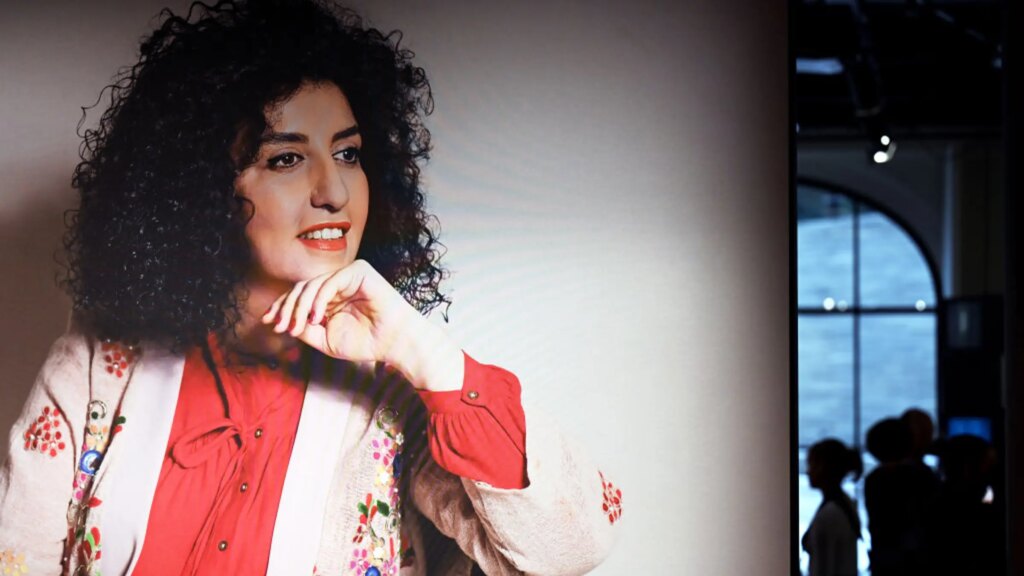
Nobel Peace Prize laureate Narges Mohammadi is in critical condition in Iran, according to her family, who accuse authorities of denying the detained activist urgent cardiac treatment.
Narges Mohammadi’s brother, Hamidreza, tells TIME that his sister is suffering from a condition known as Prinzmetal angina, which causes spasms in the coronary arteries and can trigger heart attacks and other serious complications.
“We are really worried that Narges’s heart will stop beating,” he says during a phone interview from his home in Oslo.
Mohammadi, who has been imprisoned in Zanjan Prison in the northwest since her arrest in December, was transferred last Friday to a local hospital after her health sharply deteriorated. Her family says she developed the condition during her detention.
Her brother says family members were able to visit her at the hospital this week under close supervision by Iranian authorities.
Mohammadi’s family is demanding she be transferred to a hospital in Tehran, where she can receive specialized treatment. Iranian authorities have rejected the request, Hamidreza says.
“The most important situation is that she must be treated by several specialists—and she has specialists who have treated her before,” he says. “It’s an emergency—every minute counts.”
Worsening health in custody
Mohammadi, one of Iran’s most prominent human rights activists, has campaigned for women’s rights, freedom of expression, and the abolition of the death penalty for decades despite repeated arrests and imprisonment. The 54-year-old was awarded the 2023 Nobel Peace Prize for her fight against the oppression of women in Iran and her advocacy for human rights and freedom for all.
“I will never stop striving for the realization of democracy, freedom and equality,” she said after receiving the prize.
Mohammadi has been arrested 13 times in her life, and sentenced to 31 years in prison and 154 lashes, her foundation states. She was temporarily released from Tehran’s Evin Prison due to poor health in December 2024, but was re-arrested a year later after speaking at a memorial of a human rights lawyer.
Her brother claims she was severely beaten during and after her arrest, causing intense headaches and significant vision loss in one eye. He says she has also experienced severe chest pain, nausea, fainting spells, and fluctuations in her blood pressure, and suffered a suspected heart attack in March.
Hamidreza explains that a deputy from the prosecutor’s office in Tehran travelled to Zanjan and, along with six doctors in the city, determined that Mohammadi was in critical condition and required treatment from specialists for “at least one month away from the prison.” He says authorities have rejected that recommendation.
“The authorities are trying to sweep it under the rug and keep her in that condition, hoping that she would die,” Hamidreza says.
Hamidreza says communication with his sister and family in Iran remains “very limited” due to continued nationwide blackouts following deadly mass protests.
Growing calls for Mohammadi’s release
The Norwegian Nobel Committee has called on Iranian authorities to “immediately transfer” Mohammadi to the appropriate medical team in Tehran.
“Without such treatment, her life remains at risk,” the committee wrote in a statement. “Narges Mohammadi is imprisoned solely for her peaceful human rights work. Her life is now in the hands of the Iranian authorities.”
The committee had previously called on Iran to “immediately and unconditionally” release Mohammadi from her “arbitrary and unjust” captivity, citing a litany of abuses she has endured in prison, including repeated beatings, solitary confinement, and interrogations.
The activist’s children, Ali and Kiana, who lead the Narges Mohammadi Human Rights Foundation, have also repeatedly demanded that their mother receive adequate care.
In a statement to TIME, Ali described the withholding of proper cardiac treatment as “a deliberate form of torture.”
“We continue our mother’s struggle here by echoing her voice and the voice of all human rights activists inside Iran who are fighting for a better future.”
The two children have not seen their mother in 10 years. “When you grow up in a political family in Iran, responsibility comes very early,” Kiana said in the statement. “You learn that silence is not an option.”
Family appeals to President Trump
Hamidreza believes Iran is using the war with the U.S. and Israel as cover to punish and imprison dissidents like his sister.
“They have been using the pretext of war to execute a lot of people and arrest a lot of people without proper trials,” he says, noting that “history repeats itself” in reference to the thousands of political prisoners who were killed during the Iran-Iraq War.
Mohammadi’s family is urging President Donald Trump not to overlook political prisoners and dissidents in any future negotiations with Iran.
“Don’t let the Iranian government to use the Strait of Hormuz as a hostage, and demand that any negotiation be dependent on the release of the prisoners, and stopping the executions, and stopping the killing of people like Narges,” Hamidreza says.
The post Narges Mohammadi in Critical Condition in Iranian Custody, Family Says appeared first on TIME.