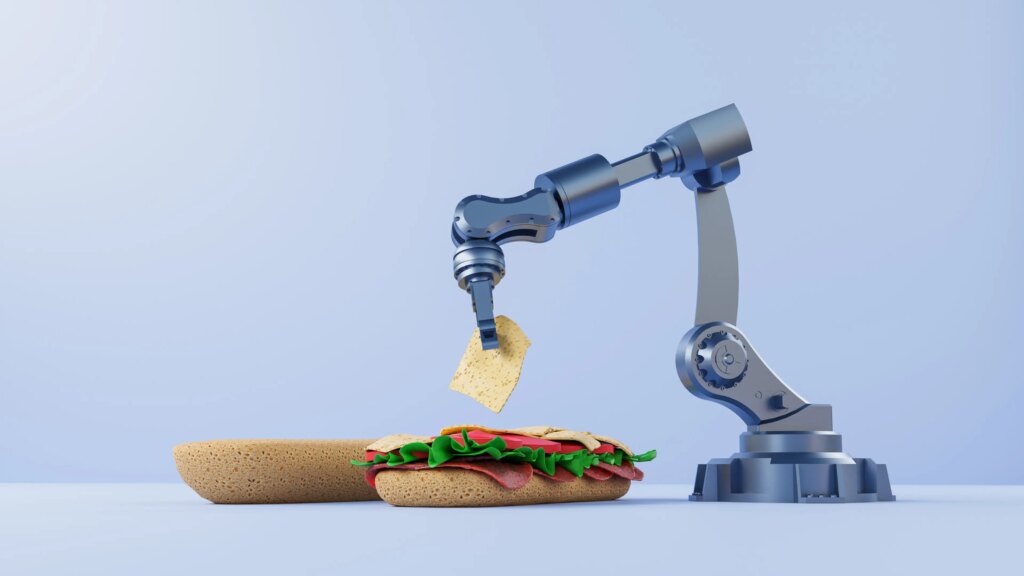
Earlier this week, I visited a lunch spot in London where several 20-somethings were busy toiling behind a counter. To their left sat a less ordinary sight: a food assembly robot that might one day put them out of work.
I was here to witness a pilot program by the London-based startup Kaikaku AI. With some $1.8 million in funding, it’s one of a group of startups who see recent advances in AI and robotics as an opportunity to eliminate some repetitive kitchen tasks, reduce food businesses’ labor costs and—at least according to Kaikaku CEO Josef Chen—bring down prices for consumers while making food taste better, too.
Never one to shy away from first-hand reporting in the public interest, I arrived hungry.
I punched my order into an iPad and wandered over to the robot. From the top, it looked like any other food assembly counter, with trays of shredded carrots, onions, salad leaves, and sweet corn. Then I crouched down and peered through a clear plastic window to see funnels descending from each tray to a conveyor belt beneath.
My empty paper bowl jerked along the belt, stopping under each funnel. A cascade of spring onions came first, then an avalanche of mango chunks and edamame beans. Next, the bowl stopped under something resembling a downward-pointing revolver, each chamber filled with a different sauce. My chili-garlic sauce was duly discharged. Finally, a handful of raw salmon chunks came tumbling out of the last chute. The conveyor delivered my bowl to an elevator, which lifted it up through a hole at waist-level, ready to be grabbed by a human worker.
What came next wasn’t automated at all. The human arrived with a separate bowl of rice and sliced cucumber. (The machine is capable of dispensing rice, Chen explained, but not yet in the neat way that this restaurant prefers.) The worker mixed my robot-dispensed ingredients manually, dumped them into the bowl of rice, then seasoned the mixture by hand with sesame seeds and crispy onions. I tucked in, and it tasted like any other salmon poke bowl I’ve had.
Kaikaku isn’t the first company to attempt to automate salad assembly. Sweetgreen acquired a startup called Spyce Kitchen in 2021, attempting to do a very similar thing. It didn’t take off, and the company sold it off last year. But according to Chen, a convergence of factors happening now specifically means that Kaikaku has a shot at success—including robotics parts becoming cheaper, an innovation in food-safe 3D printing, and human labor becoming more expensive. Kaikaku uses proprietary machine learning systems that make use of recent advances in AI to accurately weigh and dispense food, he says. The company’s machine, called Fusion, can theoretically handle 360 bowls per hour—far more than even a team of humans at full pelt. What I witnessed, during an admittedly low-footfall lunch hour in London, was significantly more sedate than that; maybe one bowl per minute.
After my experience eating a lunch that was (sort of) prepared by a robot, I could have left the restaurant skeptical. Assembling a salad, it’s true, is far simpler than cooking a complex meal. And most of the work done to get the food into my mouth was still done by humans: farmers, fishermen, drivers, merchants, and indeed the worker who mixed it all together. Many of these humans already made use of machines, like the crop-planters that have automated the tedious work of sowing edamame beans by hand. What difference should one more machine make, simply because it comes at the last step in the process?
Instead, I left wondering what the future holds for the worker who handed me my bowl. When I asked her what she felt about the robot, she only had good things to say. “It’s definitely a good idea,” she replied. “At the moment, we are suffering a lot with getting good team members. So an extra help, something like this, really helps us go faster.” But speaking to Chen, it became clear that Kaikaku’s endgame is the full automation of her kind of work. “Instead of having 20 people in the kitchen slicing vegetables, or three chefs doing nothing else but timing how long pasta has been cooked, all of those will be automated,” he told me.
The post How a Robot (Sort of) Made Me Lunch appeared first on TIME.