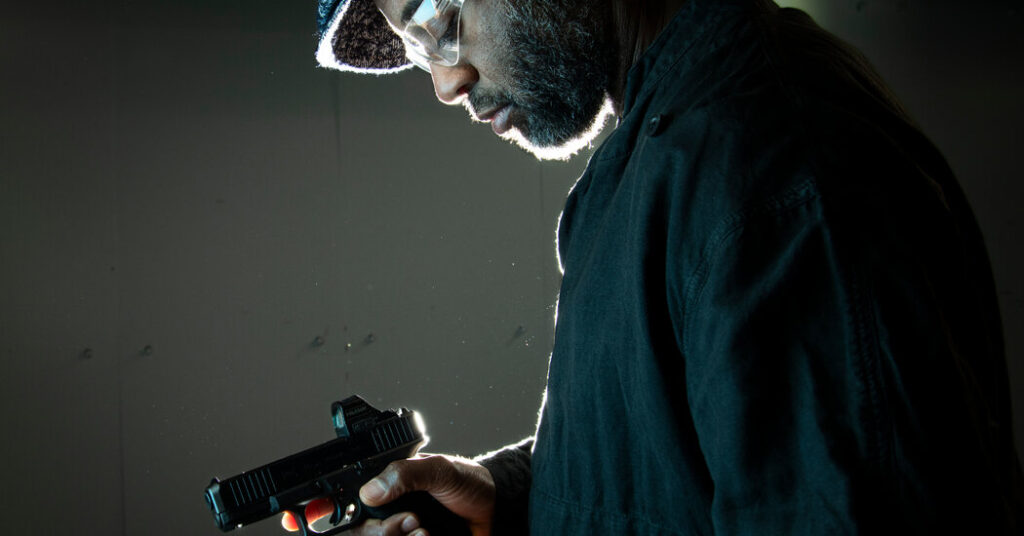
A fully loaded Glock 19 weighs around 800 grams. Less than a liter of red soda, six apples, a watermelon, a bottle of merlot or a bag of sugar. Less than my youngest son’s geometry textbook, less than the 1,000-page high school history tome that his older brother lugs around. Less than the rap sheet I got for a crime I committed when I was 16, which made it illegal in nearly every state for me to be at a gun range. But I was in Virginia, where I was allowed to possess a gun, loading a magazine into a pistol 25 years after my convictions, then firing round after round into a paper target wafting in the wind.
Little about my childhood in Prince George’s County, Md., predicted I’d go to prison before I could register to vote. I was a decent student, class treasurer-elect and backup point guard on my high school’s junior varsity basketball team. I’d not won a fight since second grade. When a friend’s brother was arrested for attempted carjacking in my ninth-grade year, I spent an unsettling Christmas at his house, listening to his family speak to him on a recorded line. That same winter, I read Nathan McCall’s memoir, “Makes Me Wanna Holler,” about the years he spent in Virginia prisons; his description of a shank he made by melting a razor blade into a toothbrush handle made me terrified of the idea of doing time. I would have bet good money prison was not in my future.
But in the fall of 1996, I started experimenting with disaster. As a freshman in high school, I tried selling drugs but ended up getting robbed. Once, I cruised around my neighborhood with friends in a stolen car. Eventually, a month after my 16th birthday, I committed the crimes that forever changed my life. The facts that matter most: I was hanging out with three friends one Saturday night. Someone said he needed money, and in a fit of adolescent bravado, I suggested we rob somebody. I was pretending to be hard; the closest I’d been to a pistol was a night when I was 15 years old and stray bullets chased me from my neighborhood playground. But in a stroke of malevolent serendipity, my friend’s cousin showed up with a gun and a car. I felt I couldn’t back out.
We drove to a suburban mall in Virginia, and once there, I asked for the cousin’s scratched-up matte black automatic, shoved it in the pocket of my winter coat and walked with the guy who needed money into the dimly lit parking lot. When we approached two women who were walking to their car, I froze, afraid of what might happen next. The two women leaped, startled, into the car and fled. We wandered the parking lot for 10 minutes before finding a man asleep in his car. I steeled myself and walked up to him. The winter coat I wore swallowed my body, and even with my arm extended, the driver didn’t know that I was tapping on his window with the barrel of a gun. When I got his attention, I pulled my sleeve back to reveal the weapon. As he climbed out of his car, we demanded his wallet. Seconds later, we took the car and drove off into the night.
I was arrested the next morning. If I’d been armed with a knife, I might have avoided being tossed into adult prisons as a 5-foot-5, 125-pound teenager. Because I’d used a pistol that night, I was more dangerous in the eyes of the law. In Virginia and many other states, committing a felony with a gun means a mandatory minimum prison sentence. In the end, the judge sentenced me to nine years in prison. After that, my life became a riff on Du Bois’s idea of double consciousness. Once I pleaded guilty, I was no longer a dumb kid who made a tragic decision. I was a felon.
With good time, I came home a little over eight years later. Still, I understood that my new identity would always threaten to erase any other role I desired to inhabit. Though my crime did not result in anyone’s death or injury, I worried my conviction meant that people would always assume me to be a violent person. In my heart, I came to believe that I was a violent person.
There is a long list of rights you can lose once you’re convicted of a felony. The specifics vary from state to state, but include voting, sitting on a jury, running for public office, applying for food stamps, living in subsidized housing, getting a license to practice cosmetology. And in every state, federal law prohibits a felon from possessing a firearm. When the Virginia Department of Corrections let me go, my release papers explained that “possession” of a firearm — even if the weapon was out of my reach — could send me right back to count times and chow calls. If I was in a car and knew that the driver had hidden a gun under his seat, I would have had “constructive” possession of that weapon even if I was asleep in the back. If you are in the house and your lover’s gun is unsecured, you are in possession. If you’ve been convicted of a felony and are close enough to wrap your fingers around a pistol’s grip, you’ve most likely violated the law.
But sometimes I couldn’t help it. At cookouts, friends and friends of friends who lived with one foot in the streets sometimes showed up carrying, and their pistols wound up on a table or a bed or getting passed from one admiring person to another. I lived in a constant state of anxiety about being found guilty by proximity. But my apprehension was as much about the cruelty I knew guns inflicted on the world as it was about getting locked up again. Guns were at the center of nearly every tragedy I grew up with: a friend shot in the leg while running from someone who was trying to rob him; a classmate relieved of his Eddie Bauer coat while staring down a shotgun in our high school parking lot; another friend murdered with his own weapon the summer before 11th grade. Once I got out, I would open letters from friends I met in prison who were serving life sentences because of crimes they committed with guns. Most painful of all was the suffering of my mother, who was sexually assaulted at gunpoint while I was behind bars. All told, guns nauseated me.
So for years, I desperately tried to avoid them. They loomed over me as not just a tool of despair but a symbol of what I accepted as my own criminality. I was mortified by what I once did with a pistol, and by the violence my conviction connected me to. I worked hard to escape the label that the state foisted on me, but I never seemed able to — until, one day, I decided that shooting the weapon that had terrified me for so long might help me finally shed all that guilt.
“Certain kinds of black men’s stories,” Elizabeth Alexander once wrote, “are ever in vogue, stories that offer the easy paradigms of criminality and putative redemption.” My life and career after prison bore that out. When I came home, I confessed my crime to anyone who would listen, emphasizing my mastery of what I called the three R’s of rehabilitation: regret, remorse, responsibility. I pursued achievements that I thought would validate me in the eyes of others. I earned a bachelor’s degree, wrote an award-winning poetry collection and had a memoir about my time behind bars published. My story brought me recognition, but my writing often felt like a return to the scene of the crime. I didn’t realize how, in telling my story of redemption, I was also internalizing the state’s judgment of me as a threat.
Eventually, after years of struggling to get a job that could help me pay back my student loans, I pivoted and applied to law school. Maybe, I thought, a degree from Harvard or Yale would let me walk into a courtroom as a public defender and help me feel I was something other than a felon. In the fall of 2012, I enrolled at Yale Law School and moved to New Haven, but self-judgment shadowed me. When I applied to rent my first apartment near the university, I asked the real estate agent whether he thought we’d get the lease given my record. “The landlord is a retired police officer,” he told me. Even after the landlord agreed to rent me the space, I couldn’t stop wondering what he might think of having a convict tenant.
At law school, I believed myself to be an attractive nuisance, admitted only because I survived prison. In my first year, I enrolled in a constitutional law seminar taught by Prof. Heather Gerken. She pushed us to read judicial opinions the way you would read literature, giving us permission to see litigators and judges as sometimes unreliable narrators. As a progressive student with a criminal record, I never expected to admire anything about Justice Antonin Scalia. He argued for positions I thought were heinous, like his idea that the Eighth Amendment did not preclude the execution of juveniles.
But reading judicial opinions as literature meant understanding that judges’ politics and personalities should not determine whether I could learn something from their arguments. Besides, I admired Scalia’s wit, inventive logic and pugilistic prose. (In one dissent, he knocked the majority’s opinion as “interpretive jiggery-pokery” and “pure applesauce,” bits of wordplay that would get a nod from the dopest battle rapper.) Yet when it came to gun rights, he abandoned inventiveness for conventional wisdom, especially when it came to people convicted of crimes. Writing for the majority in District of Columbia v. Heller, the case that scrapped some of the strictest gun laws in the country, Scalia noted that “nothing in our opinion should be taken to cast doubt on longstanding prohibitions on the possession of firearms by felons and the mentally ill.”
That single sentence left me shaken. The court’s Heller decision was the most significant gun ruling in 70 years: For the first time, individuals — not just militias — were held to have a constitutional right to possess a firearm. Still, the decision left no room for me to ever own a pistol. None of my classmates objected to that part of Scalia’s thinking. I remained silent, but the ease with which we all accepted that arrangement cemented the sense that I lived, forever, in a world apart.
A few days after the Heller discussion, I went to Gerken’s office hours to talk about how each time the word “felon” was spoken in class, I felt attacked, as if my classmates were judging me. I remember a look of confusion shadowing her face. How, she asked, could I think I was anything other than admired? I left her office feeling both affirmed and adrift, realizing I was two people in my own mind: the one forever condemning himself and the one my classmates respected. When I graduated from law school, the commencement speaker told the audience my story. Listening, I became uncomfortable. I looked down into my hands, worried that my friends and their families would resent my being singled out for praise, or reduce the praise to my prison sentence. But when I looked up, my entire class was standing, circling me with applause.
Soon after graduating, I landed a coveted clerkship at the Third Circuit Court of Appeals, and then went on an artistic run that nobody dreams of from a prison cell. My third poetry collection, “Felon,” earned me a wider audience and put me in conversation with my heroes at literary festivals across the country. I published an essay in this magazine that not only won a National Magazine Award but also had strangers recognizing me on the subway. I became a visual artist and had an exhibition at the Museum of Modern Art with my friend, the painter Titus Kaphar. I won a MacArthur Fellowship, the so-called genius grant. Scholars, criminal justice reform advocates and legislators praised my success. In 2020, I was awarded a Mellon grant that allowed me to start Freedom Reads, an organization dedicated to building libraries on cellblocks. It required me to work closely with corrections departments across the country. I walked into countless prisons and thought I was returning as a good citizen. But in the eyes of the law, I knew I was still a felon, with all the assumptions of violence that entails.
Somehow, all of my achievements were not enough. I knew it was paradoxical, but I found myself fixated on wanting my gun rights back. Maybe I imagined that being given permission to carry a firearm would mean I was no longer someone to be feared. Perhaps that would banish the feeling of shame that had smothered my life for so long.
For me to legally possess a firearm, a judge in the same Virginia courthouse where I was sent to prison as a teenager would need to declare me fit to do so. I put together a petition that told stories about the life I built after prison: my two sons, my time spent coaching youth league basketball, my life as a poet and teacher. At the hearing, more than two decades after a prosecutor argued that my carjacking negated every positive aspect of my character, a different prosecutor now called me a “super citizen.” A judge granted my petition. Under the law, I could possess a firearm in Virginia.
It wasn’t too long before I realized that simply having the right to carry a gun wasn’t satisfactory: I actually wanted to shoot one. In 2023, I went to a range in Fairfax, at the National Rifle Association’s headquarters. When I entered, I found a taxidermic animal head mounted on one wall. A handful of Tom Clancy and John Grisham novels, meant for those waiting to enter the range, sat on a bookshelf. I’d called a few weeks before to find an instructor. When I told the person answering the phone that I was a lawyer, he told me he had the perfect teacher for me: George Lyon, a lawyer who was one of the plaintiffs in, of all cases, D.C. v. Heller. Already, I thought, the gun range was humbling me.
In my backpack I carried a copy of my signed 1996 confession; the 1997 judge’s order sentencing me to nine years in prison; and the judge’s order returning my right to possess or carry a firearm, thinking I’d need to show the documents before anyone would allow me to shoot. I expected to be interrogated, but the man working at reception, who I’d spoken to weeks before, said he didn’t need to examine my gun license. He handed me a clipboard with basic safety precautions, personal information to complete and a waiver to sign. I could hear an instructor explaining to a nearby class that “there are two categories of people who cannot legally possess firearms: felons and idiots.” I laughed to myself: When police officers arrested me for the robbery, I had the victim’s wallet on me. It made me both a felon and a fool.
George, it turned out, looked more like an accountant than a sharpshooter. He wore glasses and stood a few inches shorter than me and carried his pistol in a holster on his side. After a primer on gun safety, he handed me an empty automatic. Within 20 minutes, I was holding a gun for only the second time in my life. I stared at an unmoving target about seven yards away. In my head I ran through terrifying outcomes, from shooting out the small lights illuminating the lane to putting a hole in my foot, to ending up in handcuffs. As I raised my arms and aimed, I was surprised to feel the gun’s weight in my hands, somehow both lighter and heavier than I’d expected. I tried to bend my knees but found that they had almost locked in anticipation. I felt my body tense; my chest filled with an aching anticipation. Then, as I began to press the trigger, my breathing slowed. When I finally fired, my shoulders and left foot jerked back from the recoil. My entire body was rocked by what I’d done. And then I smiled.
I don’t remember much after that, except that I continued to shoot. The range, with its long and narrow lanes, looked like a bowling alley, with a dozen men who approached shooting as a sport. Eventually, their example rubbed off on me, and the activity began to feel playful. I noticed that George carried a revolver on his hip, and as much as I hated to admit it, watching him draw it from its holster reminded me of the westerns I watched as a kid, when I fantasized about being Doc Holliday. While I was shooting, I could be whoever I wanted; handling the weapon felt like cosplay.
George taught me to shoot knowing full well I once robbed a man at gunpoint. And yet, for all his generosity, George also made me uncomfortable. He told me to look over my shoulder each time I stopped shooting — because I should imagine that there might be a bad guy behind me. After each missed shot, I’d forget to glance back and he’d remind me to turn around. “Most gunfights happen within five yards,” he said, the length of a car. Who, I wondered, did George see himself dueling in such a gunfight? I couldn’t help but imagine encountering the 16-year-old me, tapping a car window with a pistol.
I never returned to that range. Instead, I searched for one that employed licensed instructors, thinking they’d make me feel less like I was training to be a vigilante. I settled on Sharpshooters Group, a range in Lorton, Va. Nate, a subdued military vet, was to be my instructor. At the front of an otherwise empty classroom, a bright orange replica of a handgun sat on a table in front of him. Before I could touch a pistol, he used the replica to take me through an hourlong instructional class on handgun basics. I’d already learned some of his lessons from George: gently bending my knees as if preparing for a jump shot; wrapping my right hand around the pistol’s grip, with my pointer finger alongside the barrel but away from the trigger. Others were new. To ensure the chamber was empty, for example, he told me that I had to turn the gun to the side and pull the slide back as if opening a book. I needed to “be ready to destroy anything you point this barrel at,” he warned me. “And anything behind it.” The lesson reminded me of friends doing time for bullets that missed their targets and ricocheted to injure or kill others.
By the time I began working with Carl, another instructor who was a military vet, I had started to feel comfortable around guns for the first time. He taught me a series of Zen-like practices. Breathing was the key, he told me. So was precision: For the bullet to land where I desired, I had to squeeze the trigger slowly so that I wouldn’t lose control when the bullet erupted from the barrel. And there was what I came to hear as his signature phrase: “That’s right.” One day, determined to become a better shot, I purchased 400 rounds. Once I had a loaded weapon in my hand, Carl offered advice at a volume I could barely hear: Remember to relax; don’t lean into the shot too much; your follow-through still drifts left.
The range returned me to the role of student, which had always made me feel safe. Immersing myself in learning rather than fantasy made me feel competent, less an impostor. Going to Sharpshooters became a habit. A few days a month, I’d travel to Lorton and shoot for an hour or so. I got lost in understanding the nuances, like choosing which eye to close while aiming and how to shoot in clusters. Eventually, target practice began to feel like shooting free throws again and again until the action becomes automatic. When Carl’s tone shifted from a whispered calm to excited urgency, I knew I’d found my zone. “That’s right! That’s right! That’s what I’m talking about,” he yelled as I placed a tight circle of holes near the bull’s-eye. For two hours I practiced firing at targets that danced in the distance as my bullets skipped through them. Once Carl walked away, there was nobody to witness me marveling at the target after each shot.
At Sharpshooters, I felt like I had found a new community. I listened to the jokes of the people around me, noticed the idiosyncratic way some bedazzled their gun bags. I bought my own bright, orange-rimmed eye protectors to match my N.R.A. hat. I even gave copies of one of my poetry collections to everyone at the range.
Once, pausing to watch the guy next to me, I noticed that he’d line up his targets and then start shooting almost with his eyes closed. When he retrieved the target, there was a single hole, pierced multiple times, through the bull’s-eye. “You Special Forces?” I asked after we both finished and were washing away the lead that had accumulated on our hands and faces. He laughed and told me that he’d gotten nice with his weapon by practicing dry firing at home, shooting imaginary round after round at a wall in his apartment. He was passing along trade secrets, and it made me feel, for once, fully present. I savored the fact that I was no longer a strange exception in the room, but a part of this motley collective — a senior citizen couple; a local law enforcement officer practicing with a weapon I hoped he’d never have to fire; and other fools like me, geeked about shooting paper zombies and geometric figures.
Every time I handled a gun, my perception shrank so that all I saw were the targets. The noise that had engulfed me ever since I came home from prison began to quiet. I was used to hearing a voice that interrogated every moment of my life, seeking evidence that people were suspicious or afraid of me, but at Sharpshooters, that voice receded. I realized that I felt more comfortable at the range than I did at literary events, where my reputation was premised on the revelation of my crimes, like a confessional. I’d spent years in those rooms, believing I needed to perform an arc of redemption, that I had to narrate all my successes, all the ways I was more than my mistakes. I wasn’t aware of what that cost me until I walked into a gun range where no one seemed to care about my past. Few questions are asked of people firing round after round at paper targets. I could disappear.
Even as I found joy and camaraderie at the range, I couldn’t help wondering what my mom would make of the pleasure I was taking in guns. How, I wondered, could redemption be found in these weapons that had twice devastated our lives, and continued to wreck the lives of countless others? This question reverberated for me when I met Sheena, an instructor who taught self-defense to Black women. She came from a community similar to mine, and her interest in guns was not just for sport. “I do this to give Black women confidence and to make sure they can feel safe in a world that doesn’t feel safe,” she told me several times.
Sheena was the first person at the range who talked to me about the violence that guns had inflicted on people she knew. When she spoke, I heard the rhymes between our lives. Those rhymes didn’t comfort me, or allow me to push away the broader context and narrow my perception to the gun and the target. Rather, Sheena reminded me that there was no way to disentangle guns from the violence that haunted me. More than that, she taught me that the experiences of those who commit violent crimes and those who are victimized by them are forever entangled yet ultimately incommensurable. There was no way for me to convince others that I was not a threat or that I was worthy of their trust. The only trust I was likely to earn back was my own — the trust I had in myself that I was no longer that scared 16-year-old. That would have to be good enough.
With a pistol in my hand, the stakes were as high as they’d been when I picked up a gun all those years ago. But now every decision belonged to me, and I could make one that didn’t leave me reeling. At the range, I could master the simple skill of hitting a bull’s-eye, rather than letting my overwhelming fear of guns master me. It was a relief — cathartic and strangely bereft of violence.
Reginald Dwayne Betts is a poet and the founding chief executive of Freedom Reads, an organization that opens libraries in cellblocks, as well as a contributing writer for the magazine. His latest collection of poetry is “Doggerel.”
The post A Gun Derailed My Childhood. As an Adult, I Found Relief at the Range. appeared first on New York Times.