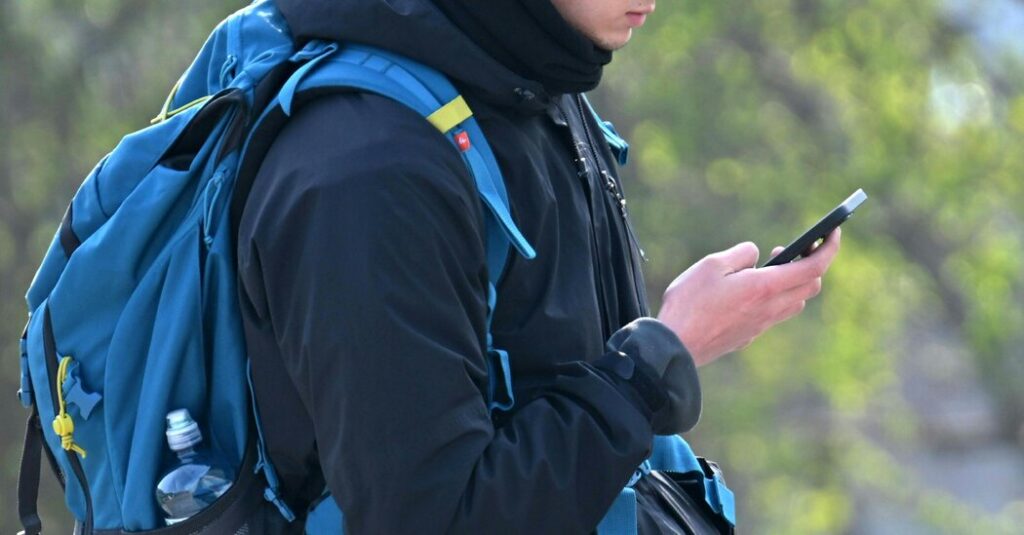
All children alive today were born after the advent of the smartphone and social media.
How many could function without their phone or TikTok account?
That’s the question that 72,000 children in five European countries recently tried to answer. They chose to limit their access to the digital world, exchanging Instagram and iPhones for paper address books and printed tickets.
It was the latest international effort to limit how the digital world encroaches on childhood. In some countries, governments are seeking mandatory social media bans. Some schools have banned phones in class, with mixed results. This project, run by independent experts in Austria, was something different: a voluntary digital detox.
For three weeks in March, some participants gave up their phones entirely. Some switched to “dumbphones” — cellphones without internet access. Some kept their smartphones but reduced daily screen time from hours to minutes. Others quit social media.
Wondering how that felt, I interviewed 14 participants in Austria aged 10 to 17, along with their parents and teachers, to construct a diary of the experiment.
The children spoke of a world transformed, one where they felt more connected to their surroundings and engaged with immediate family. Others said they felt bored and lonely, unable to contact faraway relatives.
The conversations have been lightly edited for length.
Day 1: Phones off
Moritz Voltmer, 14, gave up his phone entirely: There was this big event at school where we turned our phones off at the same time. I remember being unimpressed. Like, 21 days is going to be easy.
Özlem Koza, 11, aimed to cap her daily phone use at one hour: The first day was the hardest and the worst. I didn’t want to go home, because I knew I’d want to use my phone. At home, I thought about my phone often.
Days 2-4: Acclimatizing
Salome Slouk, 16, used a dumbphone instead of a smartphone: When I’m on my phone, I don’t have to think. I’m just scrolling, and afterward, I can’t remember what I saw. When I didn’t have my phone, I couldn’t stop my thoughts. They were overflowing.
Johanna Spring, 17, kept her smartphone but stopped using social media: There’s a corner of the house with my cello. I picked it up and started playing. There’s something fun about not having a phone and just picking stuff up and trying things out.
Days 5-7: Building connections
Niki Sumper, 16, limited his smartphone use to 10 minutes a day: I played chess with my dad and some board games with my mom and my dad. We spent the whole evening like this. Normally, I’m in my room and listening to music, playing PlayStation, but mostly being with my phone.
Johanna: If you scroll through TikToks, there are shifts in emotions all the time. You can get depressed very easily. If you don’t have that at all, you’re looking for connections with people. I think I listened more. When I talk with my mom, if we disagree, one of us will shut the other person down. I tried listening to what she would say. We had a much nicer connection.
Days 7-11: Thinking better
Niki: Normally, I write 10 sentences, then pause, look at my phone, then write the next paragraph. I forget what I wrote before, and sometimes I repeat the same phrases or write something that doesn’t fit with the essay entirely. But this one I wrote without breaks.
Moritz: I studied for a Spanish test. Normally, when I study, I take short breaks to send some Snaps or something. But as the challenge went on, I learned to concentrate more. I knew that no one was going to call me, text me, and that gave me a little bit of a boost.
Days 12-14: Feeling lonely
Niki: The hardest part of the project was not communicating with friends. In the first days, it was OK, but in the middle, it became tough. My best friend lives close, so I asked him to manage everything so we could meet with other friends. I thought it was a bit embarrassing to go to my friend and tell him, “Call all my other friends and tell them to meet here and then.”
Özlem: At home, I noticed that my mom, my brother, my dad, all of them, were on the phone all the time, and I was the only one in the house without a phone. I was really annoyed. I often told them not to do that, but they didn’t listen to me.
Salome: There’s so much time when I’m on WhatsApp and texting with my boyfriend. I feel like I have to text him small things, like: “How are you doing?” But [during the project] he knew I couldn’t do it, so I didn’t have to.
Days 16-17: Finding workarounds
Moritz: I got a dumbphone. You have these buttons, and you have to press them three times or so to get the right letter. It was very inconvenient.
Niki: I wanted to visit a good friend of mine in a different town about 30 to 40 minutes away by car. I decided to bicycle. I went to my laptop, Googled the distance and the route, and printed it. It took me around one hour and 20 minutes. I biked through tiny districts of Lower Austria that I’d never seen before. It was really nice seeing animals like weasels, squirrels, owls, horses, deer, a fox.
Salome: I went to Vienna with my mom to buy something, and after that, she stayed in Vienna, but I had to go back home. I looked on her phone and had to memorize the names of the train stops. I was kind of scared, but I got home fine.
Day 22: Phones on
Moritz: We had a big event at school to turn on our phones together. I had a great time during the challenge, and I feared I would use my phone frequently again.
Salome: Do I really want to give the dumbphone away and get a real phone again? I didn’t really want to.
Johanna: I had over 70 messages on Snapchat, so I put it down immediately. I didn’t want to look at it.
Niki: I checked my messages, and then I checked what I missed on Instagram and TikTok. It wasn’t much.
Day 25: What they learned
Johanna: I’m trying to limit the time I’m spending on my phone overall and use it more consciously. I have a book now in my bag all the time, which I just read when I’m on public transport instead of doomscrolling.
Özlem: I really, really love my phone, but I’m using it less, one to two hours per day. I draw or study or help my mom or go outside.
Salome: I waited to change the SIM card back until Saturday morning. I just wanted to remain in that feeling of only being available when someone calls me. I still haven’t opened TikTok, and I don’t miss it.
The post They Never Knew a World Before Smartphones. Could They Survive Without Them? appeared first on New York Times.