Subscribe here: Apple Podcasts | Spotify | YouTube | Overcast | Pocket Casts
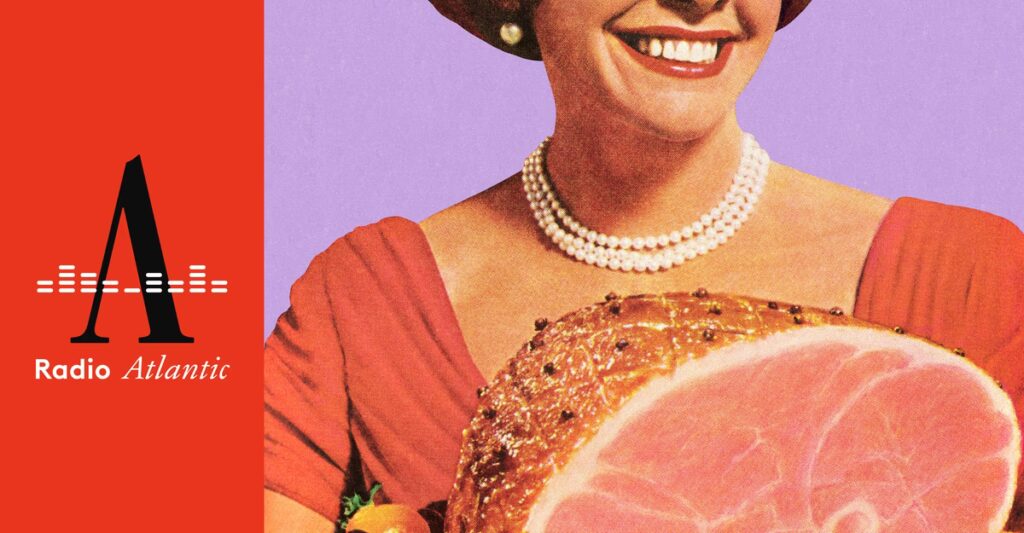
Every generation of feminist has the tormentor it needs. For mine, it was Martha Stewart, a tycoon masquerading as a domestic goddess, who taunted us with her lazy afternoons on the farm picking peaches and tending to her flock of Old English Game hens and Silkie bantams. The online generation is cursed with the tradwife, who usually serves up the homemaker fantasy with an aggressively retrograde worldview.
Tradwife influencers such as Hannah Neeleman might bake bread, tend chickens, and pick from their orchards much like Stewart did, but they also take care of an impossibly large brood of children and declare themselves contentedly, even ecstatically, subservient to one very lucky man. “My husband does not have to lift a finger when he is at home,” another tradwife influencer, Estee Williams, has cooed to her tens of thousands of followers on Instagram. (Stewart, by contrast, was divorced by the time she launched Martha Stewart Living. She had one child and, although she never said so explicitly, seemed to believe that children and straight men would just dirty the furniture.)
The author Caro Claire Burke had been happily married for a few years when she downloaded TikTok and the algorithm served her a tradwife video. By then, she had already consumed the writings of Noam Chomsky and been “radicalized,” as she put it, so the image of a woman in a prairie skirt with her smiling children both soothed and infuriated her. Burke eventually started her own TikTok criticizing the tradwife, whom she defines as “someone who adheres to norms that we understand as traditional, so subservience, taking care of children, staying within the home, obeying your husband.”
She extended that critique into her first novel, Yesteryear, about a modern tradwife who finds herself transported to 1855. The novel has become an instant best seller; already its film rights belong to Amazon, and Anne Hathaway is attached as the lead. And yes, the main character’s perfect-seeming life unravels, but not at all in the way a reader expects.
Burke joins me this week on Radio Atlantic to talk about her novel, her own political evolution, and options for young women who roll their eyes at both the girlboss and the tradwife.
The following is a transcript of the episode:
[Music]
Hanna Rosin: Every once in a while, but not all that often, a work of fiction steps into the cultural debate at just the right moment and in just the right way.
Rosin: How would you define a tradwife?
Caro Claire Burke: Well, I guess the simplest definition is a traditional wife. I think it’s someone who adheres to norms that we understand as traditional, so subservience, taking care of children, staying within the home, obeying your husband.
Estee Williams: Why are we telling women, even starting out as young girls, that they need to have a life of independence?
Burke: But then there’s, of course, the tradwife influencer, who is someone who performs those ideas online, mostly for money.
Nara Smith: When my husband woke up with a case of the sniffles and a tingle in the back of his throat, I told him to stay in bed and I’d make him a hot bowl of soup. Lately, I’ve loved—
Rosin: Right now, that work of fiction stepping into the cultural debate is Yesteryear, by Caro Claire Burke, about a modern tradwife who finds herself transported back to 1855.
Burke: A woman who performs these ideas in the present day wakes up in a different time period and has to kind of reconcile those two beliefs.
Rosin: The novel, which came out last month, has generated a lot of buzz, the kind that makes for a two-year waiting list at the library, that will have thousands of people reading it at the airport this summer.
The film rights have been sold, and Anne Hathaway has already attached herself as the star. She said she devoured the book in one sitting.
It also happens to be Burke’s very first novel.
Burke: All of it is pretty dissociative.
Rosin: (Laughs.)
[Music]
Rosin: I’m Hanna Rosin. This is Radio Atlantic. Today on the show, we’re talking to Burke about her breakout hit—and the cultural-political phenomenon behind it.
Seen one way, the tradwife is just a TikTok trend, sometimes soothing to watch, sometimes infuriating, and at this point probably trolly.
Williams: My husband does not have to lift a finger when he is at home because if he’s the breadwinner and he goes out—
Rosin: But the fantasy that fuels the phenomenon—women should be at home, having children and tending the hearth—is spilling out into the real world, where actual policies get made: J. D. Vance’s comment about “cat ladies,” the rise of pronatalism. And in the same week that Yesteryear is at No. 1 on The New York Times best-sellers list, the Supreme Court is also weighing how to proceed with abortion pills by mail.
Reporter (from CBS News): This, of course, is a major issue for women in states where there is an abortion ban, but also in other states across the country. Telehealth is the way that about a quarter of women get abortion drugs nowadays. So this had extreme—
Rosin: Yesteryear is written by someone with a political point of view. Burke grew up in a conservative family, but says she was radicalized after discovering Noam Chomsky.
A year or so ago, she became well known on TikTok for her cheery but biting critiques of tradwives.
Burke (on TikTok): Quite a few people have reached out to me trying to understand what the difference is between a tradwife and a stay-at-home mom. And I’ve been doing some research on my own—
Rosin: An explicit agenda sometimes makes for dull art. But Yesteryear is surprisingly weird.
The novel centers on Natalie Heller Mills, a hugely successful tradwife influencer. Her perfect life, with the cowboy husband and the smiling children and the home-baked bread, is not as it appears online—which is how you’d expect the plot to go if the author is a tradwife critic.
[Music]
Rosin: But where it ultimately lands? Very unexpected.
Rosin: You’ve been in tradwife life a long time.
Burke: What makes you say that? (Laughs.)
Rosin: (Laughs.) It was just that you were like—
Rosin: I sat down with Burke to talk about her novel, about her own political evolution, and the poles that women today sometimes feel they get stuck between: tradwife or girlboss. Are those really the only options?
Rosin (in interview): Do you remember the first time you watched a tradwife video, when you first became acquainted with the phenomenon?
Burke: Yes, it was the winter of 2024, and I had just downloaded TikTok on a whim, and it was one of the first videos that was served to me.
Aria Lewis: What I eat in a day as a 22-year-old tradwife. So first off, I start the day—
Hannah Neeleman: One of our favorite things to eat in the falltime is homemade applesauce.
Smith: —cold. I got so excited and decided to start making them some marshmallows to go on top. I started by—
Rosin: Did you wonder why it was served to you? (Laughs.)
Burke: I did. I think that’s a job for my future therapist.
Rosin: Uh-huh. (Laughs.) Okay. I was like, Is it served to all women, or was there some way you downloaded TikTok that they were like, Caro will like this.
Burke: It’s a good question. I think there’s something about those videos. There’s a little bit of something for everyone, and I think that that’s why they’ve kind of captured the culture the way that they have.
Rosin: Well, that’s what I was curious about. Was there any part of you that was drawn to it? If you can even remember anymore, what were your very first mix of reactions to watching?
Burke: Yeah, I was very drawn to it. I think that there is something about it. There are many elements of it that I’ve thought about. I think first and foremost, the visuals are appealing.
Neeleman: This was Sunday after-church meal. We got a bunch of rainbow chard. The stalks were so vibrant and gorgeous.
Burke: It’s something that is designed to do well on an algorithm. You have these very calming visuals of children and women at home and baking and beautiful clothing.
Jasmine Dinis: I have some sourdough fermenting on the bench, a baby, an apron, a cute dress. I’m tiddling around the house, cleaning things—
Burke: Visually, it’s quite appealing, but then I think it also kind of tugs at some deeper and perhaps more gnawing instincts or insecurities, I guess I would say, about womanhood and about how womanhood and being alive should feel. And I think that it kind of transmits those feelings.
Dinis: —a 9 to 5. I’ve had the corporate job. I have made a lot of money outside of the home, with no kids. I lived the boss-babe lifestyle, and I hated it. It was so exhausting. I was—
Rosin: Those feelings being, I guess that’s the time immemorial, back to Martha Stewart and before, there’s a perfection; there’s an ideal here.
Burke: Yeah, I think there’s a perfection and there’s an optimization of what it means to have a family and what it means to be a woman that I think we’re cultured to understand and to identify from a really early age.
Rosin: Right. Okay, so maybe we need to start at the beginning with you, because you’ve had a political shift in your life, which you’ve talked about. Do you remember, let’s say in high school, having any politics, any politics inherited from your family or just politics?
Burke: I think that what I had, I think it would be a rough stretch to call them firm politics. I don’t know if any 15-year-old has really established politics.
I think that my family and that my general community would be described as Republican, but this was also kind of Bush-era Republicanism, which feels quite different from where we are now.
Rosin: Right, right. And then, at the University of Virginia, you rushed.
Burke: I rushed, and I did not get in anywhere. Yeah, that was my pivotal radicalization moment.
Rosin: (Laughs.) Was not getting chosen for a sorority.
Burke: (Laughs.) I got chosen by no one, yes.
Rosin: Aw, that’s so sad. What was radicalizing about that?
Burke: It’s kind of funny. I think it was the first time period where I didn’t get into a group at a young age, and I think so much about that experience is about performing femininity, performing womanhood, and performing likability. And I like to think of myself as someone who can do all of those things if she has to, but I think it was more so just not getting in and then starting to pay attention to the world around me.
The University of Virginia is a relatively conservative college environment, and so that was something that I think started to perk my ears up a little bit.
Rosin: Mm. So then when you graduated from college, did you have, in the way that some women do, any vision of what your life would be like—like, I’m gonna have 17 children, or no children or work a lot or not work or anything like that?
Burke: I always visualized marriage and motherhood. I always knew I wanted a family. But I had no real clear idea of what that meant or what type of decisions that would entail. I certainly didn’t have clarity on what my professional life would look like. I think it was more just something that I assumed that everyone did, and I think that I didn’t really ask any questions about it for a long time.
Rosin: Mm-hmm, mm-hmm. So then when did Noam Chomsky enter the picture? I feel like that’s the pivotal moment.
Burke: (Laughs.) So you’ve done some research on me, okay.
Rosin: Yeah, I’m trying to get to—there was some strong pivot, and I’m not sure where it was, but maybe it was Noam Chomsky. I don’t know.
Burke: Yeah, absolutely. So I started dating the man that I would marry, and I think that he and I both underwent, I would say, a period of time that was also reflective of the country’s kind of radicalization moment; 2015, 2016, 2017, there was so much political unrest.
At the time, I was living in Los Angeles. I was writing for a number of sites, including Bustle and Elite Daily. I was covering the Brett Kavanaugh hearings. And my husband was also doing a lot of reading, and I would say that he was the one who kind of guided me forward to starting to ask more questions, and starting to seek out different and perhaps more systemic answers for the questions that I had.
Rosin: And what were the questions, just as a sample? Were you asking questions about gender, men, and women? Were you asking questions about income inequality? What were the range of questions that you guys started thinking about?
Burke: I think, for me, my angle in has always been through gender, and it was thinking a lot about the expectations that I guess I felt increasingly pressured by. I think one intimate example is that I definitely wanted to have children, but I didn’t feel like we were financially equipped to do so, and I didn’t feel like I had any clarity on my own career for a very long time.
And I think a perfect example of that is that I sold Yesteryear, and I am now pregnant. It felt like something that I could do and that I could accomplish once I had sort of established my own identity. And that was something that took a long time for me to reconcile.
Rosin: Your podcast is called Diabolical Lies. What is the diabolical lie?
Burke: Oh, I think there are many. The name of that podcast was inspired by that sports player, Harrison Butker—
Harrison Butker: Ladies and gentlemen of the class of 2024—
Burke: —who gave a commencement speech to a number of young women in the crowd who were getting their college degrees—
Butker: I want to speak directly to you briefly because I think it is you, the women, who have had the most diabolical lies told to you. How many of you sitting here now—
Burke: And he said that they had been fed a number of diabolical lies, which is to say feminism, the idea that they have been told they might find meaning outside of their homes. And I just thought that that was a hell of a thing to say to a woman graduating college.
Butker: —that all of my success is made possible because a girl I met in band class back in middle school would convert to the faith, become my wife, and embrace one of the most important titles of all, homemaker.
[Applause]
Rosin: I can see how all of this sort of wonder—and I don’t know if we would go so far as to say anger; I don’t know what you were feeling—was kind of building up in you when you were in your 20s.
Burke: I don’t know if it was anger; I think it was actually kind of relief.
Rosin: Ah.
Burke: I think that the more research that I have done and the more I have tried to find some sort of answers for why things are the way that they are, I think it’s comforting, actually, to try to understand, Oh, there’s a reason why this feels the way that it feels. There’s a reason why this is harder than it seems like it should be.
I actually find that it’s not comforting to know that those obstacles exist, but it is comforting to know that they are real.
Rosin: Okay, so is that why tradwives became so central, because you’re discovering something about the world itself, but tradwives is a fantasy that bypasses that, doesn’t account for that as an explanation?
Burke: Yeah, I think it’s important to note that the tradwife is an idea. The phrase itself was coined by men to describe a type of woman that they didn’t think existed in the world: a woman who was always happy, who was compliant, who always enjoyed, basically, doing what they wanted. And so a tradwife is not synonymous with a stay-at-home mother.
So yeah, I think that the fact that it is quite literally constructed as a fantasy, to serve as a symbol of a type of womanhood that we’re expected to achieve that is impossible. And so yeah, I do think it’s connected.
Rosin: Can you describe Ballerina Farm, which is the most well-known tradwife?
Neeleman: Last week, I made a Tuscan plum tart, which was so simple—
Rosin: Maybe there are listeners who didn’t get fed tradwife on the algorithm and don’t know enough about it.
Burke: Sure, yeah, it’s an account that shows a family who live in Utah. I think they’re now up to eight or nine children.
Neeleman: We have a new addition to the family, baby No. 9.
Burke: And the woman—who is often called Ballerina Farm, but her name is Hannah Neeleman—and she started out by posting very, I guess you would say, tradwife content, which is her at home, her displaying Mormon values, talking about God—
Neeleman: —mission farewell. So she’s leaving on a mission for 18 months. She’s going to Peru.
Burke: —talking about the importance of living off the land, etc.
Neeleman: My heifer gave birth yesterday. Milking a heifer can—
Burke: And I think that it has since been amplified by a number of conservative voices, including the late Charlie Kirk. They received a lot of attention from that. And now it’s a CPG [consumer packaged goods] empire. I think that they are an eight-figure empire at this point.
Rosin: So take something like Ballerina Farm, the nostalgia—you said it’s created by men, that the fantasy is created by men. It’s actually literally created by women. What do you think the woman is yearning for and what do you think the man is yearning for who’s watching something like that or very into something like that?
Burke: Do you mean the woman who’s making the content or watching it?
Rosin: I think the woman who’s watching the content. I’m just trying to understand why it’s so popular.
Burke: Well, I think that the idea of the nuclear family is something that has a bit of a stranglehold on us right now. This goes back to the 1950s.
Announcer (from a Maybelline commercial): —nothing else so easily turns a plain woman into a beautiful woman.
Burke: That was also a time period where we had a number of advertisements, the propaganda of the 1950s housewife.
Announcer (from a Maybelline commercial): And nothing else does so much to make you attractive as beautiful eyes. But the most important reason of all: Your eyes are your most precious possession.
Burke: So I think this idea of performed masculinity and performed femininity, and if you do it correctly, everything else in your life will fall into place: You won’t feel anxiety. You won’t feel stress. You’ll have a better relationship with your children and your husband and yourself. And so I think it’s the idea that, if we can fit into these roles more correctly, the way that they look online, in this perfectly curated clip, everything else in our lives will feel better too.
Rosin: Right, so remember when J. D. Vance talked about “cat ladies”?
Burke: (Laughs.) I sure do.
J. D. Vance (on Fox News): —is that we’re effectively run in this country, via the Democrats, via our corporate oligarchs, by a bunch of childless cat ladies, who are miserable at their own lives and the choices that they’ve made, and so they wanna make the rest of the country miserable too. And it’s just—
Rosin: What did you make of all that?
Burke: Oh, it’s hard for me to take much that he says quite seriously. But I think that he’s a very savvy politician, and he was tapping into a stereotype that people enjoy, kind of similar to the purple-haired barista, which is, again, as much of a construction as the 1950s housewife.
So yeah, I think he was trying to give a through line for people who want to be angry at something, and it’s easier to be angry at the idea of the childless cat lady than it is to be angry at the idea of a corporation. There’s just more to grab on to.
Rosin: Yeah. It’s easy to dismiss, but as your book, everything we’re talking about, shows, it is such a powerful force and, particularly right now, such a powerful force. This idea of the traditional family, traditional gender roles, it feels very present right now.
Burke: It’s very present, and I think something that I find really funny is when I was talking about tradwives on TikTok, I found myself in a position where I was doing certain interviews for it, and the positioning two years ago was that this was a woman’s issue; this was something that was an aesthetic trend.
And I don’t think anyone thinks that now, in 2026. I think we have seen a real consequence of this obsession with reactionary and gendered values, and I think that there are real, literal consequences to it, related to our reproductive rights, related to our legal rights. So even if I can’t take him very seriously, I do take very seriously the consequences of those beliefs.
Rosin: Right. The aesthetic trend has had real political consequences. We’re talking in a week in which it’s unclear whether mifepristone is gonna be available or not available. It feels like it does seep down in the culture in pretty concrete ways.
Burke: Yeah, absolutely. I also believe—I would have to be fact-checked on this—but I think 2025 saw the most significant drop in the labor workforce in recent history for women, not because they wanted to become tradwives, but because they’ve reached a socioeconomic breaking point, where it’s so difficult to keep everything together.
Rosin: Right. This is related, but not the same—sometimes when I see trends that aren’t exactly tradwife, but more in the vein of young women saying, I just wanna stay home. I just wanna stay in bed. I just wanna take care of my house, and I wonder, are they being pulled towards traditionalism, or are they just kind of preexhausted? They don’t wanna be a good worker bee in this economy. They think maybe that’s pointless. Do you think those trends are related, the same?
Burke: Yeah, I think it’s kind of hard to say, and this is something I thought about a lot with my novel, the idea that someone might hate their job, and they might wanna stop doing their job, but that doesn’t mean that they wanna be subservient to a man. (Laughs.)
Rosin: Yes.
Burke: There is this kind of feeling that the promises of the modern girlboss feminism that I think were of the 2010s era, I think you can be quite disenchanted with those promises and maybe like the idea of walking through a field in a beautiful dress without necessarily wanting the submission and the lack of autonomy that comes with it.
[Music]
Rosin: After the break, we get into the book.
[Break]
Rosin: Okay, let’s talk about the novel. People describe it as a satire, but that’s not exactly right, right?
Burke: I’m curious what you think it is ’cause I’ve heard a number of things.
Rosin: The thing is, I think the difficulty of talking about this book is that it’s so much darker, it’s more of a psychological thriller, kind of horror—it goes to unexpected places, but you can’t really talk about that. So you can just talk about the summary, which I think makes people think that you’re doing a satire of the tradwife who’s gonna turn out to be very unhappy in the end. And it’s way more complicated than that.
Burke: Yeah, I appreciate that, and I feel the same way. When I was writing Yesteryear, I felt a little bit of an anxiety over it ’cause I didn’t know how it was gonna be placed as a genre. Is this historical fiction? Is it thriller? Is it camp? I had a woman at a recent signing ask me, Is this allegory or commentary?
Rosin: (Laughs.)
Burke: And I just said, Get back to me and let me know. (Laughs.)
Rosin: Yeah, exactly. Exactly, exactly. How would you describe the main character, Natalie?
Burke: Natalie Heller Mills is an ambitious and acidic and neglectful and hysterical woman.
Rosin: Mm. Sounds cute.
Burke: (Laughs.) I think the term that people like to use is whether someone’s likable or unlikable, but that was never something I was considering when I was spending time with Natalie. That felt beside the point to me.
Rosin: Right, and that is the first surprise because I expected in the book, given your TikTok and what you’ve said about tradwives, for perfect tradwife Natalie to have a rise and fall, which she does. But what I didn’t expect is that even during the rise, she is unlikable, miserable. And she sees pretty quickly that marriage is kind of lie, that women have no good choices—in other words, the same thing you are seeing. So why did you decide to make her so self-aware, as opposed to she’s trying and trying and trying to be wonderful and perfect, and it all comes apart at the seams?
Burke: Well, I’m sure that you’ve heard other fiction writers say this, and I don’t know if it’s an infuriating thing for fiction writers to say, but I really didn’t feel that much control over who Natalie became. I certainly had an intent of her being more of the woman that you just described, and I thought that her husband would be someone who was far more in control.
And the more that I wrote of Yesteryear, the more this woman came out who was such a force. And I think, given her intellect and the force of her beliefs and the effort she takes to survive, which is how I kind of feel like a lot of the momentum of the novel is created, I think that I had to contend with that with the stakes of the novel I was trying to create.
And so that proved to be a really exciting tension, like, the fact that this woman is in control, but with every scene, I’m also wondering if she is actually, in fact, not in control. And that was really satisfying to me.
Rosin: Right, okay, that makes sense. Now, her roommate in college, Reena, is a rival opposite, or maybe an imagined rival opposite. She’s career-minded, boy crazy, insecure. She’s supposed to represent the sort of J. D. Vance image of a sort of miserable modern woman, and she stays in Natalie’s psyche a long time. What is the Reena-Natalie duality, in your mind, represent?
Burke: Well, I think it’s important to note that we don’t ever really know Reena; we only know the way Natalie views her. And so Natalie is very uncharitable. She has a very specific projection that she puts onto this roommate.
And I think that Natalie sees the world and she sees a lot of the elements of it that would make someone want to disavow it. I think that she sees the elements of modern feminism that a lot of people talk about right now, which is, You’re gonna have a bad job, and you’re gonna dislike it, and then you’re gonna be too late for kids. And wouldn’t it be easier, wouldn’t things be easier if you just got married?
And she enters college with the basics of that moral framework. And so I think that when she already has that foundational understanding and then she sees this young woman who is having a hard time in college, who is getting treated poorly by men, I think it is kind of her knee-jerk response to go, Yep, and that’s why I’m out. That’s why I’m peacing out of this.
Rosin: Right, and I guess the reason she stays in her head so long is what you talked about earlier—it’s this constant tension. You know that she’s never sure. She’s so self-aware that she’s never quite sure whether her damning judgments are as absolute as she wishes they were.
Burke: And she’s quite defensive of her own decisions, and so she’s very critical of the decisions that other women make, especially when they are making decisions that I think will lead to more freedom. I think Natalie finds that to be quite threatening, and so she has to find reasons for why these women are wrong and why she’s right.
Rosin: Ugh, this is stressful. It’s reminding me of “mommy war” days.
Burke: (Laughs.)
Rosin: Anyway, talk about your decision to make pretty much all the men in this novel, like, dolts or despicable.
Burke: Ooh, I don’t think her father-in-law is a dolt. I think he is probably the most formidable adversary in the novel.
Well, with Caleb—so Caleb is her husband, and he is a bit of an idiot. He also, I think, is—at least in the first half of the novel—the most redeemable character. He’s relatively gentle. He doesn’t have ambition, but he’s a nice guy. He’ll let Natalie do what she wants. She wants a house; he’ll buy her a house.
But I think that with him in particular, I was thinking about the type of chemistry that would be necessary for this marriage, and I think once I knew how masculine Natalie was—she takes on a lot of the traits that she would associate as masculine—there needed to be a little bit of a give with her husband.
And it just created a much more interesting dynamic to me to have a husband who was not necessarily this violent, controlling, overbearing stereotype that we often imagine. He actually might have turned out okay in another life. He’s not a genius, but he’s not a bad guy at the beginning. And I think that he falls through a number of rabbit-hole conspiracy-theory worlds in the same way that Natalie does.
Rosin: Right. Although there’s more gender tragedy in that because he is more pliable and open and she is so desperately trying, always trying to make everything right that it—I don’t know. It’s just like, you don’t wanna be stuck in her brain.
Burke: Absolutely.
Rosin: I’m not gonna say anything about the ending, but I am curious—did you conceive of the book backwards, so you understood the ending and then wrote from there?
Burke: Yes, it was always gonna be this ending.
Rosin: Yeah. Okay. I figured, but that’s all we’ll say.
There are a couple of persistent unpleasant pressures in the book. One, I would say, is motherhood, just this cry of, Mama, mama, mama, mama, coming at Natalie all the time. Now you yourself are pregnant. I feel like I can say that ’cause you said that.
Burke: (Laughs.) You can. Yeah, absolutely.
Rosin: (Laughs.) You said it first. How have you been talking to yourself about motherhood?
Burke: Oh, I think, from the jump, I always had a pretty clear separation from what I believe and what Natalie believes. That’s true for motherhood. It’s also true for marriage; I have a wonderful marriage. It’s also true for how Natalie sees the world. So I’ve always known that I wanted to be a mother, and so when I was constructing Natalie and when I was thinking about her relationship, it always felt quite separate to mine.
I will say, I find myself very moved and a bit more teary when I think about her daughters, who play a very pivotal role in this novel. And that’s something that I’ve always found moving, but that, as I’ve been on tour and now I’m about six months pregnant, I spend a lot of time thinking about generations and how we pass on trauma and both healing, and I find it very moving.
Rosin: The other persistent force is people watching you—everyone always watching—which is something Natalie is so aware of. So the question to you: You are being watched more than ever, and how is it? You say that—
Burke: (Laughs.) Oh, how much time do you have?
Rosin: You start a TikTok. TikTok is popular. The book is a best seller. How’s it going?
Burke: It’s unpleasant. I think that’s my honest answer. I don’t like being watched. I don’t think many people who have a balanced relationship to being alive would love being watched. And I have had to create a number of pretty significant boundaries just so I can remain focused on what I’m doing, so that I can keep working. I wanna keep writing.
And I try to stay focused on in-person reactions and in-person conversations. And I don’t spend that much time on social media or the internet, especially right now, ’cause there is a lot of conversation about the book. And that is the right of anyone who reads the book; it belongs to them now as much as it belongs to me. So I think my job is to kind of stay out of their way.
Rosin: When you look out at the political landscape right now, it’s like a tidal wave of nostalgia, misogyny, sort of all the things that you’ve been noticing for years and years. Do you see any positive counterforce?
Burke: I do. I actually feel quite optimistic about the coming decades. I think that the research I do for my podcast has kind of encouraged me to see how cyclical all of these things are, how you have two steps forward and one step back.
So I think the thing that really encourages me is writers like Jessica Valenti, who cover the abortion fight, who just provide so much information. I think that there is the work that is being done, which is basically just standing in the face of that tidal wave and trying to hold your ground. I think that that means more than we might be able to know at the time, and even if you’re not stepping forward right now, if you’re holding strong, that will have a lot of value five to 10 years from now.
Rosin: If the 2010s were the girl-boss era and now is the tradwife era, what is the next era?
Burke: Well, I am currently talking to you from New York City, [Mayor Zohran] Mamdani Nation, and so it makes me think about a tweet I read a year ago that always makes me laugh, and it says, If you don’t wanna be a girl boss or a tradwife, what’s the option? And the option is Marxism.
Rosin: That was a propaganda moment for you. (Laughs.)
Burke: (Laughs.)
Rosin: I just teed that one right up. But that was very good. Okay, we’ll all be Marxists.
Burke: That’ll make J. D. happy.
Rosin: Cat-lady Marxists.
Burke: (Laughs.)
[Music]
Rosin: This episode of Radio Atlantic was produced by Jinae West. It was edited by Kevin Townsend. Sam Fentress fact-checked. Rob Smierciak engineered and provided original music. We also had music from Breakmaster Cylinder. Claudine Ebeid is the executive producer of Atlantic audio, and Andrea Valdez is our managing editor.
Listeners, if you enjoy the show, you can support our work and the work of all Atlantic journalists when you subscribe to The Atlantic at TheAtlantic.com/Listener.
I’m Hanna Rosin. Thank you for listening.
The post The Tragedy of the Tradwife appeared first on The Atlantic.