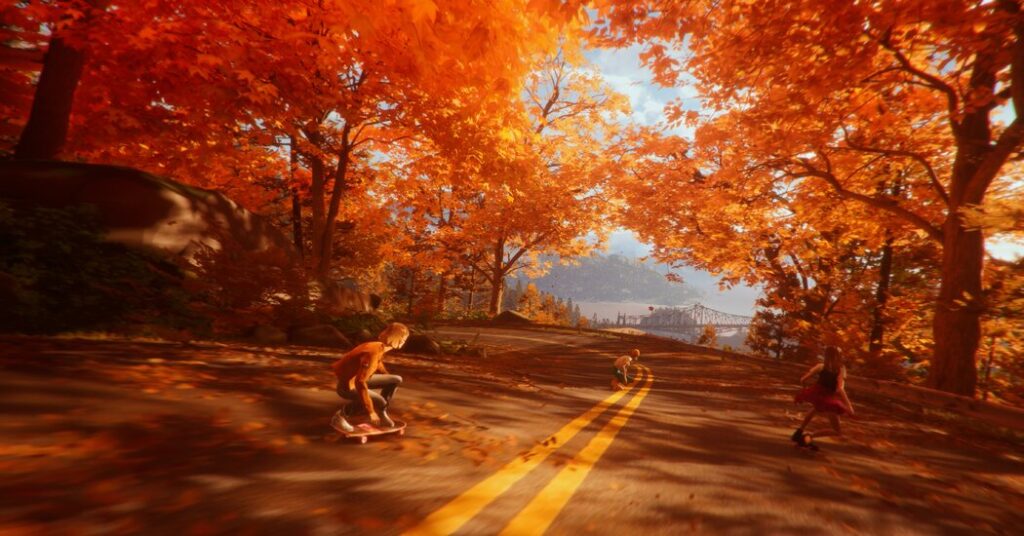
As a heartfelt remembrance of Northern California teen culture in the 1990s, Mixtape feels like a gamified jukebox musical film somewhat like “Across the Universe.”
Although the characters don’t sing, the chapters in this three-hour narrative game are anchored by an eclectic group of deep cuts and hits from the likes of Roxy Music, Siouxsie and the Banshees and the Chi-Lites.
That variety makes sense because Stacey Rockford, Mixtape’s main character, has the goal of becoming a famous music supervisor in New York. Always wearing headphones with orange earpieces and a jacket with a Brain Ded patch, she enthusiastically introduces each song with factoids, like an MTV Pop-Up video come to life.
The gameplay is light. Steer, speed up or perform a limited amount of skateboard tricks through the suburbs. Search three friends’ rooms to find old videos or place batteries into a digital camera. After breaking in to a theme park with animatronic dinosaurs, find a switch to turn on the power.
Mixtape is a smaller endeavor, but the Life Is Strange series and Lost Records: Bloom & Rage have integrated songs with smoother interactive aplomb.
Even so, there is indeed beauty as you skateboard past majestic mountains and fast-flowing waterfalls to the sound of Devo’s “That’s Good.” You can videotape a beer party in the dark woods to the tune of Iggy Pop’s “Candy.” And you can wallow in and float through your sadness with “Most of All,” by the ’70s singer-songwriter B.J. Thomas.
The Thomas ballad is the backdrop for the game’s most moving sequence. By this point, players have gotten to know Stacey, Slater and Cassandra and have witnessed emotional bonding, through both humorous cynicism and shared interests. When the song plays, Cassandra has somewhat betrayed Stacey.
Down to the point of feeling bereft, Stacey is lifted into the air, floating low and high through the town of Blue Moon Lagoon, knocking over books and approaching pig balloons, a reference to a staple of the old Pink Floyd concerts.
Here, floating isn’t just about sadness. It’s about losing control. While players can somewhat lead Stacey’s movement aloft, she is guided by the game developers (and the breeze) to a predetermined place. In that sense, she must follow where the wind blows. Stacey can feel as though she has all the answers, but she learns that life can get in her way. When Thomas sings, “I miss you, baby, most of all,” I became choked up.
The center of Mixtape’s plot, however, is unimaginative. The primary tension occurs when Cassandra’s father, a police officer, grounds her after an incident involving beer and liquor, meaning she’s unable to attend what is partially a going-away party for Stacey.
Before the grounding, Stacey remembers a salient moment with the proudly rebellious Cassandra, a natural at softball. It’s fun playing her as she swings for the upper decks. As she hits hard, fireworks spray in the night and the high school field becomes a professional stadium. It’s not Cassandra’s passion, though; her controlling father forced her to play. She gives it up, wondering if she’ll ever feel passion for a career the way Stacey does.
There’s splendor in most of Mixtape’s outdoor environments, and I liked much of the music, especially the nostalgic deep cuts. But it’s unnecessarily difficult to listen to the songs: You must move through a chapter to retrieve the music. Forced to direct the action, it’s a chore to feel the song’s essence, its groove, its hook. It would be glorious to have a stand-alone soundtrack, or for a chapter’s song to play by itself like a race replay in Mario Kart.
Mixtape was reviewed on a PlayStation 5. It is also available on the PC, Switch 2 and Xbox Series X|S.
The post Teenagers Bond With the Help of an Eclectic Soundtrack appeared first on New York Times.