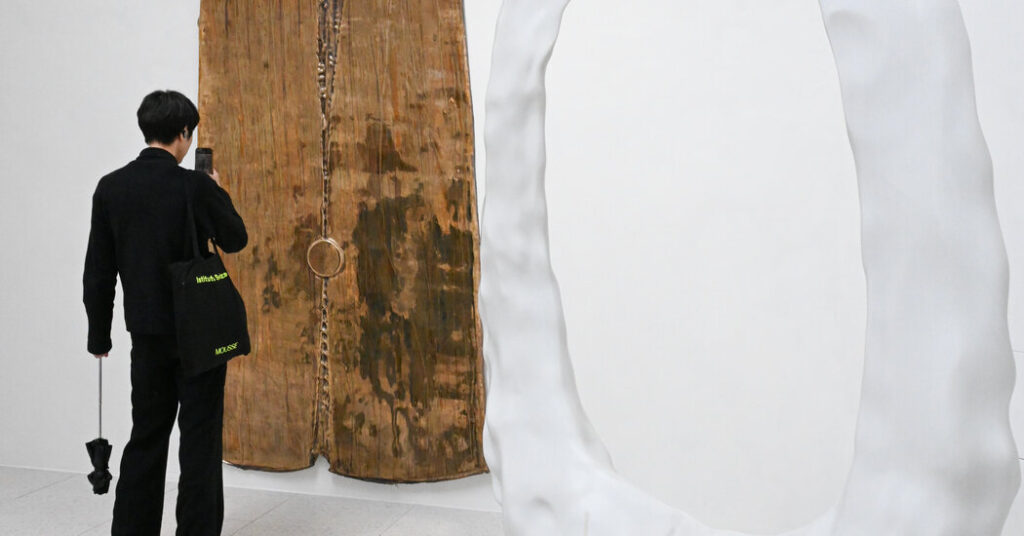
Welcome back to the Venice Biennale, the world’s oldest and grandest exhibition of contemporary art; and, this year, the bitterest, too. It rained, as usual, on the heaving opening days of this massive May-to-November show. But there have been much darker stormclouds, geopolitical rather than meteorological, hovering this week over the Giardini and its national showcases of new painting, performance and associated clownery.
Artists representing Russia, barred from the Venice Biennale for the last two editions, have returned this year — in seeming violation of European sanctions, and occasioning boycotts, protests and even government inspectors sent up from Rome. The participation of Israel, too, has brought trouble; the Biennale’s prize jury resigned in large part to protest its inclusion.
And then there is the United States pavilion, which became a gilded trap after the Trump administration revised government protocols for what sort of art should represent the nation on the world stage.
Several established artists and museums shunned the opportunity to offer, on a reduced timetable, “works of art that reflect and promote American values,” according to the new U.S. guidelines, and to comply with the administration’s anti-D.E.I. rules. The State Department named the Mar-a-Lago-going owner of a Florida pet food store as the pavilion’s commissioner. The honor (or former honor) of representing the United States eventually went to Alma Allen, a competent but hardly compelling sculptor of bronze and marble plaques and curlicues.
The 2026 U.S. Pavilion offers a twinned sensation of outrage and exhaustion. The government’s selection process has debased what was once a major stage for American art. Allen, on that stage, has declined to flatter his benefactors — but neither has he shown the rest of us that the concessions were worthwhile. The 20-odd sculptures here, ranging from a gourd of Mexican onyx to a stylized bronze of a boy clutching his legs, look fine enough for a South Beach hotel lobby. They do not offend, except in their inertness.
Visitors may experience a numbness — am I feeling anything? do I even care? — if they walk in; on the preview days of the Venice Biennale, the crowds were notably thinner around the U.S. Pavilion than in years past. They will find bronze cast into coils and loop-de-loops, and marble or travertine hewed into rings or crags. A central gallery displays a 14-foot totem of polished bronze that looks like a vanilla seed pod; the side galleries feature jagged-edged reliefs recalling tree bark, or a nipple and its areola.
Biomorphic, talismanic, Brancusi for beginners (and a century late for that), these sculptures present some modest technical facility but no great thought. They are abstract-ish, but have no real faith in abstraction. They require no greater interpretation than the vocabulary children use to describe clouds: This one could be a snail, that one a cat, this one a tank. “Call Me the Breeze,” the show is titled. Bronze may be heavy, but this is as insubstantial as air.
We’ll see what happens after opening day, when hundreds of thousands of artists and tourists will see a show in two parts. The Venice Biennale comprises a principal exhibition of more than 100 artists, which was to have been organized this year by the Cameroonian curator Koyo Kouoh. Last May, a full year before opening day, Koyou suddenly died. A team of her friends and assistants, all untested at this level, has tried to salvage the exhibition she would have made.
Alongside the main show, nearly 100 nations organize stand-alone exhibitions of their own, either in permanent pavilions in the Biennale gardens or in pop-ups around the lagoon. And it is these national presentations, rather than the main show, that have become the flash points for this week’s geopolitical disputes. (My review of the central exhibition, and my colleagues’ views on all the other pavilions and independent shows around Venice, will be published over the next days.)
The first Venice Biennale took place in 1895, and in 1907 a Belgian pavilion was constructed, followed shortly after by pavilions for other European nations; Russia has owned one since 1914, three years before the revolution. Today, new powers pull out their aesthetic weaponry (the Qataris have invested in a big way this year), and culture ministries large and small see Venice as their biggest opportunity to grab the attention of museum directors, collectors and critics.
Beginners sometimes call the Venice Biennale an Olympics of contemporary painting and sculpture. The better analogy is to a theme park — an Epcot of art, a small world mirroring all the big world’s rivalries.
This is why appeals to the freedom of art, as the leadership of the Biennale tried to make amid all this spring’s controversies, ring so hollow in the Giardini: At the Biennale, geopolitics is always in the gallery with you.
For crying out loud, this place was a fascist institution for well over a decade, after Mussolini’s government brought the Venice Biennale under national control in 1930. When Hitler landed on the Lido in 1934 to meet Mussolini for the first time, the two dictators’ first stop was the Giardini della Biennale — where the Führer admired sappy maritime paintings but took a dim view of the German pavilion. That pavilion was remodeled in bombastic Greco-Nazi style in time for the 1938 Biennale, and though its swastika has been removed it’s still standing here, as is the central pavilion, newly renovated but retaining its fascist facade.
Politics would seep into the Giardini again during the 1970s, when the Biennale staged antagonistic showcases of art from contested parts of the globe. The renowned Biennial of 1974 was explicitly titled “Freedom for Chile,” with displays across Venice by Italian and international artists in opposition to the Pinochet regime. The edition of 1977, known as the “Biennale of Dissent,” showcased unofficial art and samizdat from the Soviet Union and the Eastern bloc — infuriating the Communist Party and leading Soviet-aligned countries to refuse to participate in the Biennale for years afterward.
With the end of the Cold War came an end, too, to any real belief in national artistic schools. The Biennale, ever since, has struggled to square its nation-by-nation structure (and fascist inheritance) with the emergence of a global art discourse.
That struggle began in earnest in 1993, when the artist Hans Haacke hung a photo of Hitler and Mussolini at the entrance of the German pavilion — and then, inside, smashed the Nazi-era floor into a junkyard of marble slabs. The back wall he embellished with the huge word GERMANIA: the harmless Italian word for the country, but also the Latin name of Hitler’s dreamed mega-capital.
Haacke delivered, at once, a precise critique of nationalist cultural policy and a furious burst of vandalism. Rather than just treat the pavilion as a vitrine, Haacke made it a medium in its own right, which he needed to rework, resculpt, reconstitute in order to make anything meaningful.
This changed everything. For the Nigerian curator Okwui Enwezor (who organized the Venice Biennale in 2015), Haacke’s German pavilion of 1993 was the first to take seriously “a crisis of the idea of the national space” — in this case, a former Nazi show palace assigned to a reunified Germany for the first time — and how that crisis would require a new kind of art. No one ever called Haacke subtle, but he established a principle that has held ever since: National or cultural history had to be accounted for in a place like this.
It’d be far better for everyone if we just did away with the unhelpful 1900s inheritance of these country-by-country displays. But if we have to have them, then an artist working within nationalist walls has no other choice than to work at the nexus of form and history.
Why can’t we just enjoy things? Because the form of a work of art is always situated. It has to be meaningful both on its own terms, through scale and shape and color and line, and simultaneously meaningful within an institutional framework.
Nowhere is that double demand more urgent than in a national pavilion, and several American artists, notably Ed Ruscha and Martin Puryear, have done that with distinction when they represented the U.S. Other artists, mistaking the assignment, have fallen into point-and-click celebration and moralism; the last Biden-stamped American pavilion, at which Jeffrey Gibson displayed garish totems and punching bags with didactic slogans like “We Want To Be Free,” was just as unsuccessful as this one, for opposite reasons.
And goodness knows I’d take some real art-for-art’s-sake resistance if it were on offer here. For Allen, who lives and works in Mexico, perhaps on a better day we could try to read these innocuous sculptures in a manner familiar from Eastern European exiles of the 1970s and 1980s, who understood art’s real mission to be a quiet preservation of the human spirit.
But any putative inner exile is hard to square with the fact that a good fraction of these silly things used to sit on the median of Park Avenue in New York, sprucing up a business thoroughfare like so much 1970s “plop art.” So the apter and sadder interpretation is that these are precisely what they look like: decorative baubles, nonchalant about form and situation, offering a perfectly flattering reflection to any aesthete or authoritarian gazing at their polished surfaces.
Jason Farago, a critic at large for The Times, writes about art and culture in the U.S. and abroad.
The post An American Artist Plops His Sculptures on a World Stage appeared first on New York Times.