When the film adaptation of Lauren Weisberger’s novel “The Devil Wears Prada” opened in theaters in June 2006, I went straight from a long day at the office to see it alone because everyone I knew was busy at work. Also like everyone I knew, I was in my first adult job, and work — doing it, thinking about it, planning for the future of it — occupied most of my waking hours.
I was 22, about the same age as the movie’s heroine, Andy Sachs. We both lived and worked in New York, and we both had an exceptionally shaky grasp of high fashion, but that’s where the similarities ended, at least superficially. She aspired to be a writer at The New Yorker but was for now the junior assistant to Miranda Priestly (Meryl Streep), the nightmare editor of the glossy fashion magazine Runway; I was a business analyst at a big investment bank, fetched only my own coffee and had never once seriously considered a career in journalism.
As I witnessed Andy’s evolution from overwhelmed new hire to hyper-competent gal Friday, then newspaper job seeker with a much better haircut, I saw something to strive for. I loved it, and have watched it dozens of times in the last 20 years, but over time I’ve come to see it differently — and not just because I have changed, too.
In my own new-hire orientation a year earlier, I and a hundred other fresh-faced graduates had been exhorted by an upper-level manager: “If you want to succeed at work,” he said, straightening his tie, “make yourself the indispensable one on your desk.” Be the first to the office, the last to leave, he explained. Never turn down an assignment. Assume you will be doing all the worst work, and never say no, and for goodness’ sake — the implication was clear — if you don’t like how your boss is treating you, do not go to human resources. Suck it up and soldier on.
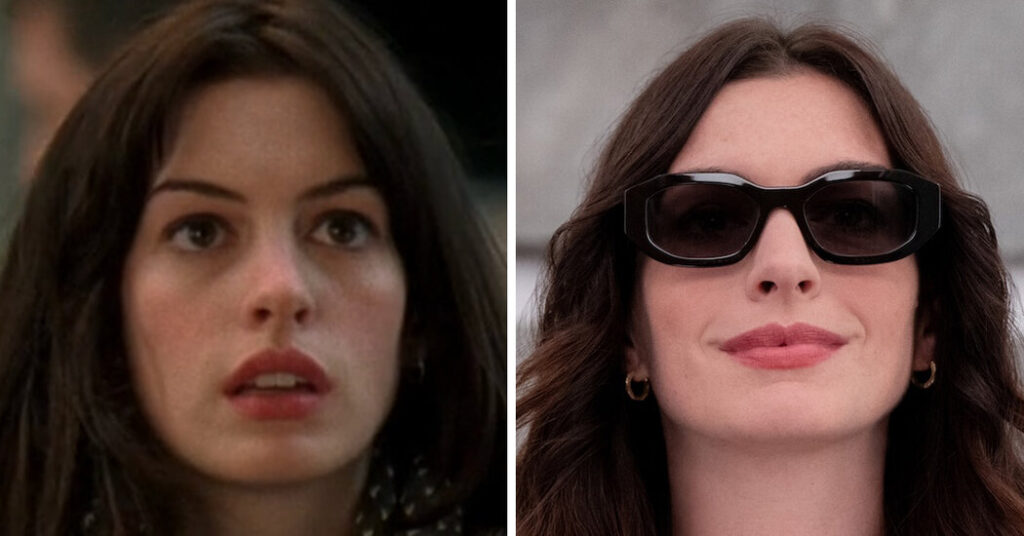
“The Devil Wears Prada” improved on the novel. It ditched Andy’s whiny inner monologue at the indignity of having to remember her boss’s lunch order and hang her coat. But the film retained all the trappings of mid-aughts female anxiety, dilated by the magazine setting. The most egregious element is its fixation on body size, the weighing of almonds, the declaration by the art director Nigel (Stanley Tucci) that “cellulite is one of the main ingredients in corn chowder.” When Andy, played by the slender Anne Hathaway, tells Nigel that she’s gone from a Size 6 to a Size 4, he toasts her with champagne, and the moment is played as aspirational, not ironic.
Never mind that her weight loss is clearly a product of work anxiety — Andy is getting good at her job, and her shrinking body is a sign. So are some other changes in her life. The most dated thing about “The Devil Wears Prada” is how seriously it takes the advice that upper-level manager gave to us new bank hires. Sheryl Sandberg’s “Lean In” was still seven years away, and the Nasty Gal founder Sophia Amoruso wouldn’t popularize the term #girlboss till a year after that. But Miranda Priestly was the prototype, a boss who was disliked because she steamrolled subordinates, and as much as Andy resented her, she also came to resemble her.
In another scene, Nigel and Andy are standing in Central Park, managing a fashion shoot. “My personal life is hanging by a thread,” Andy complains to Nigel.
“That’s what happens when you start doing well at work, darling,” he says. “Let me know when your whole life goes up in smoke. That means it’s time for a promotion.”
On the page, the lines read as rueful, but onscreen they’re a mentor’s life advice, and Andy takes them in. The cost of work, for Miranda and Nigel, is life. True, by the film’s end, Andy has watched Miranda betray a friend, realized to her horror that she is headed down the same path and decided to get away before it’s too late. But there’s no indication that it’s personal boundaries she craves. She just needs to get back to her real passion: news reporting.
Which is not exactly the kind of job you leave at the office.
It’s been funny to watch “The Devil Wears Prada” recently and realize that the lesson I thought Andy learned about healthy work-life balance is not there at all. In fact, in the new sequel “The Devil Wears Prada 2,” set 20 years after the first film, it’s clear that Andy hung onto some of her Runway lessons. She does have a healthy personal life. But she also works long hours and has made choices that others might not. Now I identify with her at the start of the sequel. We both work at newspapers, and live in the kind of Brooklyn apartments where you have to coax the bathroom sink into yielding clear water sometimes. We’re both far more confident and far better dressed than we were in 2006.
And we’ve both had to figure out that there’s some kind of third option between the all-consuming toxicity of the #girlboss era and just treating a job like a necessary evil, a thing that you have to clock in and out of so you can pay for the rest of your life. Nobody’s getting rich doing journalism — “The Devil Wears Prada 2” is, mostly, a movie about how the news media is in a death spiral — but by middle age you tend to learn what really matters to you, and sometimes, accumulating extra money isn’t it.
Miranda is still stuck in her obsession with overly thin bodies, and she still treats underlings as if they’re beneath her notice. But even she has softened a bit, with age but also with a little human resources intervention, thanks to a less obsequious Gen Z.
And when Andy returns to Runway, she knows what she’s about and what matters to her. She can see the good in what she learned from Miranda and Nigel while being kind to assistants and seeking out the kind of stories that she believes matters. It’s funny to see it, but it’s true: Somehow Andy has fulfilled one of Miranda’s old statements that once horrified her — that Andy reminds Miranda of herself. It’s just that loving your job doesn’t have to mean becoming Miranda Priestly. It can mean being Andy Sachs.
Alissa Wilkinson is a Times movie critic. She’s been writing about movies since 2005.
The post ‘The Devil Wears Prada’ Then and Now: Why It Hits Differently appeared first on New York Times.