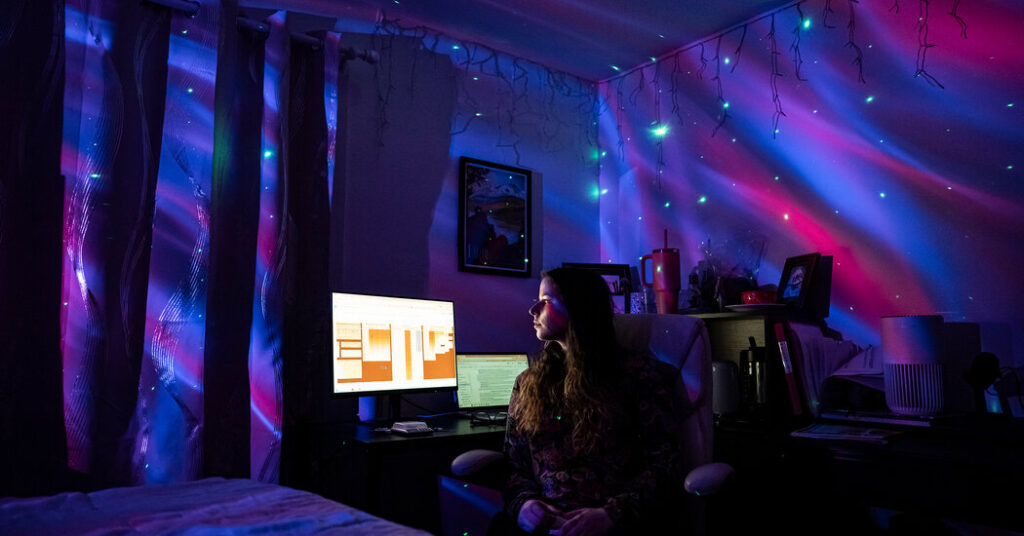
A 27-year-old woman began an experiment on herself early one morning in December 2024. Her laboratory was her childhood bedroom, tucked into a second-floor corner of a pale yellow house in the Boston suburbs. On a bookshelf behind her sat a small stuffed sloth and some favorite books, including “Siddhartha” by Hermann Hesse. Her parents were asleep in the room next door.
Her name is Rebecca, but she goes by Becks. Sitting at her desk in a gray T-shirt, she opened a small plastic bag filled with white powder. The bag was stamped “SR-17018,” and “NOT FOR HUMAN CONSUMPTION.”
She extracted some powder with a red microscooper, poured it onto a digital scale and carefully weighed out 25 milligrams. She gathered this into a blue and white pill capsule and sealed it, and then swallowed the capsule with water. It was 4:27 a.m.
“It’s my turn to be a guinea pig,” Becks wrote in the online diary she was keeping of her experience. In sharing her story with The New York Times, she asked that her last name not be used so potential employers don’t discover her drug history.
Becks had joined the vanguard of a dangerous, highly speculative do-it-yourself approach to getting sober. For a decade, on and off, she had been addicted to various drugs, most recently kratom, an opiate-like substance, which cleared her head and covered up her pain but required constant dosing. She feared the call of fentanyl, which she’d tried a few times.
“Every morning, I woke drenched in sweat from overnight withdrawals. It was a grim existence,” she wrote of her kratom use. She tried various methods to get sober, including three short inpatient detox stays and one monthlong rehabilitation treatment. She had periods of sobriety but couldn’t sustain it.
Then she heard about SR-17018, one of many new and unpredictable synthetic drugs made largely in China and sold online even though it is not approved or shown to be safe, and can pose lethal risks.
Most of these compounds, known as novel psychoactive substances, are designed to get people high. Among those substances, SR-17018 stands virtually alone in that people are using it to try to free themselves of addiction, and some claim it helps.
Excitement about SR-17018 grew after Reddit users discovered a 2019 study suggesting it could free drug-addicted mice of their dependence.
But SR-17018 hasn’t been tasted for safety and there are no studies showing that it works as a detox medication, outside modest research in animal labs. The only evidence for its value is anecdotal and based on self-experimentation.
Dr. Laura Bohn, the molecular pharmacologist who discovered the compound, said treating oneself with it is “a terrible idea.”
“I don’t want it taken by people as guinea pigs,” she said.
But like so many people who struggle with addiction, Becks, a curious chemistry hobbyist and former biology major, was desperate. In 2024, 80,000 people died from drug overdoses in the United States, more Americans than died in the Vietnam War. Writing in her diary about her experiment, Becks vowed she would not be added to the tally.
“My parents will not be among the people that bury me when I go,” she wrote in the diary. “I am going to be alive and I am going to live.”
Day 1
Dec. 8, 3:50 a.m. “I’m going to quit Kratom today. I’m nervous about it. Really hoping that it isn’t too difficult.”
4:27 a.m.: “Took 25 mg” of SR
7:47 a.m.: “Still unconformable in my own skin, and I’m starting to get a pretty bad headache.”
11:47 a.m.: “I’m really impressed!! Normally by now, which is 12 hours after my last Kratom dose, I would be super tense, hot and cold, covered in goose bumps, and super irritable. I also just want to mention that (at least for me) this stuff has zero recreational value. I don’t feel high at all, and I have zero desire to take more. This is wild.”
She took more SR throughout the day. Her experience shifted.
8:15 p.m.: “My head hurts so bad.
“But I can’t cave. This is the longest I’ve gone without Kratom in more than a year.”
Diary of a guinea pig
Becks grew up in New England, introverted and a reader. Her mother, a gifted pianist, played classical songs on a Steinway grand in the front room. Her father, now retired, was a manager at a design and engineering firm.
Becks’s experience with potent drugs began her senior year in high school, after she had surgery on a broken foot. Her doctors gave her two opioids, Dilaudid and Opana. “I was taking opioids every four hours,” she wrote in her chronicle.
“I learned that opioids could make the bad feelings disappear and that life felt unbearably painful without them,” she wrote. “A year later, I discovered kratom.”
Kratom, derived from a plant that acts on the brain’s opioid receptors, is legal over the counter in most states and under federal law, though the Federal Drug Administration has warned of its addictive properties. By the time Becks was 20, her daily consumption of 50 grams mixed into water — a standard dose is a few grams — left her powerless: Too little and she withdrew, too much and she vomited.
That spring, despite her use of kratom, and experimentation with acid, MDMA, Adderall and cocaine, she graduated from Skidmore College with a degree in integrative biology.
After college, the drug journey intensified. “Dilaudid, Opanas, kratom, MDMA, coke, benzos, amphetamines, meth, GHB … you name it,” she wrote of the things she used.
In her diary, she chronicled periods of sobriety. Six months before she began experimenting with SR-17018, she checked herself into an inpatient psychiatric ward in Boston for depression and suicidal ideation. She went through detox and, to ease the pain of withdrawal, was given several days of supportive medications, including Suboxone, which people may take for months, years or indefinitely to curb opioid cravings. The drug has been credited with revolutionizing recovery because it does not require a person to endure the agony of getting off drugs.
But getting and staying sober has gotten harder in an era of ultrapowerful lab-made drugs, which drive more intense and frequent cravings. Suboxone can be effective in some cases, but does not address some of the new drugs at all.
This is why it’s not surprising that users are searching for other answers, said William Cope Moyers, vice president of public affairs at the Hazelden Betty Ford Foundation in Minnesota, where he’s worked since 1996 and went to treatment in 1989.
Mr. Moyers, who has used Suboxone, swears by the drug but also said more tools are needed. There are only a handful of medications used to curb cravings for alcohol and drugs, partly because pharmaceutical companies don’t see it as a lucrative market.
“The science has not kept pace,” said Mr. Moyers. “The medications have not kept pace.”
Relapse
On Day 2 of her experiment, Becks wrote that “after a restless nap filled with vivid dreams, I experienced a strange combination of physical sensations: a stinging, hypersensitive sensation like road rash all over my body, phantom muscle cramps, and the feeling of being covered in tender bruises.”
On Day 3, she woke up to a surprise — she felt no symptoms of withdrawal. Later, however, she described malaise, and then overwhelming pain.
Day 4: goose bumps, headache, boredom, hot and sweaty, but “mental clarity.”
Day 5: “Intrusive thoughts about my parents’ eventual passing triggered uncontrollable sobbing.”
In the days that followed, Becks had enough hopeful moments that she felt she could lower her dosage of SR-17018 and then taper off entirely. On the ninth night, she skipped a dose. The next day, her blood pressure spiked, and she felt intensely anxious.
“I was pretty convinced I was dying, and ended up having a breakdown over the potential costs of going to the hospital without medical insurance,” she wrote.
Later that day, she relapsed with kratom, “to manage the intense discomfort.” The experiment was over.
Still, she felt that it had been valuable. On Dec. 19, at 4:22 p.m., she sent an email to Dr. Bohn, the researcher who had invented SR-17018. Becks had read her paper and knew about her from a friend in her Reddit community.
“Hello! I just wanted to reach out to thank you for contributing to the discovery of SR-17018,” she wrote in her email. “If you’d like to learn more about how people have been using it, I’ve compiled all of the reports about human use of SR-17018.”
It was not the first such letter Dr. Bohn had received. Her compound had a following.
Promising results — and warnings
Scientists have long sought to develop a drug that dampens pain without causing dependence and suppressing breathing to a dangerous degree — two major side effects of most opioids. But teasing apart these properties has proved elusive.
In 2009, Dr. Bohn, now a vice dean of research at the University of South Florida, began working at Scripps Research Institute in Jupiter, Fla. There, she inherited a precursor to SR-17018 that had been created by a chemist — a lucky find that she likens to “dumpster diving, but behind a high-end boutique.”
She and the chemist refined the initial molecule and began testing it in mice. In research published in 2019, they demonstrated that mice given SR-17018 showed little to no respiratory suppression.
And when they gave the drug to morphine-dependent mice, it eliminated their withdrawal symptoms and restored the pain-relieving effects of the morphine. This suggested that the mice were returning to their base line tolerance, as if their brains were reset to the time before they became dependent.
“I immediately understood its potential,” said Massimo, 41, in an interview over email with The New York Times. Massimo, who lives in Italy, declined to give his last name because of the stigma associated with his two-decade-long drug habit. He wrote he had tried everything to get sober — going cold turkey, hospital detox, methadone, Suboxone.
“The withdrawal was unbearable,” he wrote. “The cravings were louder than reason.”
In October 2024, through online communities, Massimo found a source of SR-17018: Chinese labs that scour science papers for new discoveries, creating what is loosely known as the “science-to-street” pipeline for novel drugs.
Massimo ordered SR-17018 and took it for two weeks to taper from Isotonitazepyne, an ultrapotent synthetic opioid. He said he got off drugs at the end of 2024 without much struggle and wrote to Dr. Bohn to thank her. Others on Reddit described similar results.
But amid the praise were multiple warnings from people who’d had bad experiences. One person wrote of getting a batch of SR-17018 that had an odd taste. “My neck and my hands started twitching and getting stuck in a crooked position, all night,” the person wrote. “The next day, I went to the hospital.”
Experts in addiction were left with many questions: Was there a placebo effect with SR-17018 that helped a person weather the initial pain but then gave way to further addiction? Did it expose underlying mental health issues? Could a person get briefly sober, see their opioid tolerance drop, and then use again and overdose?
In November of last year, the National Early Drug Warning System, an organization that tracks novel drug activity, warned of the emergence of SR-17018 and its health risks, including the risk of death.
“A critical safety concern raised across multiple discussions is the risk of fatal overdose if individuals return to opioid use after their tolerance has been reduced by SR-17018,” said the organization, which is led by researchers at the University of Florida, New York University and Florida Atlantic University.
“The maintenance of abstinence is the challenge,” said Dr. David Frenz, an addiction specialist in Minneapolis. “The stakes are really high. It’s like, do you want to potentially relapse, overdose and die?”
‘Unspeakable loneliness’
Becks began using SR-17018 again on Dec. 20, the day after she emailed Dr. Bohn. She called it her “redemption arc.” Once again, she was adapting ideas she had read online.
“I had a really good day today,” she wrote on the first day. “I took a shower, I cried a bit to some sad songs, I did some work stuff, and I felt … normal.”
In the ensuing days, she experienced chills, runny nose, intense irritability, diarrhea, anger, sleeplessness — and some good moments. On Christmas, her parents asked her to go to a party. “I’m going to have to mask so hard the whole time,” she wrote. She took an extra dose, got through the event and felt good about it.
On Dec. 27, at 9:07 a.m., she wrote: “Feeling: restless and distressed. I HATE OPIOID WITHDRAWAL I HATE IT I FEEL SO SICK AND UNCOMFORTABLE AAAAAAAAAAA.”
Free-fall ensued. She took kratom and other drugs, and on Jan. 8 received an Express Mail order of cocaine and meth. On Jan. 31 she started using heroin. She fluctuated between periods of intoxication and sobriety, suffering from what she described as “unspeakable loneliness.”
She posted extensive notes about her experience on Reddit and gained a measure of authority there. People regularly asked for her help with using SR. She felt she was recovering.
In June, she went on a bender with a friend from Florida, shooting fentanyl and cocaine. By late that month, she developed a new sobriety plan: She switched from fentanyl to a less potent opioid. She planned to try again with SR when that was gone.
Soon, though, she felt that she understood the drug’s limitations: It appeared to ease the cravings but wasn’t a panacea.
“SR provides this amazing opportunity for you to detox, but that’s all it is,” she said in an interview at the time. “If you don’t have plans in place for when things go wrong, it’s not going to keep you clean.”
A few days later, she started taking SR-17018 again. This time, she made an appointment to be admitted to inpatient drug rehabilitation. On July 8, as she rode away from home in an Uber, she texted her parents:
Mom and Dad,
I’m writing to let you know that I’ve gone to get help. The camping trip was not the truth, and I am truly sorry for having to mislead you. The truth is that I have been struggling for a very long time.
I need to do this for myself so l can have a future.
Love,
Rebecca
Progress toward sobriety
In the months after she finished rehab, Becks ordered heroin online but decided not to use it, fell in love with someone who lives in the Netherlands and spent time in Europe, used kratom less than five times and took some ketamine and hallucinogens.
She attributed her relative sobriety to newfound intimacy, a change of environment, a change in diet since discovering that she was gluten intolerant and “definitely a lot of luck.”
Did SR-17018 play a role? She thinks so.
Dr. Bohn hopes to find out. While she continues to discourage self-experimentation, she is applying for funding to ratchet up her study of SR-17018 and related drug molecules as potential withdrawal medications.
“I’m wondering if we can extract usable information from what Becks has compiled and additional conversations on Reddit,” Dr. Bohn said. “It needs to be carefully and expertly considered, but I think there is valuable information there.”
Becks, now 28, has been doing her own discovery. Lately, she’s been confronting difficult emotional and family experiences that she feels are related to her drug use. In March, she wrote in her diary that she loved herself for the first time in her life and that “there wasn’t any resistance of discomfort.”
“I’m seeing the child inside myself who was scared and sad,” she said in an interview. “Not this monster who needs to punish herself.”
Matt Richtel is a health and science reporter for The Times, based in Boulder, Colo.
The post Her Self-Experiment with Drug Detox Almost Broke Her appeared first on New York Times.