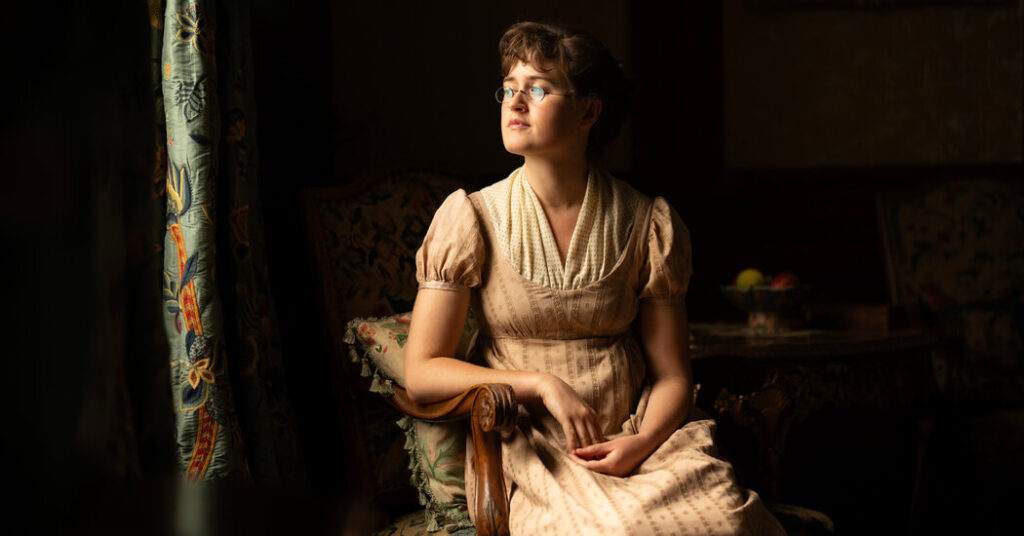
As she was playing the lead role in “The Other Bennet Sister” — which tells the story of “Pride and Prejudice” from the perspective of Mary, the overlooked middle sister — Ella Bruccoleri didn’t think much about the idea of portraying a “plain” character who “is known for being less attractive than her sisters,” the actress said in a recent interview.
So she has been surprised by the strength of viewers’ responses in the two months since the BBC aired the show, the most-watched new drama of the past year in Britain. It shouldn’t be rare to see “a normal-looking person” onscreen, she said, but “a lot of people, I think, feel very validated by seeing someone that isn’t a supermodel” leading a TV show.
In this and other ways, Mary is an unusual protagonist. She is not the wittiest Bennet sister (that would be Elizabeth), the prettiest (Jane) or the most audacious (Lydia). In Jane Austen’s original 1813 novel, Mary, the third of the sisters, might be the most sanctimonious. Her most memorable moment is when her father asks her to stop playing the piano badly at the Netherfield ball (with the withering comment “You have delighted us long enough”).
“The Other Bennet Sister,” which starts streaming on BritBox in the United States on Wednesday, is based on Janice Hadlow’s 2020 novel of the same name. It revisits Austen’s most popular story of love and social mores in early 19th-century England from the perspective of a young woman trying, and often failing, to live up to the expectations that society places on her gender.
In this, Bruccoleri said, the show’s themes resonate with her, and with many viewers. For women in that time, known as the Regency period, “it was seen as desirable to be socially animated and charming and witty,” the actress said, “and those are all the things that, if you have those skills today, you will excel still beyond people who find those things really difficult.”
Mary certainly finds those demands difficult. Bruccoleri plays the character as endearingly open and eager to please, even as she struggles to pick up on social cues and watches her sisters sparkle more brightly around her.
As those four sisters each marry and their mother becomes increasingly frustrated with Mary’s lack of prospects, Mary decides to carve out an identity away from matters of the heart.
“It was time to find my own way, to look for a new version of myself as a serious-minded woman,” her voice-over announces at the end of the first episode. “The old Mary would be no more. I would transform into the intellectual one.” (One of her favorite books, for example, details different types of rock.)
Through Mary’s eyes, many well-worn “Pride and Prejudice” characters are redrawn: Mr. Collins (Ryan Sampson) is less a cringeworthy creep and more a fellow lost soul, struggling to navigate social conventions. And Mrs. Bennet (Ruth Jones) is not silly and meddling — instead, Mary has “been emotionally harmed by this woman,” Bruccoleri said.
Jones, who is best known for co-writing and starring in the British sitcom “Gavin and Stacey,” described the show’s Mrs. Bennet as “such a fantastic monster, and really funny.” On set, Jones would apologize to Bruccoleri after they filmed especially brutal scenes between Mary and Mrs. Bennet, Jones said in a recent phone interview.
In needing to secure financial stability for herself and her daughters, Mrs. Bennet is “like an 18th-century estate agent who’s got five properties to sell,” Jones said, and one of them won’t budge “however much she tries to lower the price.”
“I don’t think you can forgive her for how she treats Mary,” she added, “but you can understand where she’s coming from.”
Mrs. Bennet has almost as difficult a relationship with her husband, here played by Richard E. Grant. Jones and Grant are good friends, and “our fractious fictitious marriage is the exact opposite of how close we are,” Grant said by email. In Mary’s story, Mr. Bennet is “essentially a benign bystander,” Grant said, without the warmth he shares with Elizabeth in “Pride and Prejudice.”
According to Sarah Quintrell, the show’s writer, “this well-known family is a kind of Trojan horse for a lot of things about growing up,” including how siblings can have such different experiences of the same parents.
When she was adapting Hadlow’s novel, Quintrell said, she was guided by the question “How can I make an audience feel how I felt reading this book?” But the novel, which runs to nearly 700 pages, is also “quite dark,” Quintrell said in a recent video interview, and “we wanted to bring something joyful to the screen” that also captured the “humor in that kind of growing-pains story.”
In recent years, a wave of period shows have taken intentionally offbeat, ahistoric approaches to the genre, including “Bridgerton” on Netflix, “The Great” on Hulu and “Dickinson” on Apple TV. But “The Other Bennet Sister” plays it straight.
“There’s no high concept, there’s no twists,” Quintrell said, “there’s nothing to hide behind.” Instead, she added, “you’ve really got to invest in the characters. And actually, I think that makes it quite different from a lot of other television.” (Period drama purists will also be pleased to hear that these characters haven’t prematurely discovered cosmetic filler or veneers.)
By the end of the second episode, the show has advanced beyond the plot of “Pride and Prejudice.” Mary moves to London to stay with relatives who are much kinder to her. And despite the best efforts of one Caroline Bingley (Tanya Reynolds), she finds friends and at least one suitor, complicating her plan to remain an unfeeling intellectual.
Before being cast as Mary, Bruccoleri spent a decade playing “funny, supporting parts” in series like “Bridgerton” and “Call the Midwife.” “I never saw myself as playing the lead,” she said.
But “I learned a lesson through playing Mary,” Bruccoleri said, which echoes what her character discovers: “The more I can embrace my authenticity, rather than trying to fit myself into a box that other female actors inhabit,” then “the better off I will be.”
The post Celebrating Jane Austen’s Awkward, Lovable Middle Sister appeared first on New York Times.