Five
by Ilona Bannister
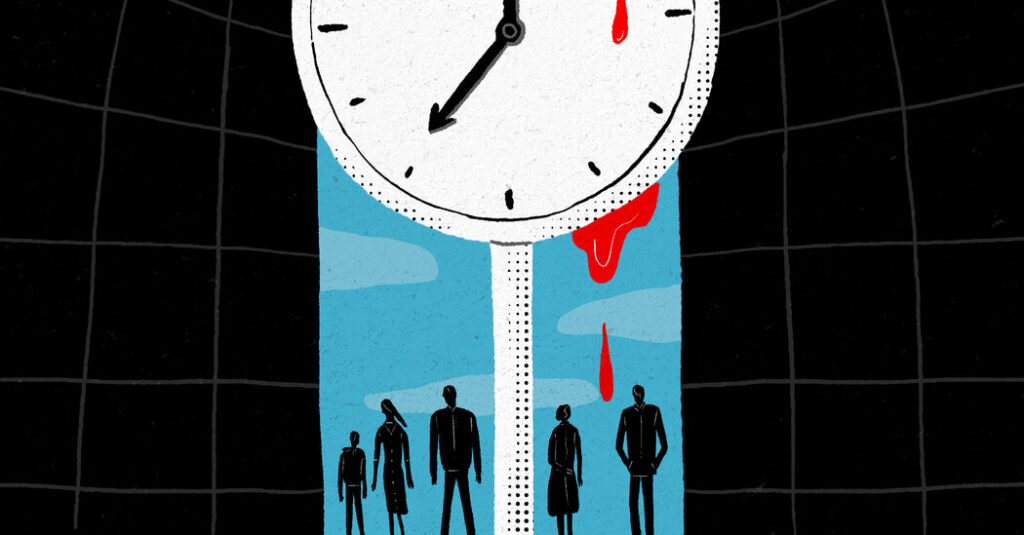
It is 7:01 a.m., and a handful of people — five, in fact — are waiting at a suburban train station for the 7:06 to London. By the time it arrives, Bannister reveals in the opening line of FIVE (Crown, 223 pp., $28), one of them will be dead.
Who will it be? The harried mother? Her devilish, possibly psychopathic child? The vibrant, debt-ridden young man? The self-regarding businessman? The prickly older woman?
“Consider these five in relation to one another. Consider them in relation to themselves,” Bannister writes, addressing the reader directly. “But please don’t hang about. We don’t have much time.”
Time, however, is elastic in this book, which jumps back and forth between the present — slowed down into a choreographed series of split-second developments in real time — and the past, delving into the characters’ troubled histories.
The story is presented as a kind of morality tale, a Rorschach test for all of us.
“There is probably one that you’re OK with getting rid of,” she writes of the potential victims, their characters and histories coolly laid out for our consideration, like lab rats in a cage. “Of course there is.”
How to Survive in the Woods
by Kat Rosenfield
“Hiking the Appalachian Trail,” a naughty political euphemism for “visiting your mistress in Argentina,” takes on a darker meaning in Rosenfeld’s slyly terrifying HOW TO SURVIVE IN THE WOODS (Harper, 306 pp., $30). Three people — Emma Sharp, the founder of a nutrition start-up; Logan Grant, her monstrous husband; and a woman named Taylor, who in a bizarre turn of events is both Logan’s former girlfriend and Emma’s current secret lover — embark on a trip to a remote section of the Appalachian Trail in Maine. Their various goals: a little hiking, a little sightseeing, a little murder.
It’s a tale told in two parts. The first is an account of Emma’s marriage to the abusive Logan, whom she meets after a professional disaster has led her to attempt suicide. But his promise to look after her forever morphs over time into psychological and physical terror; he’s so controlling that Emma can barely remember who she was before she met him. “It does not occur to her,” Rosenfeld writes, “that the type of man who forbids you to die will also have ideas, many of them, about how you are allowed to live.”
Emma finds common cause, and more, with the assertive Taylor, who still appears to be traumatized from her own relationship with Logan. (Their cover story is that Taylor was planning to bring a boyfriend who dropped out at the last minute.) But that’s the least of the twists in a plot full of surprises. All these people have secrets, it turns out. Emma, in particular, is hiding how much she learned from her father, a doomsday prepper who taught her how to be the last person standing in a field of bodies.
A Deadly Episode
by Anthony Horowitz
The first book in Horowitz’s “Hawthorne & Horowitz” series — police procedurals in which a dimwitted fictional version of the author attempts to solve crimes alongside a much more clever detective — was “The Word Is Murder.” The sixth, a meta-romp called A DEADLY EPISODE (Harper, 384 pp., $32), finds the pair in Hastings, England, where that earlier novel is being turned into a movie.
“Horowitz,” the character, is none too pleased by how it’s going. The actor playing him is a washed-up alcoholic. The director’s only previous credit is an art film about an 18th-century female lighthouse keeper. The screenwriter is a radical eco-warrior who hates crime novels, and by extension Horowitz. “There’s so much death in the world, do we really want to celebrate it?” she asks. Her screenplay appears to be nothing like his book.
“This is a film about humanity,” she declares. “Murder is inhumane, but the detective and his assistant are defined by it. It’s like, you know, Nietzsche.”
Alas, they’ve barely started filming when the actor playing Hawthorne, the self-regarding David Caine, is found in his trailer, stabbed to death. (“I suppose it might have been a mercy killing,” Hawthorne remarks. “If the killer had read the script.”) Suspects abound. But who was the intended victim: the fake Hawthorne, or the real one?
This book allows Horowitz, or “Horowitz,” to go on a mission to learn more about the origins of his elusive partner. As always, most of his surmises turn out to be wrong, but we are treated to a pleasing tale-within-a-tale about an old case of Hawthorne’s that reveals him, once more, to have Holmesian levels of brilliance.
As always in this sprightly series, the best parts come at the expense of the author. In real life, Horowitz is a prolific novelist and screenwriter whose television credits include a pair of cozy crime series, “Midsomer Murders” and “Foyle’s War,” which he also created.
“I absolutely love your work,” the film’s producer tells the fictional Horowitz. “My father’s been watching all of ‘Foyle’s War.’”
Sarah Lyall is a writer at large for The Times, writing news, features and analysis across a wide range of sections.
The post Sizzling Summer Thrillers appeared first on New York Times.