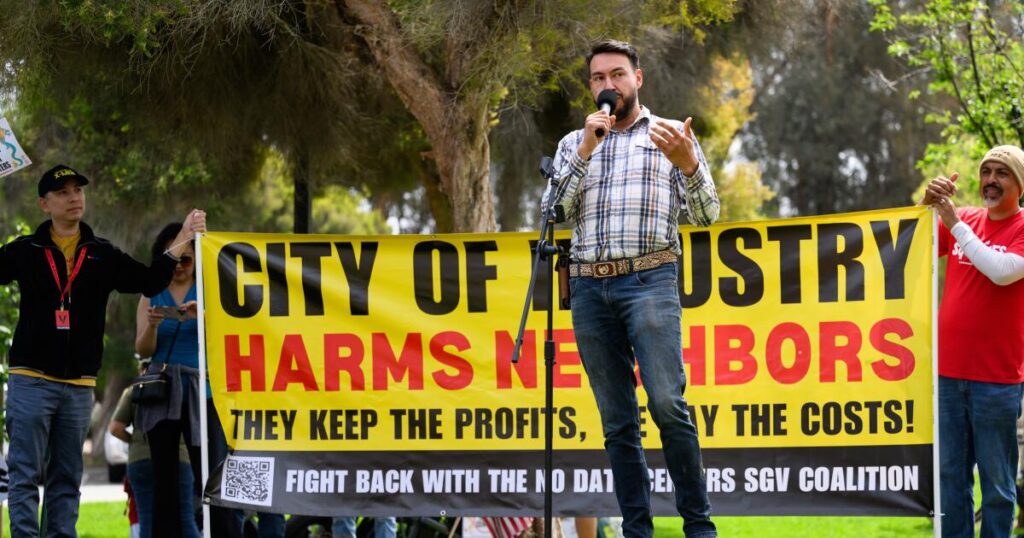
On Saturday morning, hundreds of San Gabriel Valley residents gathered on a warm yet gloomy day in Rowland Heights to protest the creation of battery energy storage systems and data centers in the City of Industry.
In February, the City of Industry City Council voted unanimously to change zoning laws to allow for the construction of a battery storage site just northwest of where Azusa Avenue meets the 60 Freeway.
Although it only houses around 200 residents, the City of Industry is home to roughly 3,000 businesses, including many factories; with its unusual two-mile-wide, 14-mile-long strip, it neighbors about a dozen different communities.
Protesters at Saturday’s rally expressed concerns regarding the impacts on air quality and potential health hazards that may arise with the building of battery storage structures.
A particular area of fear for attendees was the future of the mostly vacant Puente Hills Mall — which stood in as “Twin Pines Mall” in the 1985 sci-fi movie “Back to the Future.” With the City Council’s latest move, residents are alarmed that there is now an avenue for converting the dying mall into a data center.
And just like in the Hollywood flick, community members were concerned with the gigawatts required to power the project — fearing that a new data center would bring higher utility costs to residents of surrounding municipalities.
Participants largely hailed from the mostly unincorporated communities neighboring City of Industry, such as Rowland Heights, Avocado Heights, Hacienda Heights, La Puente and South San Jose Hills.
The event was put on by the No Data Centers SGV coalition, which comprises members and leaders of several community activist groups including San Gabriel Valley Progressive Action, Avocado Heights Vaquer@s, Puente Hills Community Preservation Society, SGVoices, Party for Socialism and Liberation and No Data Center Monterey Park.
Attendees waved signs in English, Spanish and Chinese, representing the diversity of the San Gabriel Valley community, which is predominantly Asian American and Latino.
“This is probably the first time we’re getting all these communities to unite, come together in solidarity and to work together to bring resources together to tell the City of Industry that if you don’t listen to us, we’re going to bring our voices to you,” Andrew Yip of SGV Progressive Action told the crowd.
“This is a city that is a parasite. They suck and extract resources from surrounding communities, and they don’t give us a single dime when they build warehouses, when they build industrial complexes,” he added.
Data centers have existed for decades, but their prevalence is rapidly increasing due to the worldwide boom in artificial intelligence, as seen through the rising power of companies like OpenAI and Anthropic.
Cornell University researchers last year estimated that AI growth could add 24 million to 44 million metric tons of carbon dioxide to the atmosphere annually by 2030 — the equivalent of adding 5 million to 10 million vehicles to U.S. highways. Additionally, the cooling mechanisms needed to maintain AI technologies could drain 731 million to 1,125 million cubic meters of water annually — which is about equal to the combined water usage of 6 million to 10 million households.
Stephanie Sanchez, a 63-year-old resident of Hacienda Heights, said she attended Saturday’s rally to protest the pollution that could potentially come from the construction of these structures, a topic she’s all too familiar with.
“I grew up in Boyle Heights, East L.A. That’s where I first came to learn about these polluters because I grew up in with Exide,” Sanchez told The Times. “My family was exposed to cancer and I lost my grandmother, my uncle, my mother. I had cancer. So it’s there and I think people need to be aware.”
The former Exide Technologies battery recycling plant in Vernon melted down pallets of lead acid car batteries in blast furnaces for nearly a century, blanketing up to 10,000 nearby properties with toxic dust and poisoning the soil — including homes in the heavily Latino neighborhoods of Boyle Heights and East L.A.
Exide accepted responsibility for the contamination, closed the plant in 2015 and pledged to pay for cleanup efforts. However, a 2026 study found that lead levels in the soil remain high within the clean-up zone.
Sanchez also remarked on how it is often communities of color that take on the bulk of the environmental ramifications of such storage centers.
These centers are often located in “sacrifice zones” — neighborhoods or stretches of land that have been environmentally despoiled in the name of corporate profits. In California alone, data centers have been built in the largely Black and Latino “sacrifice zones” of Hawthorne, the Del Paso Heights neighborhood of Sacramento and the Bayview-Hunters Point neighborhood of San Francisco, a 2025 study found.
“Why can’t they put these data centers and battery companies in Burbank or Temecula? Why not in those areas?” she said. “No, they always focus on people of color that don’t make a lot of money, that don’t speak up because they don’t know they can, who have no advocates. So this is why we need to speak for everyone and have everybody out there and educate the people.”
Samuel Brown, a community organizer and a lifelong resident of the San Gabriel Valley, rode his horse to the rally. He is the founder of the Avocado Heights Vaquer@s, a coalition of horse riders, residents, educators and allies that is in favor of more green spaces and against development that can contribute to the displacement of working-class families living in the rural communities.
“What we’re seeing is that City of Industry is now compounding the existing inequities and disparities in health and in environmental justice by pursuing the data centers,” Brown told The Times. “Very clearly the communities mobilized and raised objections to it and rather than sit down in a very transparent way, they’re doubling down, and moving forward full steam.”
Brown noted that what the City of Industry is doing by potentially creating more environmental pollutants is not unique to the region. Members of the San Gabriel Valley region have experienced respiratory issues for years as a result of manufacturing plants and cancer clusters have been identified in the area.
He pointed out that the diversity of the rally’s crowd highlighted the health and environmental inequities that face nonwhite communities.
“It speaks volumes about which communities are the communities that are dealing with this lack of governance issues,” he said. “We have low political capital because a lot of us live in unincorporated [areas] and it’s not an accident that our communities are also large immigrant communities and communities that don’t primarily speak English as a primary language.”
A representative for the City of Industry told The Times that the city “does not have a comment on the rally and the claims made there.”
The rally came weeks after a few key wins for anti-data center activists in the San Gabriel Valley.
In Monterey Park, the local activist groups No Data Center Monterey Park and San Gabriel Valley Progressive Action dissuaded the city from constructing a 247,480-square-foot data center within the municipality.
Advocates successfully pushed the City Council to take up an ordinance to place a permanent ban on data centers, the first of its kind in California. The City Council also voted to place a measure on the June 2 ballot that would permanently prohibit data centers within Monterey Park to ensure the ban could only be overturned by another ballot measure.
In late April, the city councils of El Monte and Baldwin Park independently voted to implement a year-long ban on any data center building proposals within their city limits.
The San Gabriel Valley isn’t the only community in Southern California taking on data centers and battery storage locations.
Saturday’s event came less than a week after citizens of Coachella — where over 95% of residents identify as Latino — staged a demonstration against the city’s proposal to build a 240-acre technology campus, which would include the construction of a data center.
Earlier this year, The Times reported on citizens of Imperial County — which lies near the U.S.-Mexico border and is over 80% Latino — who have taken steps toward trying to quell the expansion of data centers in their area as a way to mitigate any of the environmental and health hazards associated with their construction.
Elsewhere in the country, residents of the predominantly Latino town of Sunland Park, N.M., have fought to preserve access to clean water as the city has mulled over plans to create a new data center. In Memphis, Tenn., the NAACP has sued Elon Musk’s xAI for operating two data centers in the largely Black-populated area of Southwest Memphis, which has exacerbated the environmental issues in that region.
The post New coalition decries ‘parasite’ data centers proposed in City of Industry appeared first on Los Angeles Times.