Ukraine is intensifying drone strikes on Russian oil facilities, hitting a key Black Sea refinery four times in two weeks and setting off a days-long carcinogenic blaze that environmentalists say represents one of the country’s worst ecological disasters since the fall of the Soviet Union.
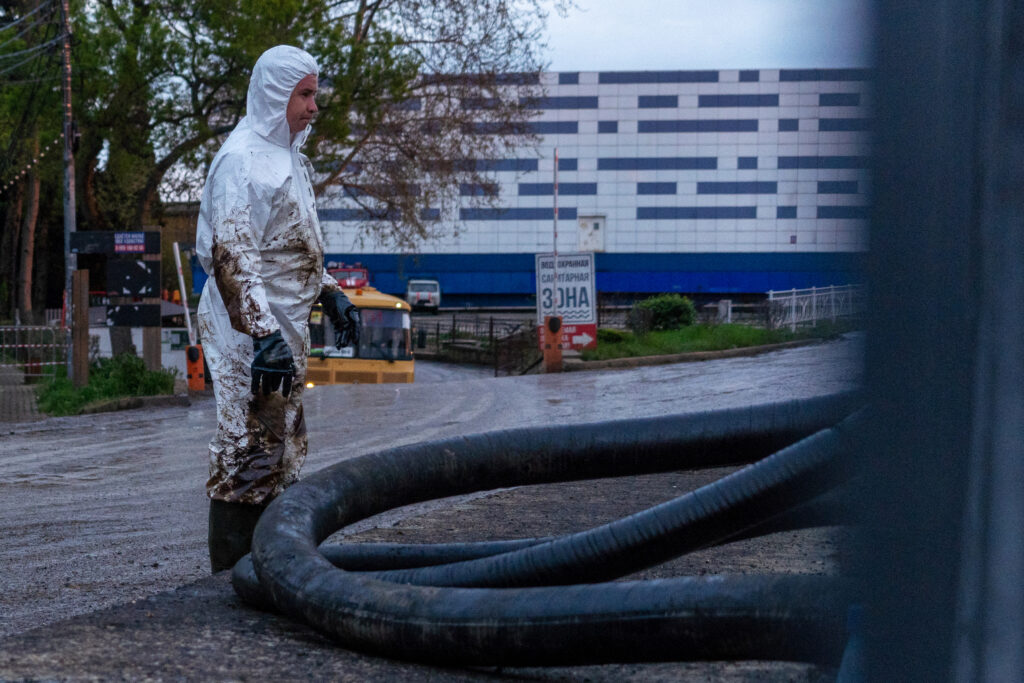
A plume of black acrid smoke once again rose over Russia’s Black Sea city of Tuapse on Friday after Ukraine struck the refinery and oil terminal there overnight, the fourth in a spate of attacks that have also caused oily droplets of “black rain” to fall on residents and contaminated more than 30 miles of coastline as an oil slick spread.
Firefighters have battled for days to extinguish major fires at the refinery and storage facilities since the first strike, on April 16, only to see the fires reignited by repeated drone attacks.
The Ukrainian strikes, which also damaged and caused fires last week at a refinery and oil-pumping station in Perm near the Urals, demonstrate Ukraine’s increasing reach — thousands of kilometers into Russian territory — and growing ability to evade Russian air defenses.
The strikes cast a further shadow — in this case, actual black, throat-burning clouds — over Russian President Vladimir Putin, at a time when he is already facing growing discontent over his failure to end the war in Ukraine, the worsening Russian economy and clumsy attempts to impose restrictions on access to the internet. A Ukrainian drone reached even farther into the capital Monday, hitting a high-rise residential building in Moscow about 3½ miles from the Kremlin.
Tuapse residents have railed against the government’s efforts to play down the impact of the strikes, which have received scant coverage in Russian federal media. They have complained of an inadequate response by the authorities, a growing sense of abandonment and exhaustion, as well as fear that the scale of the disaster is being covered up, including through the state’s increasing restrictions on internet access.
Putin acknowledged the strikes for the first time last week following a third attack by Ukrainian drones, which set off a fire that raged for a further two days, but he said that “there don’t seem to be any serious threats; people on the ground are coping with the challenges they face.”
Putin’s comments came after he spoke with the regional Krasnodar governor, Veniamin Kondratyev. On Wednesday, Anna Popova, the head of Russia’s consumer watchdog agency, Rospotrebnadzor, said that there were “no health risks” for residents despite the ongoing fire.
“It’s simply unbearable to listen to this anymore. The same routine statements again — but where is any real involvement?” one Tuapse resident, Alina Orlova, asked in a post on social media about Putin’s comments. “Why won’t he come here himself, look people in the eye, support them personally? He keeps talking about unity, but in reality it’s all just words. We’re living in smoke, with fear and anxiety for the health and future of our children.”
Analysts said Putin’s diminishing of the impact of Ukraine’s strikes was typical of a system in which officials increasingly cocoon the president from bad news, fearing to tell him the truth, and in which it has become impossible for the president to acknowledge the damage being caused to his country by his invasion of Ukraine, which is now in its fifth year.
Putin “has a very distorted view of what’s going on. He said everything is fine in Tuapse. But it is an absolute catastrophe,” said Andrei Kolesnikov, a Moscow-based political analyst. “He has completely lost an adequate understanding of events. … If this is how you view reality, it is not possible to build a policy that can deal with crises.”
Others said Putin will never accept responsibility for the terrible costs of the war.
“Basically we are in a situation when a person who is responsible for starting a war with Ukraine and all the chaos, with hundreds of thousands of dead — I don’t think he will ever say or accept there are big problems because of this,” said Vladimir Slivyak, the head of Russian environmental protection group Ecodefense. “It doesn’t matter how obvious it is. He will not say this.”
Local authorities have closed schools, canceled events related to annual public holidays in May, and called on residents to stop drinking tap water and to stay indoors with windows closed. Environmentalists said the local government should have ordered a full evacuation of Tuapse to protect citizens from the toxic effects of the raging fires, which they say are releasing carcinogenic compounds into the air including benzene, which can cause leukemia.
Instead, following the third attack, officials ordered only residents living on several streets closest to the refinery to evacuate to a nearby school for fear the fires could spread to their homes.
“The Russian authorities were obliged to start an evacuation of the whole city right at the moment when they realized it was a big fire and they are not going to be able to stop it anytime soon,” Slivyak said. “These black rains are happening because there is extremely high air pollution. It is extreme contamination of the air, and it is extremely dangerous for health. There are polluting particles in the air that can cause cancer.” The pollution can cause immediate harm to the elderly, the young and those already suffering from heart or lung disease, he said.
On social media, some residents are alleging a coverup.
“Watch the news on TV and everything is fine — not a word, not a half-word about this catastrophe. You can only find out the REAL state of things from the internet. How can this be?” a resident, Alla Kevshina, posted April 25.
“That’s exactly why they cut the internet and especially Telegram,” another resident, Tamara Oreshkina, responded, referring to the Russian messaging service. “They’re afraid of the truth and of people organizing.”
Residents and environmentalists have also reported a growing ecological disaster on the coast of the Black Sea as an oil slick spread, leaving dead fish and dead dolphins in its wake.
Ukraine has ramped up its attacks on Russian oil infrastructure in recent months after making substantial improvements to the numbers of long-range drones it can mass-produce, according to Michael Kofman, a senior fellow in the Russia and Eurasia program at the Carnegie Endowment for International Peace who closely monitors wartime developments in Ukraine and Russia.
“Not only has Ukraine demonstrated that it has substantially increased the numbers of long-range strike zones, but there has also been a qualitative step change in the technology employed and how they are organizing these strikes now,” Kofman said. “That’s why they are achieving greater effect.”
Since the beginning of the year, Ukraine has struck Russian oil infrastructure more than 20 times, including refineries, export terminals and pipelines, intensifying a campaign that has cut into Russian oil revenue at a time when the country stood to reap gains from record oil prices caused by the U.S.-Israeli war against Iran.
A spate of strikes on major Russian oil terminals, including Ust-Luga and Primorsk on the Baltic Sea and Novorossiysk on the Black Sea, at the end of March and beginning of April have cost Russia about $2.2 billion in lost revenue after the attacks caused weeks-long closures at the port facilities, temporarily reducing export volumes, according to Borys Dodonov, head of the Center for Energy and Climate Studies at the Kyiv School of Economics.
The more recent strikes on Russian oil refineries will further increase the cost, Dodonov said, adding that the attacks on Rosneft’s refinery in Tuapse have caused so much damage that Russia could be forced to rebuild the refinery entirely, a potential cost of $5 billion.
Despite the mounting costs, Russian oil export revenue still climbed because of prices sent soaring by the Iran war — climbing to $19 billion in March, up from $9.8 billion in February, Dodonov said. Russian oil revenue “almost doubled due to the closure of the Strait of Hormuz and the Iran conflict, but the Ukrainian strikes reduced this all the same,” Dodonov said. “We call them Ukrainian kinetic sanctions,” he said, “instead of the ones imposed by the U.S.”
Nevertheless, with Russia’s budget facing growing strains from sanctions and the escalating cost of the war on the nation’s economy, it would require global oil prices to average $115 per barrel for the rest of the year for Russia to adhere to its current budget plan for 2026 without making cuts, according to Craig Kennedy, a former vice president at Bank of America Merrill Lynch who is now a scholar at Harvard University’s Davis Center for Russia and Eurasian Studies.
The strikes on Russian oil infrastructure also caused Russian oil companies to start cutting production in April by about 300,000 to 400,000 barrels, Kennedy noted.
“When you have record-high prices, the last thing you want to be doing is cutting production capacity, and that could be due to a combination of damage to storage facilities both at refineries and ports, as well as damage to infrastructure pipeline systems,” Kennedy said.
The post Poisonous black rain falls in Russia as Ukraine strikes oil facilities appeared first on Washington Post.