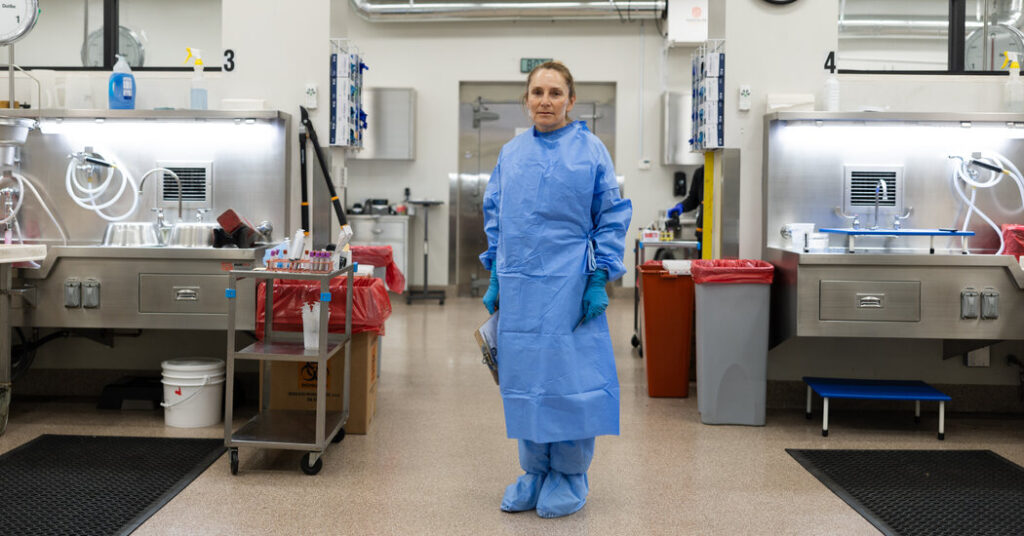
The chief medical examiner was not satisfied. The toxicology report on the dead man’s blood samples made no sense, given what her investigator had noted at the death scene:
Oct. 26, 2025, 2:43 a.m. Apartment, South Knoxville, Tenn. Decedent: white man, 52, supine on bed, in T-shirt, pants, belt, socks. In the bathroom: thumbnail-size baggies, cut straws, dollar bill, hollow pen, white powder.
But the only substances a lab found in his blood were nicotine and caffeine.
“Please look harder, please look harder,” implored Dr. Darinka Mileusnic-Polchan, the chief medical examiner for the greater Knoxville area. “Can’t we do something else?”
She sent the samples to a second lab. It found sedatives, but not enough to explain the death. She sent them to a third lab, which specializes in detecting novel drugs.
Those results were alarming: The victim had overdosed on cychlorphine, a compound in a new class of opioids called orphines that are 10 times more powerful than fentanyl.
In the six months since his death, at least 50 fatal overdoses involving cychlorphine have been confirmed in the greater Knoxville area. The largely unknown compound is on track to be the third-most-common drug involved in the region’s fatal overdoses this year, after fentanyl and methamphetamine.
Over that period, Knoxville became a national hot spot for cychlorphine. But if it were not for Dr. Mileusnic’s tenacity, the community would most likely not even know the drug was circulating.
As an ever-morphing stream of lethal opioids infiltrates the streets, medical examiners have become frontline drug detectives, pressing to identify the new substances causing deaths. The most persistent, like Dr. Mileusnic, are going beyond their traditional roles, coordinating with law enforcement and local health departments to swiftly warn communities about the latest killer in their midst. In that capacity, medical examiners perform another vital function: sentinels of public health.
But many medical examiners (and their lesser-trained counterparts, coroners) lack the money, technical resources and time to pinpoint each drug implicated in an overdose fatality. Since many novel compounds do not yet register on standard toxicology screens, they are listed on death certificates as “other and unspecified narcotics.” That means the prevalence and toll from new drugs like orphines are most likely being underreported.
Shortly after Dr. Mileusnic received the definitive report on the cause of the October overdose, she learned that just a few sand-size grains of cychlorphine can be lethal. Users can die so abruptly that the classic signature of overdose, froth around the mouth and nostrils called “the foam cone,” often does not have time to bubble up. Respiratory suppression is rapid: The chest becomes rigid, making manual compressions to try to save the victim difficult.
Researchers believe that most orphines originate in Chinese labs. In July, China banned an earlier class of synthetic opioids called nitazenes, and by the fall, orphines arrived in the United States.
In January, the Center for Forensic Science Research and Education, the nonprofit Pennsylvania lab that finally identified cychlorphine in the Knoxville death, issued its first national alert about it. The drug has since been detected in at least 14 states. In February, the United Nations Office on Drugs and Crime reported that at least 11 orphine variations, known as analogs, have been identified worldwide.
“We would never know about the hot spots if medical examiners like Darinka weren’t pushing to test these substances,” said Alex Krotulski, the director of toxicology and chemistry at the research center, which tracks new illicit substances around the country. “Cychlorphine would be completely missed. And that’s not helpful from a public health perspective.”
Clues at the Scene
As soon as the call comes in that a body has been discovered, the hunt for cause of death begins. The police take control of the scene, but the medicolegal death investigator, as the position is formally known, controls the body.
Karissa Fulton is one of 14 investigators, almost all women, who work in shifts around the clock for Dr. Mileusnic at the Knox County Regional Forensic Center, which has the technical expertise to complete exhaustive autopsy analyses. She typically arrives at the scene within an hour of getting the dispatch.
The position of the body can be an early hint that a powerful opioid was involved, because the death collapse is so precipitous. A body abruptly folded over at the waist, facing down on a bed; kneeling, face planted on the ground; sitting in a chair, nose to knee, arms dangling. If the body is supine, investigators look for indications of a mattress imprint on the face or excessively puffy, purpling eyelids and cheeks. Those signs could suggest that the person had indeed died face down and was then turned over by someone.
Ms. Fulton looks for the foam cone and traces of orange vomit. Next, seeking substances for testing, she searches the dead person’s pockets, underwear and socks, where people stash drugs. She scoops up paraphernalia that may have drug residue: credit cards, burnt tinfoil, glass pipes, lottery tickets.
Sometimes the drugs have already disappeared. So, said Chris Hawley, another investigator, “we always photograph trash cans. Is there trash in the can? Or has it been thrown out to the curb, really quickly? And we always check the toilets.”
Then the investigators bring their trove to the forensic center, to be tested and analyzed.
Teaming Up With the Police
In the early 2000s, as an assistant medical examiner in Chicago’s hard-driving office, Dr. Mileusnic saw plenty of deaths from cocaine, heroin and even fentanyl patches. In 2002, she and her young family moved to Knoxville, an old Southern city in the drug-battered Appalachian foothills, with two interstate drug pipelines running through it. Upon arrival, Dr. Mileusnic, who had moved to the United States a decade earlier from her native Croatia, experienced severe culture shock — not from the slower pace of life but from the prescription opioids increasingly listed on death certificates.
“It was rampant and scary,” said Dr. Mileusnic, 63. “I said: ‘This cannot be! We have to do something about it.’ And that was the beginning of our deep involvement in this kind of toxicology, the drug overdose arena.”
As her office expanded — she is the chief medical examiner for three counties — Dr. Mileusnic contracted with NMS Labs, a Pennsylvania center that conducts extensive, even esoteric forensic testing on tissue and blood samples for agencies nationwide. Since 2010, her office has been publishing annual overdose fatality trends, noting which drugs predominate.
Crucially, she also forged alliances with local and state public health, criminal justice and street outreach groups. The county’s Overdose Death Task Force meets regularly to share intelligence, such as needing multiple doses of overdose reversal drugs like Narcan to revive a person who has apparently ingested an orphine — rather than a single dose typically used for fentanyl. At one meeting, Chris Thomas, the director of the forensic center, pointed out a recent surge in overdose deaths among day laborers, prompting more aggressive distribution to them of naloxone, the generic overdose reversal drug.
In 2024, overdose deaths in Knox County dropped to 334, down 36 percent from 519 in 2023, among the sharpest declines in the country. That may be due in some measure to Dr. Mileusnic’s vigilance. (Nationwide, overdose deaths also fell during that time, but by a smaller margin, down 24.4 percent, according to federal data.)
Lt. Josh Shaffer of the Knoxville Police Department, who has led overdose death investigations for more than a decade, acknowledged the importance of his team’s relationship with the medical examiner’s office.
“What are we seeing in the street that we can tell them to look for in autopsies?” he explained recently. “What are they seeing in the autopsies that benefit us in the street?”
In late January, when it became obvious that cychlorphine had not just shown up in a bad batch of drugs but was racing through the street supply, Dr. Mileusnic and the forensic center shifted into overdrive. They alerted the county health department, the Knoxville police and state and federal drug authorities. Then they issued a major press alert.
Armed with data from the medical examiner’s office, the county’s public health epidemiologist determined that dealers were selling cychlorphine cheaply, on its own or mixed into fentanyl and methamphetamine, to Knoxville’s indigent people.
Now, as deaths from cychlorphine mount, Dr. Mileusnic routinely sends samples from overdose fatalities to three labs. NMS Labs can monitor for indications of the drug. The Center for Forensic Science Research and Education will confirm its presence but cannot quantify it. Then she will send a sample to the Drug Enforcement Administration: If it meets screening criteria, it will be tested by the D.E.A.’s university-based lab in San Francisco, which can both identify and quantify novel substances.
On occasion, a lab will ask if it can perform further tests on Dr. Mileusnic’s samples, to see if they contain evidence of drugs that are spiking in other regions. She almost always says yes, despite the expense. Testing is second only to salaries as the center’s biggest line item.
Funded mostly by counties, the regional center’s annual budget is about $5 million, which it augments by taking on private cases. That day, the forensic anthropologist was defleshing an exhumed body. A family was paying to have the skeleton examined, to determine whether the deceased fell to his death — or, possibly, was pushed.
Scarce Resources
“I’ve always seen part of the medical examiner’s job as prevention, to be a public health agent,” Dr. Mileusnic said. But the prevention role her office plays in the drug crisis is difficult to replicate.
There are no uniform national standards for determining a cause of death. Many jurisdictions do not employ medical examiners, who typically have medical degrees and extensive training in forensic pathology. They may instead rely on county coroners, who can be appointed or elected and are typically not required to be doctors In Georgia, for example, the requirements for elected county coroners include being at least 25 and having a high school diploma. After being elected, they must attend a five-day training course.
Budgets also constrain investigations. At the Knox County Regional Forensic Center, which works with 20 counties in addition to the three overseen by Dr. Mileusnic, Mr. Thomas has told other medical examiners that although a post-mortem toxicology report has identified fentanyl, the lab believes other as-yet-unidentified substances are present. A secondary test could cost about $400.
“Then they’ll usually say: ‘No thank you, I don’t have the money for more testing. I already have enough on board to kill them,’” Mr. Thomas said.
Dr. Mileusnic’s alerts about cychlorphine solved a mystery that had been troubling Brandon Styles. Mr. Styles, 37, who is in recovery himself, is an overdose prevention specialist for Knoxville’s Metro Drug Coalition, a recovery support organization that works with hundreds of people in encampments, shelters and rehab programs.
He also oversees five houses for men newly in recovery. Late last fall, Mr. Styles learned that one of his residents, who worked on a landscaping crew, was seen ducking into the woods and emerged wiping his nostrils.
Mr. Styles drug-tested the resident three days running. Each time, he passed.
“Then another guy in the house told me he was falling asleep while washing dishes,” Mr. Styles recounted one recent afternoon, as he headed toward a nearby encampment of people living in tents on a blacktop under an interstate. “So after lights out, I pulled him out of bed and drug-tested him. He passed.”
The next morning, the man was found naked and unconscious on the bathroom floor. Numerous doses of naloxone barely revived him — his eyelids fluttered but a deathlike gurgle rattled in his chest — and he was rushed to the hospital.
When Dr. Mileusnic’s alerts went out, Mr. Styles finally learned the name for whatever was snaking through the drug supply: cychlorphine, a compound so recent it did not have a street moniker yet.
As Interstate 40 traffic thundered overhead, Mr. Styles chatted up people lingering on benches and in tents. Quietly, he warned that there was something new in the East Tennessee dope that was killing people, so strong that they might need extra hits of naloxone to reverse an overdose. As he spoke, Mr. Styles handed out doses of the lifesaving nasal spray, cautioning them never to use alone — hoping, always, to prevent another untimely encounter with Dr. Mileusnic.
Jan Hoffman is a health reporter for The Times covering drug addiction and health law.
The post A Medical Examiner Chases Down an Elusive Killer appeared first on New York Times.