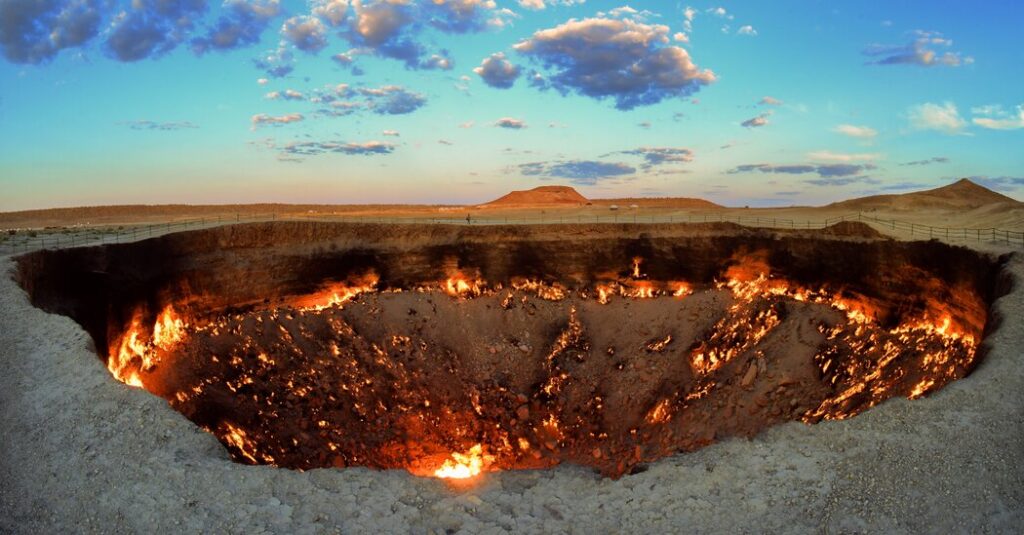
It might be the world’s most baffling tourist attraction: a roaring pit of fire the size of a soccer field sitting in a barren desert.
The Darvaza crater, known as the “Gates to Hell,” lies deep in territory of the isolated Central Asian nation of Turkmenistan.
The crater has been burning for decades. Over the years it has become a quirky draw for adventurous visitors and a puzzle for scientists and researchers. It has even been the backdrop for a self-promotional video by a Turkmen president.
But now, the flames of the “Gates to Hell” appear to be going out.
Infrared imaging data taken this year shows that the fires within the natural gas crater are on the decline. The intensity of heat from the flames has diminished by more than 75 percent over the last three years, according to an analysis by Capterio, a company that monitors natural gas flares.
At a time when so many fires — both real and metaphorical — have raged worldwide, this should have been entirely good news. Turkmenistan’s government has vowed for years to extinguish the flames, citing environmental damage and harm to people’s health.
It turns out that the story isn’t quite so simple.
But first, it helps to know more about the crater.
Its origin is mysterious. According to local lore, Soviet geologists were drilling for oil in the 1960s or 1970s when they hit a natural gas deposit in the Karakum Desert. The ground collapsed, creating an enormous pit. The geologists set a fire in the crevice to curb the emission of toxic fumes.
They figured the fire would burn out in weeks. Instead, more than five decades later, a network of tunnels filled with gas continues to fuel the flames.
“The history is always sketchy,” said Rich Beal, a Mongolia-based guide for Koryo Tours who says he has visited the site 30 times. “Nobody quite knows.”
But the attraction, for some, is unmistakable. “It’s a little like looking at a volcano that’s been opened,” he said.
The Darvaza crater is difficult to visit. Foreigners need a visa to enter Turkmenistan, a former Soviet republic, and can only get one with a letter of invitation. The government of Turkmenistan did not respond to requests for comment.
But the site, about a four-hour drive from Turkmenistan’s capital, Ashgabat, has long drawn adventure-seekers. Visitors can get so close to the pit that they felt a blast of heat from the small flames burning within it.
The crater was also a backdrop for an unusual piece of political propaganda. In 2019, Gurbanguly Berdymukhamedov, then president of Turkmenistan, released footage of himself speeding around it in a truck as he sought to dispel rumors of his death.
Turkmenistan says it has tried to control the gases leaking out of the crater. In a 2025 publication by the Turkmen Energy Forum, an industry group, the government attributed a decline in flames to two wells it drilled near the crater in 2024 to extract natural gas.
But Capterio, the monitoring company, says its data suggests that the flames may have begun to dim before the wells were drilled. It’s unclear whether natural factors have played a role in the flames dying down.
That brings up another issue with the crater: its greenhouse gas emissions.
Data from Carbon Mapper, a nonprofit organization based in Pasadena, Calif., shows that the crater emitted an average of about 1,300 kilograms of methane per hour from 2022 to 2025. That is a significant amount, though much less than the gases vented from some large oil and gas fields, said Daniel Cusworth, the director of science for Carbon Mapper.
The flames from the crater convert methane into carbon dioxide. That is good for the planet because methane, in the short term, is a “much more potent” contributor to the warming of the climate than carbon dioxide, said Mark Davis, the chief executive of Capterio. The fires of the “gates of hell” prevent the methane from being released in its raw form.
Carbon Mapper collected its last reading in October 2025, which showed methane emissions had increased to 1,960 kilograms per hour, higher than the 2022 to 2025 average, which was 1,300 kilograms per hour. Turkmenistan, a major natural gas producer, already has one of the highest levels of global methane emissions, according to the International Energy Agency. (The methane from the Darvaza site accounts for about 0.2 percent of its total annual emissions.)
So for now, even if the flames are smaller, it may not matter much for the planet. And because methane is highly flammable, the fires are unlikely to be fully extinguished anytime soon, Dr. Cusworth noted.
Last November, Mr. Beal visited with a group and observed of the pit: “I do remember it being a little bit more roaring” in previous visits.
But he said that the site remained awe-inspiring, with flames rising five or six feet high.
The heat was so intense, he added, that his group roasted marshmallows and brewed coffee over a fresh crack in the crater floor.
Jenny Gross is a reporter for The Times covering breaking news and other topics.
The post The ‘Gates to Hell’ Are Dimming. That May Not Be a Good Thing. appeared first on New York Times.