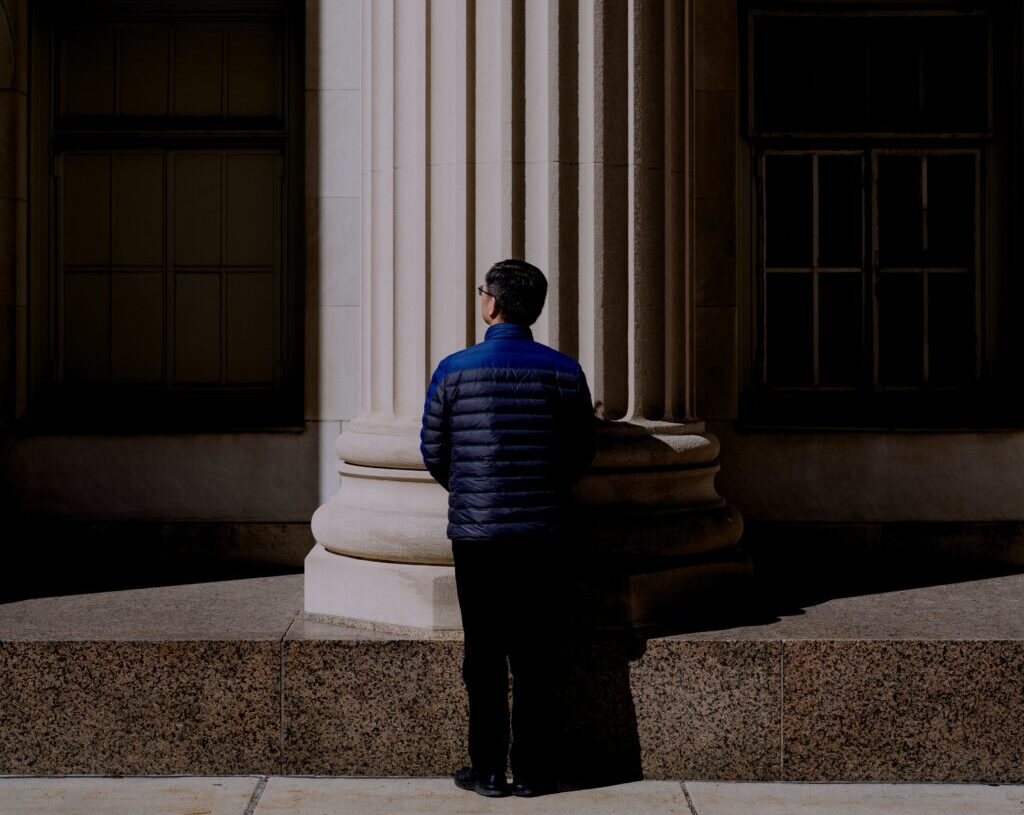
William Wang was leaving his office in Beijing when plainclothes officers accosted him in the street and threw him into a police car.
It was August 2002. Wang was taken to a facility where Chinese security officers interrogated him, beating him and shocking him with electric batons until their batteries ran out of charge, Wang alleged in a lawsuit filed in 2011. Wang remained imprisoned for nearly a decade, subjected to solitary confinement, forced labor, beatings and other forms of torture, he said.
His offense: being a member of Falun Gong, a spiritual movement that China’s government viewed as a political threat and eventually crushed through force.
Now living in the United States, Wang has been waiting years to move forward with a lawsuit against an American technology giant — Cisco Systems. Wang’s lawsuit alleges Cisco was a key technical supplier for the surveillance system that allowed the Chinese Communist Party’s persecution of him and other Falun Gong members.
“I have no objection to normal business dealings,” Wang, who lives in the Detroit area and works as a software developer, said in an interview. What Cisco did was different, he said, because the company “knew what the CCP wanted to do” with its technology.
The company denies that. Whether a court will ever determine whose account is correct will depend on the outcome of a case argued in late April before the U.S. Supreme Court. The justices’ ruling, expected later this year, could close U.S. courts to claims like Wang’s that U.S. companies “aided and abetted” foreign governments in violating internationally recognized human rights.
At issue is a centuries-old law, the Alien Tort Statute, passed by the First Congress in 1789. The law was originally designed to avoid diplomatic conflicts by creating an opportunity for noncitizens, such as ambassadors, to sue over treatment in the United States.
The statute collected dust for 200 years until a federal appeals court revived it in a torture case involving citizens of Paraguay. An appeals court in New York ruled in 1980 that two Paraguayan citizens could sue a Paraguayan police official in U.S. court for torturing and killing their 17-year-old son.
Human rights lawyers hoped the ruling would turn the Alien Tort Statute into a powerful tool to combat rights violations. Over the past two decades, however, the Supreme Court has narrowed the scope of the law, making it harder to bring human rights cases.
The Cisco case presents the court’s conservative majority with the opportunity to even further constrict the law’s reach, experts say.
During arguments Tuesday, the high court grappled with those questions. Although some justices appeared skeptical that the law created a right for the Falun Gong members to sue, others seemed to appreciate the pitfalls of closing the door completely.
“It seems to me that you have a serious conceptual challenge because we’ve held that the First Congress wanted courts to, you know, look and find the rights of action that are available under common law,” Chief Justice John G. Roberts Jr. said in an exchange with a lawyer for the Office of the Solicitor General, which is supporting Cisco. “You’re certainly not being … faithful to the First Congress’s intent.”
Nevertheless, there has been “lot of opposition” among the justices toward using the Alien Tort Statute to bring human rights claims against companies, said William Dodge, a law professor at George Washington University who regularly writes about international legal issues.
“While they almost certainly don’t want to overrule it outright … they can follow the same pattern that they followed in cases to date,” Dodge said, noting that in four prior cases the high court has restricted the law’s use in human rights claims.
Among the court’s concerns in those cases was that the statute should not reach to countries outside the United States and that suing foreign corporations could have negative foreign policy implications. And all along the high court has been skeptical that the law’s framers meant for it to be used in human rights lawsuits.
In 2018, the high court ruled against 6,000 people who alleged that they or family members had been victims of Hamas terrorist attacks and who sued the Jordan-based Arab Bank. They alleged the bank helped fund the group. The 5-4 opinion along ideological lines held that foreign corporations cannot be sued under the statute for events that took place outside of U.S. jurisdiction.
In 2021, the court ruled against a group of formerly enslaved children who alleged that Nestlé USA bought most of its cocoa from farms on the Ivory Coast of West Africa where child slavery has flourished. The 8-1 decision found that not enough of the actions alleged in the plaintiffs’ case took place in the United States to be heard in U.S. courts.
Unlike the Nestlé case, Wang and his fellow plaintiffs — 11 other Chinese nationals and one U.S. citizen — say that key actions in their case took place in the U.S.: Cisco designed the system and built its components in Silicon Valley, they say. And they allege Cisco knew that the Chinese government was using its system to persecute Falun Gong members.
“All along, Cisco was clear about how the crackdown benefitted the company,” the plaintiffs’ told the court in a brief. “Cisco’s files described the douzheng [violent struggle] of Falun Gong ‘as a lucrative business opportunity.’”
Cisco denies that. “Cisco does not customize or develop specialized or unique filtering capabilities in order to enable different regimes to block access to information,” Mark Chandler, then a senior vice president with the company, testified in 2008 to the Senate Judiciary subcommittee on human rights and the law.
In an email to The Washington Post, a Cisco spokeswoman pointed to a statement issued by Chandler after Wang and other plaintiffs filed their lawsuit in 2011. “We have never customized our equipment to help the Chinese government — or any government — censor content, track Internet use by individuals or intercept Internet communications,” he wrote.
At the Supreme Court, however, those factual questions have been largely set aside in favor of a strictly legal one: Cisco argues that the plaintiffs should not be able to take the case to court at all. The plaintiffs are bending the Alien Tort Statute to cover disputes it was never intended for, the company says.
According to Cisco, backed by the Trump administration and a wide variety of business organizations, the First Congress worried primarily about violations of the rights of ambassadors and piracy — not the possibility of U.S. entities aiding and abetting human rights abuses by foreign governments.
“Aiding-and-abetting liability constitutes a significant expansion of a civil cause of action. For that reason, this court has made clear that it is generally not available absent clear congressional direction,” Kannon Shanmugam, a lawyer for Cisco, told the justices during the April hearing. “And recognizing such a cause of action would raise substantial foreign policy concerns, as in this case, which involves serious allegations of wrongdoing in a foreign country by a foreign government.”
Washington Legal Foundation, a pro-business advocacy group, added in an amicus brief that lawsuits under the Alien Tort Statute “would expose American companies to costly, burdensome, and lengthy litigation.”
If Congress believes companies should be open to lawsuits in U.S. courts for alleged abuses overseas, it could pass a law to explicitly allow such cases, the company and its supporters argue. The courts should not create liability by reinterpreting a law passed centuries ago, they say.
Cisco won that argument before a district court but lost in the California-based Court of Appeals for the 9th Circuit. The company appealed to the Supreme Court.
The appeals ruling, if it stands, “would open the floodgates for suits against corporations in the U.S. for human right violations merely based on legal exports of goods and services,” the company’s chief legal officer, Dev Stahlkopf, wrote in a statement after the 9th Circuit ruling.
But if the Supreme Court sides with Cisco, the ruling could effectively end the use of the Alien Tort Statute for human rights cases, said Paul Hoffman, a California attorney for the plaintiffs.
“Under Petitioners’ theory, Cisco cannot be held responsible for aiding and abetting these violations no matter how substantial and direct their contributions were,” Hoffman said, standing before the justices at the April hearing. “Under Cisco’s theory, even the corporate actors who provided the poison gas for Nazi crematoria would not be liable under” the Alien Tort Statute.
Wang’s case illustrates the sorts of corporate behavior that human rights advocates hope the law can be used to police. He alleges that the Chinese government used Cisco’s technology to monitor him, leading to his arrest and imprisonment.
Wang joined Falun Gong while studying engineering at Tsinghua University in Beijing. He was drawn to the movement’s embrace of Qigong, a type of exercise that includes flowing movements, breathing and meditation, he said in a recent interview. He also connected with its teachings of kindness and tolerance.
At that time, Falun Gong had become widely popular across China, with as many as 100 million practitioners in 1999. Its growing political organizing power drew concerns from Chinese officials. After more than 10,000 Falun Gong practitioners gathered in Beijing for a protest in April 1999, China’s then-leader, Jiang Zemin, ordered a harsh crackdown, which involved widespread extrajudicial detentions, torture of practitioners during interrogations and forced labor in reeducation camps, according to news reports at time and accounts from torture victims like Wang.
That campaign soon hit Tsinghua. Wang said he faced pressure from government officials to renounce his faith. At one point, a government official encouraged dozens of Wang’s classmates to condemn him and his beliefs during a two-hour shaming session, he said. Eventually, Wang left the university and was forced to give up his quest for a doctorate.
While he was imprisoned, he said, government officials said they knew he had been writing articles about the persecution of other Falun Gong members at the university — even though he wrote his articles anonymously and sent them to the publication via encrypted files. Only after Wang was released from prison in 2011 did he learn the full scope of the surveillance and that Cisco had allegedly built the system that made it possible.
China’s embassy did not respond to a request for comment.
By then, Cisco’s alleged involvement in Chinese surveillance had become public. After the 2008 Olympic Games in Beijing, an internal Cisco slide deck on market opportunities in China was leaked to the media. The slide deck cited a Chinese government official saying the Golden Shield project, for which Cisco was a vendor, could “combat ‘Falun Gong’ evil religion and other hostiles.” The slides drew scrutiny from Congress.
In the 2008 Senate hearing, Cisco’s Chandler told senators that he was “appalled” and “disappointed” at the slide deck. The company issued a statement saying the slides did not represent Cisco’s views or principles.
Wang said Cisco should face some kind of accountability.
“I hope all American companies can make money,” he said. But “we need to understand what things are acceptable and what things are not.”
The post Tortured in China, they want to sue Cisco. The Supreme Court may say no. appeared first on Washington Post.