WASCO, Oregon — Steve Radcliffe knew, as he backed a Subaru hatchback up to the old Wasco Grade School, that his event might not draw even a single participant. The town had only 417 residents, and Radcliffe suspected a decent number would rather spend their Friday night at home or the local tavern than talk about what Radcliffe considered one of the country’s thorniest issues.
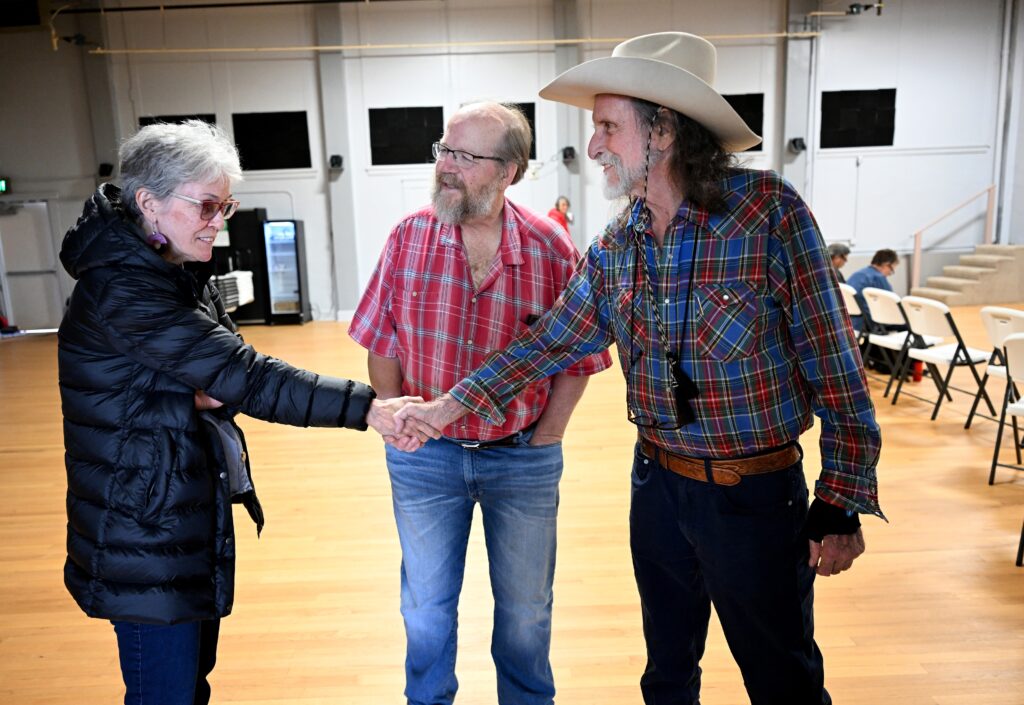
But Radcliffe was the hopeful sort. He had traveled three days and 355 miles to discuss the urban-rural divide, and he refused to believe he’d spent $1,800 of his own money for nothing. He pulled a tan cowboy hat low on his forehead, then he and a group of aging volunteers strode into the building.
Inside, they found a woman fussing over the right way to set up 10 plastic chairs in a room the size of a cafeteria. Jessica Richelderfer Wheeler told the out-of-towners she could trace her Wasco relatives seven generations back, when an intrepid ancestor hiked through the Umpqua National Forest before settling in Sherman County to farm wheat.
“This was before the Oregon Trail or anything,” she said.
Radcliffe had lived in Oregon only half a century himself. He’d come west from Pennsylvania in 1970 because he was a Quaker who objected to the Vietnam War. Rather than fight, he’d agreed to move to rural Oregon to help build a country school. But the guy running the alternative service program was “crazy as a loon,” Radcliffe found, and Radcliffe never did serve his country the way he’d expected to. He worried he might never make good on his promise, but then, after the 2016 election, he was so upset, he decided to fashion his own alternative service. He volunteered for a nonprofit that promotes civility, and he started thinking about ways to improve his state — and eventually, he hoped, his country.
Radcliffe lived out in the sticks of southern Oregon, but he leaned politically left. That made him particularly well-suited, he thought, to reach across divides. When it came to politics, he knew, rural Oregonians were outnumbered two-to-one by city dwellers and almost never got a say. Some were so frustrated they wanted to secede and join Idaho. The Republican lawmakers who represented them had fled the state more than once to halt the legislative process entirely. Radcliffe thought there had to be a compromise.
Now, he and Jennie Tucker, a liberal woman from another rural corner, were embarking on what they expected would be a long and costly process: They would hold a town hall in every Oregon county, then they’d send city folks to the country and country folks to the city. Together, the groups would form a list of bipartisan, bi-demographic recommendations to give the state legislature.
This was their 10th event, and while a few of the urban ones had drawn two dozen people, the rural town halls hadn’t exactly been barn-busters. Radcliffe and Tucker had scheduled one in Pendleton on the same day the local theater was putting on its production of “Seven Brides for Seven Brothers.” Only four people showed. And no one attended their winter discussion in Banks.
By 5:30 p.m., the crowd was small by big-city standards but overflowing by Wasco’s. Eight additional locals had showed. They joined five volunteers and sat without talking while Radcliffe brooded over a computer. He had intended to live-stream the discussion, but he couldn’t get Zoom to work.
“Well,” one volunteer told another. “Steve is 81.”
Radcliffe eventually admitted defeat, then took the podium with a confidence shaken by technical difficulties.
“The rural-urban divide, everybody in Oregon knows that is a problem,” he said. “I don’t have any silver bullets. If I did, I’d be shooting.”
The crowd remained quiet. Radcliffe was fine with silence — all those years in Quaker meetings had seen to that — but he did want the lawmakers who met 150 miles away in Salem to better serve rural Oregonians, so he tried again.
“We want to hear what you think Salem doesn’t understand about you, about your life, about your family, about the prospects for your children.”
Mike McArthur, a former county judge, raised his hand. This wasn’t the first time someone had come from elsewhere to ask Wasco residents what they want. In 2019, a group from Seattle had visited to learn why voters in Sherman County had overwhelmingly supported President Donald Trump. And others had come through, too, always with good intentions but little follow-through.
Still, McArthur considered it his “life’s work” to win more support for rural counties like his, so he offered one concrete suggestion: Bring back the Office of Rural Policy. Two decades ago, the state briefly had such an office, which required lawmakers to consider every bill’s impact on rural communities, but the office disappeared a few years after it arrived.
After McArthur broke the ice, the others, mostly men, piped up. They talked for an hour about gerrymandering, Oregon’s closed primaries, campaign finance, environmental laws, data centers and a recent bid by the new owner of Portland’s NBA team to make the state pay for a new city arena. But what really seemed to unite the crowd was a discussion about supermajorities.
A woman in a denim jacket said she wished all legislative proposals had to have bipartisan support to become law.
“The reason that we don’t get that is because we have an urban liberal supermajority in the legislature,” she said, and that supermajority could pass any bill it liked without ever garnering support from the other side. “That’s why we don’t feel listened to — because they don’t have to listen to us.”
Any state with a supermajority breaks this way, Radcliffe said. Republicans in Florida and West Virginia can run roughshod over liberals, while conservatives in California and Massachusetts have little to no footing in their states’ lawmaking process. But that wasn’t right, Radcliffe thought. Democrats like him were supposed to stand up for minorities. Oregon liberals did a good job of defending racial and sexual minorities, he thought, but they didn’t extend that same consideration to those in the political minority.
An older city councillor said the whole country had changed once then-House Speaker Newt Gingrich had gone after President Bill Clinton “like a tiger,” ending the era of bipartisanship. Few people had worked across the aisle since, and maybe that was a bigger problem than the ways rural and urban people misunderstood each other. Everyone had to pick a side in a democratic process that increasingly felt like war.
Time was winding down, so Radcliffe called on a woman who hadn’t commented. Her name tag said Margie, and when she spoke, her voice wavered.
She said she had grown up here but had been gone for 50 years. “Honestly, I was a little hesitant to move back, just knowing that it’s a very red county, and I’m not so much. I guess I wasn’t quite sure how we were going to fit in.”
A younger man with deeply tanned skin and dirt under his fingernails cleared his throat. He said his name was Justin Miller. He worked for his cousin’s excavator service, and though his politics better fit the town’s, he did understand how Margie felt. His wife had lived in Portland, and she was liberal. She had been nervous about moving to Wasco, too. But they’d found they learned from each other’s differences.
“We’ve got a 2-year-old daughter now,” Miller said. “She’s going to grow up in a household and be well-rounded on her thoughts, and it will be her choice to be however she wants when she grows up.”
The post What a modest town hall explains about rural America’s political gap appeared first on Washington Post.