The Smithsonian’s first major exhibition of African LGBTQ+ artists is a colorful, vibrant affirmation of queer life, celebrating such universal themes as joy, family and belonging. Yet at a time when LGBTQ+ communities around the world are under threat, “Here: Pride and Belonging in African Art” at the National Museum of African Art also encompasses its share of darkness and loss.
The show itself was originally scheduled to coincide with D.C.’s WorldPride celebrations last June but was abruptly postponed. Although the museum cited budget issues in its decision, the timing didn’t seem incidental in light of President Donald Trump’s administration’s scrutiny of Smithsonian museums and programming.
Now seeing the light of day, the highly varied show features nearly 60 artworks, including painting, sculpture, textiles, photography, and film and video works. More than a dozen African countries are represented, most strongly South Africa, Nigeria and Kenya, along with diaspora artists in the United States, Britain and France.
The roughly 30 artists include established names such as Nigerian American artist Toyin Ojih Odutola — who had a captivating immersive solo show at the Hirshhorn Museum a few years ago — and others who are lesser known. Here are six artists whose work is not to be missed.
Zanele Muholi
“Muholi Muholi, Parktown,” Zanele Muholi’s arresting floor-to-ceiling self-portrait on vinyl wallpaper, makes a powerful statement of queer African visibility: The South African artist, who here used makeup and color saturation to deepen the blackness of their skin, strikes an assertive pose, arms crossed and eyes meeting the viewer’s gaze head-on. The exhibition features two other works by Muholi, one of the most recognized contemporary artists documenting LGBTQ+ African communities. The intimate black-and-white photo “Pam Dlungwana, Vredehoek, Cape Town” is part of Muholi’s long-running series of portraits of queer Black South Africans. “Ayanda & Nhlanhla Moremi’s Wedding, November 9, 2013” is a short documentary film about a lesbian couple celebrating their marriage in a Johannesburg township.
Rotimi Fani-Kayode
Two works by Nigerian British photographer Rotimi Fani-Kayode, who died of complications from AIDS in 1989 at age 34, are among the most emotionally and spiritually resonant in the exhibition. In the photo “Nothing to Lose IX (Bodies of Experience),” Fani-Kayode is naked except for black leather harnesses. He is bending down in supplication — but also perhaps despair or grief — in front of a sculpture wearing a stylized painted mask evoking the Yoruba deity Eshu. In “Every Moment Counts (Ecstatic Antibodies),” the artist appears in a priestly robe in red, a color associated with the god Shango, as a troubled-looking younger man leans on his shoulder. In the show, Fani-Kayode’s photos are paired with two traditional wooden figures of Eshu and Shango from the museum’s historical collection, each of which has androgynous characteristics.
Leilah Babirye
New York-based sculptor Leilah Babirye received U.S. asylum in 2018 after fleeing her native Uganda, which has some of the continent’s harshest antigay laws, including the death penalty in some cases. Babirye honors her community by creating alternative totems to those that traditionally identified clans in Uganda’s Buganda kingdom. “Nansamba II From the Kuchu Ngabi (Antelope) Clan” is a larger-than-life ceramic woman’s head glazed in soothing light-blue hues and covered with goddess-like “hair” fashioned from bicycle tire inner tubes and other found objects; the figure’s invented clan name includes “kuchu,” an affirmative term for queer people in Uganda.
Kawira Mwirichia
The series “To Revolutionary Type Love” by the late Kenyan artist Kawira Mwirichia reinvents kangas, East African cloths printed with colorful motifs and proverbs that are often given to a bride on her wedding day. In response to homophobia in Kenya, Mwirichia designed kangas commemorating LGBTQ+ struggles for acceptance in every country, each bearing a positive message in Swahili. Twelve are on display here, including ones that portray pathbreaking gay activists from South Africa and Uganda.
Jim Chuchu
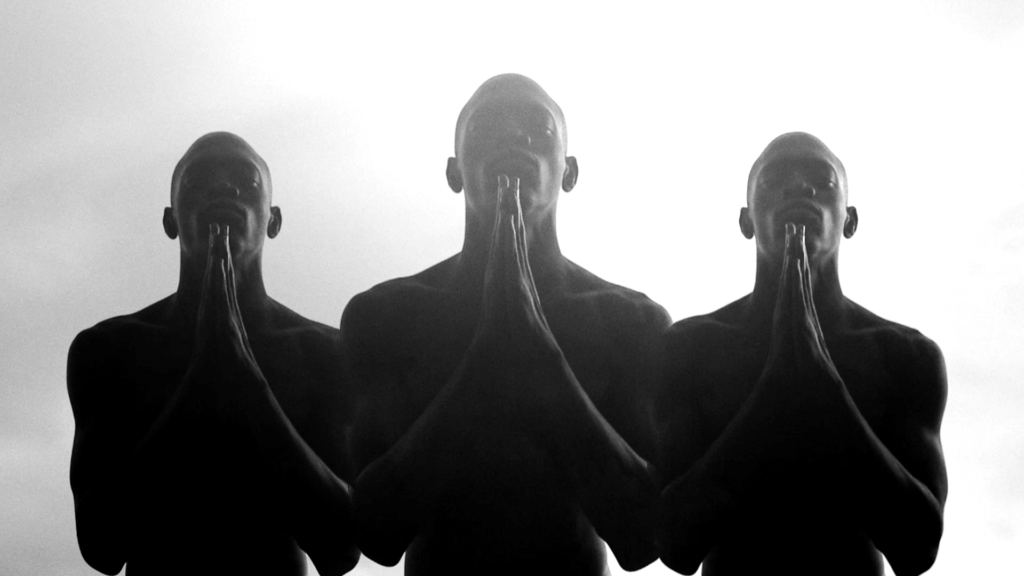
Also from Kenya, former musician Jim Chuchu directed and composed the soundtrack for his two-part black-and-white digital video work “Invocation.” The first part, “The Severance of Ties,” evokes the fast-paced editing and tempo of a music video, but it chronicles a searing family rupture: Male figures dance and chant “I am not your son,” as snippets of text from an email exchange between father and son flash across the screen. The slower, almost trance-inducing second section, “Release,” shows masculine bodies exhaling dense streams of black smoke in a transformative self-cleansing ritual.
Arvin Ombika
Arvin Ombika, who is native to and based in Mauritius, an island nation east of Madagascar, draws on a very different setting of Indian Ocean cultures and Hindu elements in his work. His stunning painting “Juxtaposition of Aurora Borealis and Aurora Australis” depicts lush leaves and flowers against a background of brightly patterned fabrics used by formerly indentured South Asian laborers on the island. In the center, a male nude — presumably a self-portrait — reclines with his back to the viewer, seemingly spellbound by the Krishna-like naked blue figure who hovers above him playing the flute.
Here: Pride and Belonging in African Art Through Aug. 23 at the National Museum of African Art, 950 Independence Ave. SW. africa.si.edu. Free.
The post An abruptly postponed Smithsonian show of African LGBTQ+ art is now open appeared first on Washington Post.