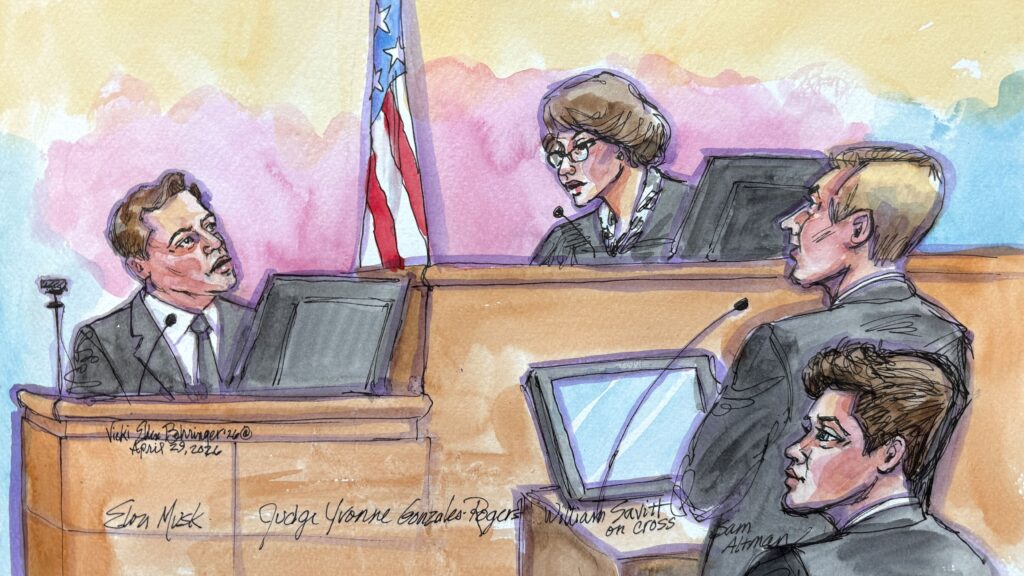
OAKLAND, Calif. — Federal judge Yvonne Gonzalez Rogers had stern words for Tesla CEO Elon Musk as she prepared to open the trial in his case against ChatGPT-maker OpenAI and its chief executive Sam Altman. “How can we get things done without you making things worse outside the courtroom?” she asked Musk on Tuesday.
Gonzalez Rogers chastised Musk for the day before making dozens of posts on X, the social media platform he owns, criticizing his opponents, including posts that rendered Altman’s first name as “Scam.”
Her question could also be heard as acknowledgment of a wider challenge that has surfaced during previous trials involving Musk or his companies: When the puckish billionaire known for divisive politics and provocative social media posts enters the courtroom, conventional proceedings can become distorted by his gravitational pull.
Musk claimed on Tuesday that his social media posts were a response to others made by Altman, who also received a warning from the judge. The Tesla CEO alleges in his case that after he co-founded OpenAI in 2015 with Altman and the company’s president Greg Brockman, the pair betrayed the company’s original mission so that they could enrich themselves. OpenAI and its executives deny those allegations. But it was Musk himself who dominated the first three days of testimony in the trial.
Musk faced hours of questioning from his own legal team and OpenAI’s defense lawyers. He showed frustration at times, cracked jokes and made references to the movie “Terminator” at others, and repeatedly triggered warnings from the judge.
After Musk on Thursday accused OpenAI’s lead attorney of asking a leading question, Gonzalez Rogers interrupted the billionaire and asked him to repeat four words after her: “I’m not a lawyer,” Musk said obediently, then added: “I did take law 101, technically.” Several members of the public sitting in court burst out laughing.
Musk, who through ventures including SpaceX, Neuralink and X commands an empire that launches rockets, installs brain-computer interfaces and shapes politics, generally insulates himself from critical or probing questions during public appearances. The courtroom is a less predictable venue that captains of industry typically avoid, said Ann Lipton, a law professor at the University of Colorado at Boulder.
“Usually, the thing is that people who are in his position, like top corporate executives, they fight very hard not to be deposed or go to trial,” Lipton said. “This is a situation where he can’t really control the narrative.”
Past trials involving Musk or his companies have shown that his reputation in business and public life brings along its own narrative that can complicate legal proceedings.
Prospective jurors for a federal civil trial in Florida last year over whether Tesla’s driver-assistance technology was to blame for a fatal crash were asked by a Tesla attorney if they had strong feelings about Musk. Several said they did, with some citing his political alliance with President Donald Trump.
When one woman was asked whether she could set aside her feelings about Musk, she replied, “It would be difficult.” She was later dismissed and Tesla was ultimately found partially liable in the matter and hit with $243 million in damages.
Musk’s reputation came up during jury selection in Oakland on Monday for his case against OpenAI in the U.S. District Court for the Northern District of California. Multiple prospective jurors said they had a negative opinion of his politics.
Gonzalez Rogers said that wasn’t reason for them to be excluded. “Many people don’t like him,” the judge said. “But that doesn’t mean Americans cannot nevertheless have integrity for the judicial process.” (The Washington Post has a content partnership with OpenAI.)
On the three days that Musk testified this week, reporters and members of the public began lining up before sunrise for a chance to occupy one of the 30 unreserved seats inside the courtroom. Those who lost out filled an overflow room with seating for 100 more spectators, where Musk’s testimony streamed live on a video screen.
The billionaire arrived by car around 7:30 a.m. each day and entered through a separate entrance from the public but was required to go through security like everyone else. On Tuesday, he was asked by security staff to remove his belt and go back through the metal detectors a second time.
Protesters calling for a halt to development of artificial intelligence set up outside the courthouse. Bill Low, a 74-year-old fine artist who lives in Oakland, wore a “Stop AI” T-shirt and held an oversize cutout of Musk’s head on Thursday.
Low was protesting all AI development, he said, believing it could lead to the extinction of the human race. He came to court knowing Musk’s presence would draw many journalists. “To me, it was really drafting off [Musk], knowing the media would be here,” Low said.
Inside, teams of bodyguards moved with Musk in and out of the courtroom. The billionaire chatted during breaks on Wednesday with his close associate Ari Emanuel, the Hollywood power player who inspired the HBO show “Entourage.”
Musk was not the only attendee to earn a telling off from the judge. On Wednesday, Gonzalez Rogers hauled a member of the public up in front of the court and yelled at her for taking a photo of Musk during the break, despite signs posted around the courthouse prohibiting photography inside. On Thursday, another member of the public sitting in the court put on a sleep mask and appeared to fall asleep soon after Musk’s testimony ended.
In the trial so far, the jury has seen dueling portraits of Musk. His legal team depicted him as OpenAI’s most important benefactor, who used his wealth and business clout to fund and accelerate the venture in its early years. Musk contended that he did so out of a belief that it was better for a nonprofit to develop powerful AI technology before corporations like Google.
OpenAI’s attorneys countered that Musk reneged on most of his early commitments to OpenAI and abandoned the organization when he couldn’t take full control. They claimed that the entrepreneur launched his lawsuit years later because the company found success and now competed with his own AI company, xAI.
“This trial, at least in the early innings, is all about Musk and his credibility as a witness. Jurors are watching everything and listening to his testimony very carefully,” said Andrew Stoltmann, a corporate litigation lawyer who is not involved in the case but has followed it closely. “One slipup with respect to the veracity of what he is saying could prove toxic to the case.”
Musk sought in his testimony to portray the stakes of the case as existential, saying several times that AI could “kill us all” if it is not developed safely. The judge eventually told him to stop repeating that claim.
“This is not a trial on the safety risks of artificial intelligence. … We don’t need to have this whole thing exploding in this way in a courtroom for the world to observe,” Gonzalez Rogers told Musk’s lawyers while the jury was out of the room. “I suspect there are plenty of people who don’t want to put the future of humanity in Mr. Musk’s hands, but it doesn’t matter, we aren’t going to get into those issues.”
David Larcker, a professor at Stanford Graduate School of Business and a distinguished visiting fellow at the Hoover Institution, said Musk’s testimony was necessary for a case that he had brought. The entrepreneur would have to appear credible for his testimony to help his case, Larcker said.
“There’s a reason courts exist. You’re trying to get the facts, apply the law. You just can’t get up there and … start rambling about ancient Greece or something,” Larcker said.
The courtroom experience may feel unusual to Musk, he added. “If you’re in that setting [and] you’re used to being in complete control, all of a sudden you’re getting pushback,” Larcker said.
Musk has appeared uncomfortable at times during previous court testimony. When he faced a jury in 2023, in a federal shareholder case over his 2018 declaration that he had funding to take Tesla private, Musk complained of back pain and trouble sleeping, and became agitated under questioning.
During that trial, a plaintiffs attorney posed the question: “Can Elon Musk do whatever he wants and not face the consequences?”
Musk was ultimately found not liable in the matter.
The post Elon Musk went to court. The judge wasn’t amused. appeared first on Washington Post.