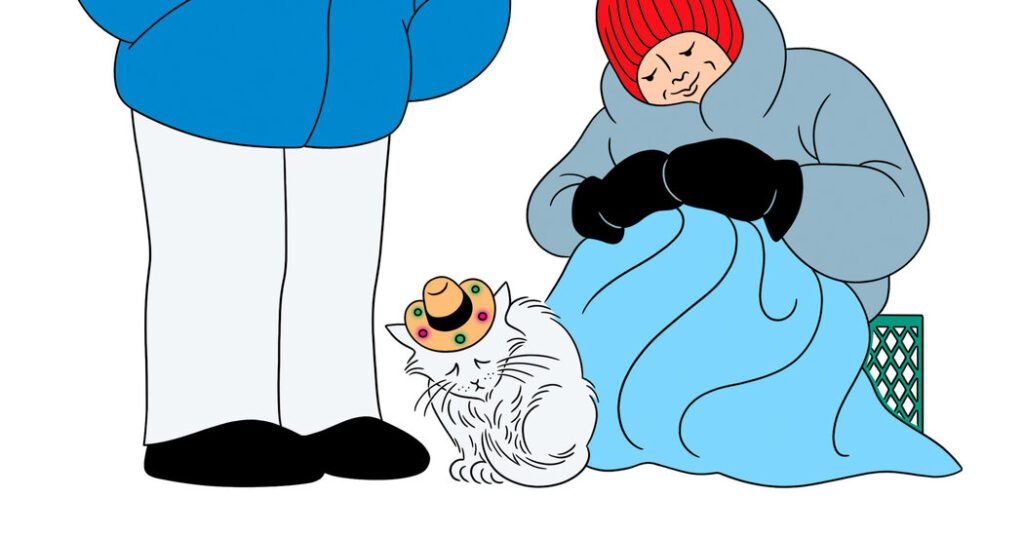
This past winter, I was walking through downtown Chicago on a frigid night when I encountered a homeless man and his pet cat. I felt sad for both, but the cat seemed especially pitiful. The man was bundled up and in good spirits, but the cat looked miserable: She was leashed to a milk crate and had only a thin blanket and wore a light-up sombrero.
I stopped to talk with the man, who was friendly, and to pet the cat, who was shut down and shivering and didn’t respond to being touched. From our brief conversation, I could tell that the man loved his cat, but also that he was mentally ill and unable to provide proper care for the animal.
I gave him some money, said good night and walked on. Now, months later, I can’t stop thinking about them — especially the cat. (I realize I sound more empathetic toward the cat than to the person, but of the two of them she seemed far worse off.)
Would it have been inappropriate to offer the man money for his beloved pet, promising to find her a warm, loving home? Taking the cat might have eased her suffering, but it would have forced the man to choose between money and the animal he loves. It might also reward him for mistreating the cat, and he could find another animal and repeat the pattern. How should I have handled this? — Name Withheld
From the Ethicist:
“Whoever offers to another a bargain of any kind, proposes to do this: Give me that which I want, and you shall have this which you want,” Adam Smith wrote in “The Wealth of Nations.” A successful exchange, he was saying, is to the advantage of each party. But when one side is acting out of desperation, it can fairly be deemed exploitative.
It’s true that people constantly do things for money they wouldn’t otherwise do; that’s basically what work is. But there’s a difference between a person in dire circumstances driven to sell an organ and a corporate manager who’s showing up only for the paycheck. To decide whether a transaction is exploitative, we ask a bundle of questions — about how constrained someone’s options are, whether what’s being given up is inherently invasive or violative of the person, whether someone has the capacity to understand what’s being given up, whether the loss is irreversible and how difficult refusal would be. All of which is to say that you were right to be uncomfortable about the exchange you were contemplating.
You raise two further concerns. First, that accepting the offer would reward the mistreatment that prompted it. But the man surely wasn’t in the business of acquiring pets in order to sell them, and you don’t doubt that he loved this cat. So there’s no marketplace in animal suffering that you’d be sustaining. You also worry that he would find another animal and repeat the cycle. There are indeed vast numbers of unsheltered animals out there. But that’s a problem of a different order and scale, one that requires another set of strategies and institutions. It’s not a reason to leave this particular animal in the cold.
Your impulse to help this creature was a decent one. It’s just that you had ways to do so without leveraging the man’s hardship. One would be to do exactly what you did: Give him money outright, as a gift. There are also organizations like the A.S.P.C.A. and nonprofits specifically devoted to the animals of unsheltered people that exist for these situations. A call from you might have brought in people with both the expertise and resources to help this man keep his cat warm and provide medical attention if needed. Neither of these options requires anyone to surrender anything. On that frigid night, you came across two vulnerable beings, not one. The challenge was to find a way to do right by both.
Readers Respond
The previous question was from a reader who was debating whether to reveal to a friend that he had an affair with his wife. He wrote:
Not long ago, I met a woman entirely by chance in an art class that I wandered into. From the moment we met, there was an immediate spark and chemistry between us — we flirted and we connected, and that flirtation grew into something more. I was single, but I later discovered that the woman was the wife of a friend of mine. He’s not a close friend — close enough that I care, but not so close that I even knew he was married, let alone to her. … Eventually we ended the relationship, knowing it wasn’t right, and we haven’t resumed contact. Now, months later, I wonder if I have a moral duty to tell my friend what happened. He and his wife seem to have a stable life together. If she chooses silence, is it my place to reveal it? — Name Withheld
In his response, the Ethicist noted:
Like all virtues, honesty is a complex character trait. It certainly involves a concern for the truth, but that concern does not require blurting out every truth you know, or even every truth another person might wish to hear. … Honest people also recognize the importance of keeping secrets that others reasonably expect them to keep. At the very least, an honest person in these circumstances might want to speak with the woman involved before deciding what, if anything, should be said. … We sometimes speak of exercising a virtue “to a fault.” What we mean is a kind of moralism that isolates one feature of a situation and, by overemphasizing it, turns a virtue into a vice. … Speaking up in this case would put at risk a marriage that you and your ex-lover have already strained. That might be unkind. To do so without fully thinking through the consequences would be thoughtless. And kindness and thoughtfulness are virtues, too.
(Reread the full question and answer here.)
⬥
The Ethicist took the words out of my mouth. In short, if one doesn’t even know a “friend” is married, they are certainly not close enough that the letter writer should admit any wrongdoing that could potentially end that marriage. Which raises the question of why the letter writer really wants to confess (hoping to break up the marriage and reconnect with the wife was my first thought). If anything, speak to the wife about this instead of bulldozing your way into their marriage. — Daniel
⬥
The Ethicist is spot on. To boil it down to an aphorism, one shouldn’t kiss and tell. There is an implicit contract of confidentiality when indulging in intimate relationships, whether they’re sexual, financial or just personal. Discretion is the greater part of valor. Don’t gossip. — Mark
⬥
I feel that there isn’t enough thought in the Ethicist’s response about the husband’s point of view. Living in a marriage with this secret is living a lie every day. He may think he’s in a happy, monogamous marriage, and he’s not. If it were me, I would want to know and face reality, and then decide if it’s worth working on the marriage. — Lee
⬥
The letter writer probably does owe his friend the truth. But the greater betrayal here came from the wife, who knew what was happening from the start and dove into the affair anyway. She should be the one to reveal it. I know that if a partner of mine had an affair, I might be able to forgive her for it, especially if she were brave and honest enough to tell me herself. If it was hidden from me and I found out another way, or if the other man had to tell me because my wife wanted to hide it? To me, that would be the truly unforgivable betrayal. — Kyle
⬥
The Ethicist’s question of whether concern for the truth is the only thing motivating the letter writer is crucial. In addition to the possibility that the letter writer hopes to reunite with the wife or to punish her, it’s also possibly he’s being motivated by a guilty conscience — wanting to confess to the friend in order to get off the hook. How much of this is for you versus for your friend? If you knew his wife had had an affair with someone who wasn’t you, would you want to tell him in that scenario? — Art
The post A Homeless Person’s Pet Needed Help. Should I Have Tried to Buy It? appeared first on New York Times.