Steve Schwarzman has spent his career on Wall Street—but he’s also been on a quieter quest on the other side of the globe, a decades-long journey to understanding China.
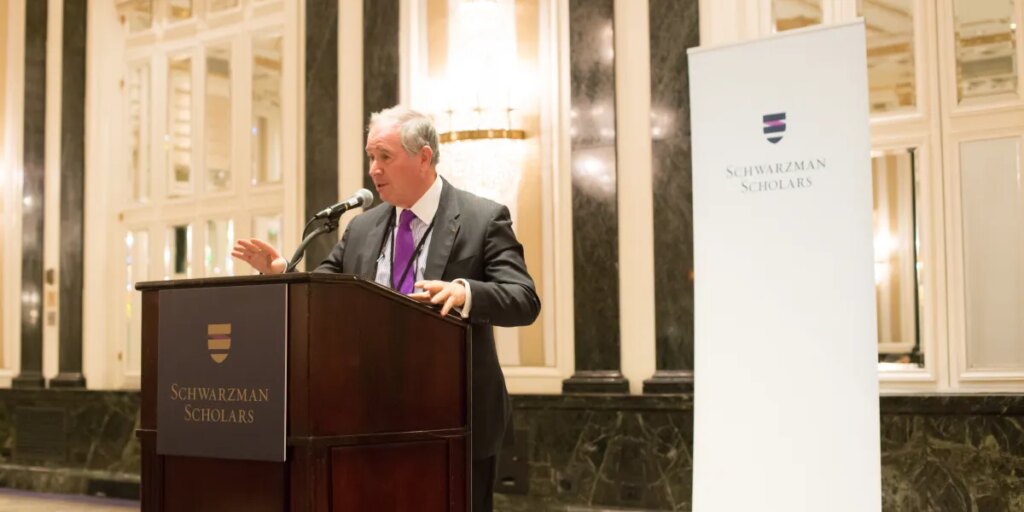
That brought him, in late April, to the New Tsinghua Xuetan, the circular, brick-hued auditorium at Tsinghua University in Beijing, an architectural wonder that resembles a totem from another age. There, the CEO and Chairman of private equity colossus Blackstone was hosting some 1300 alums at the 10th reunion celebration for the Schwarzman Scholars program. Inspired by the Rhodes Scholar program, it’s a philanthropic initiative that brings students in their early-to-mid-20s, the best and brightest from across the globe, to spend a year immersed in understanding how China works and thinks. After giving the keynote address, and joining a panel on “Leadership in the 21st Century” alongside NBA Hall of Famer Yao Ming, Alibaba chairman Joe Tsai, and Yang Lan, a media entrepreneur and on-air personality known as the “Oprah of China,” Schwarzman gets mobbed by Scholars in the audience, many of whom credit the experience for transforming their career paths. “Everyone wanted to take selfies with me,” the 79-year old Schwarzman told Fortune. “I felt like a rockstar!”
Schwarzman avows that giving the generation that will run tomorrow’s governments, businesses and institutions a deep, in-person view of China’s never be more important. “We set up the program when U.S.-China relations were at their height in terms of cooperation,” he says. “I knew we’d go through cycles that would be tense. But I didn’t think the tension would come this quickly.” Put simply, Schwarzman believes that now more than ever, that engagement’s the name of the game, and China isn’t an elective course but should be part of the core curriculum.
Schwarzman Scholars aims recruiting the world’s most promising candidates to give them an education that displays the realities and erases misconceptions about China
In spearheading Schwarzman Scholars, Steve Schwarzman forged the largest internationally-funded philanthropic program ever in China. It’s based at Tsinghua, renowned as the MIT of China. But the school occupies its own campus, Schwarzman College, modeled on the individual venues at Harvard and Oxford, boasting their own historic facades, where students live and dine. The medley of buildings designed by famed architect Robert M. Stern encompass 200,000 square feet. The campus-within-a-campus evokes both traditional Chinese architecture and the historic look you’d find in the Ivy League or the aristocratic academies in the U.K. Of the 150 students chosen each year, 40% come from the U.S., 20% from China, and 40% from around of the world. All the students are ages 22 to 28; around half just graduated from college, and the balance arrive from a remarkably diverse variety of jobs. Many have been working for as long as five years.
Schwarzman Scholars is agnostic as to the backgrounds and careers of its students, but looks for those seeking to be leaders in their fields. It heavily recruits people looking to work in government, to create their own non-profits, and join international aid organizations, as well as break new ground as entrepreneurs. A dentist from Ireland who wants to reform the way his nation provides public health won admission, and so did a Harvard grad who’s launched a VC-backed biotech startup in California.
The admissions vetting is extremely tough. “Our goal is to choose the leaders of tomorrow, whether it’s in business, law, medicine, politics, non-profits or another field,” says Schwarzman. The group conducting the interviews includes CEOs, and former government officials and high level professors from sundry nations. The admissions rate for the incoming class picked outside China is a miniscule 2.5%. “The best universities in the world have a rate of 3.5%,” quips Schwarzman. “So we’re getting in many cases 2.5% of the most outstanding 3.5%.”
The curriculum rests on three pillars: leadership, global affairs and China. The students take their classes in the lecture halls at Schwarzman college, but can also choose classes at Tsinghua. At Schwarzman, each course runs four to eight weeks; all of the faculty is visiting, and the professors hail both from the top U.S. names such as Stanford and Harvard, but also foreign institutions as varied as France’s Sciences Po and the University of Singapore. Most courses are elective. Among the three required: A full-year “China Core” offering that focuses on exploring that nation’s role in the global economy, its historical and political transformation, and its foreign relations.
Part of Core is mandatory instruction in Mandarin for the non-natives, and “deep dive” trips to different cities in China, where students meet with business heads and local officials. The regime also requires students to write a pass-fail thesis called the Capstone, and defend it before a jury of professors. At the end of their intensive, ten-month schooling in all things Chinese, the students receive a Masters in Global Affairs from Tsinghua, considered one of the ten best universities in the world.
The Schwarzman blueprint from the start: Building a global network of tomorrow’s leaders who’ve experienced China up-close
Schwarzman relates that he first got interested in the world’s most populous nation when a Chines’e’s sovereign wealth fund proposed purchasing a huge stake in Blackstone’s 2007 IPO. “They wanted $3 billion of a $4 billion offering,” he recalls. “What they wanted was so big we had to expand the offering to $7 billion. China was building foreign reserves very rapidly and wanted to show they were going to recycle a lot of that money in the U.S. We were the chosen instrument to publicize that fact both outside and within China.” That connection led to Schwarzman’s joining an international advisory board at Tsinghua pioneered by former Treasury Secretary Hank Paulson.
“Like any university, they wanted a big contribution,” says Schwarzman. But as usual, Schwarzman was thinking big, too. He told the University’s president he envisaged “something that would introduce the world to China so that they’d get their information from being and studying there.” The concept was to show how China really works to the future decision-makers. “The key was choosing students you’d bet would become the top people in their country, the future people of consequence whether doctors, lawyers, or those in politics that would change the dialogue, and bring them all together and create a cohort of remarkable people who would set up a network around the world,” he says.
Schwarzman’s initial contribution of $100 million started the fund-raising campaign and he’s continued to give since then. To date, the program’s raised around $600 million. Among the big donors were Ray Dalio, founder of hedge fund Bridgewater, and the philanthropic arms of British Petroleum, GE and Volkswagen, among many others. Schwarzman went big on costly, stylish architecture and great living conditions. “I wanted the students to have really good rooms that every kid in college would like, a single with their own bathroom. We took some of the Rhodes philosophy and adopted it to China.” Still, putting the infrastructure in place amounted to one of the towering challenges of his career. “I remember the difficulty and pain of building a building in China to start with and doing it great architect who’d never worked in China,” he says.
Students benefit from “deep dives” into the economies and cultures of cities across China—and even take internships at the nation’s top enterprises
The program offers fifteen trips to metros outside Beijing for each class, and a full-time “contacts” person spends the entire year arranging meetings with the business, political and non-profit elite in each destination. Among the most popular choices are Wuxi which has led 21st century China as a tech capital, and boasts pioneering players in bio and medtech. Another is Shenzhen, known as the nation’s Silicon Valley.
For Jay Li, a Chinese national who arrived in the first, 2017 class after attending the University of Rochester and working for the NBA in New York, a sojourn to Suzhou in Eastern China near Shanghai was especially illuminating. “The city had this great industrial heritage,” he recalls. “I was born there, but it was my first time in the city in 20 years. You got the look and feel of how industrial the city had become, the huge industrial parks everywhere, it was amazing to back to where I was born and almost not knowing where I was.” Another memorable deep dive took Li and his group to Hong Kong, where they got a briefing from Neil Shen, chief of Sequoia in China and as Li puts it, “The most famous venture capitalist in Asia.”
Wassa Cisse, a member of the 2024 cohort who came from Ivory Coast where she worked in climate management, got a primer in China’s innovations in green energy from a trip to Guilin in the nation’s southern tier. “It’s a very green city,” she relates. “It features water parks and mountains and sustainable farming. It’s unusual in having much more ecotourism and farming and less industry. It’s also green in manufacturing. I learned about their innovative use of cotton materials” that creates eco-friendly high-performance textiles via blending with silk or cashmere.
The big plunge for Sophia Lugo (2018) came from serving an internship, onsite, at a major player in the Chinese sector that had fascinated her from afar at Harvard, and that she passionately wanted to learn about. “I was pre-med, studying microbiology, and China was becoming competitive in science and technology. But most of my professors didn’t know how biotech was done in China, and the doctors didn’t know much about China either. At the time, there was lot of competition between BGI of China and Illumina of the U.S. China was filing many patents in the field, but it was impossible to get primary sources on how BGI and the rest of the industry did business.”
On deep dive trip to Shenzhen, Lugo got to visit BGI’s headquarters, and through contacts she later made at a conference, was able to secure an internship at the company. The experience helped Lugo on her thesis, a study of how biological data gets generated in China versus the U.S.
The Schwarzman term changed her life’s trajectory. Part of the inspiration flowed from the ultra-rich intellectual environment. “You’d be forced to have these conversations and debates at breakfast, lunch and dinner,” she says. “I was under intense pressure to be incredibly caught up on political and current affairs. It made me feel awake all the time. It was the most intellectually intense program I did in my education.” The excitement of witnessing the then little-known innovations at BGI, in part, led Lugo to nix her past ambition of becoming an M.D. and get an MBA from Stanford en route to getting into the business of hatching breakthrough drugs. She’s now the CEO of biotech Radar Therapeutics that’s developing new therapies in genetic medicines. The network she built at BGI is a big plus. “I have industry colleagues from BGI that work all over the world,” she says.
When the chance to join Schwarzman arose, Li was in his fourth year working for the NBA in New York. “I was just an amateur basketball fan who got inspired by watching the first NBA pre-season games in China, and by Yao Ming starring in the NBA,” he recalls. But after his year at Schwarzman, Li worked as chief of staff to Ming himself, who’d retired from hoops and was then Commissioner of the Chinese Basketball Association, the nation’s NBA. He departed to build the Asian University Basketball League where teams from different countries, from China, to South Korea, to Mongolia, compete head to head, and face off in playoffs. A big investor in the League: Joe Tsai of Alibaba, the Schwarzman pal who’s bridged two basketball worlds as owner of the Brooklyn Nets. “Schwarzman Scholars gives you the mindset to be constantly challenging yourself, and striving to change the world,” he says. “It not for the program, I wouldn’t have reached out to Yao Ming and said, ‘Hey, do you need a chief of staff?’” Or indeed sold a figure of Tsai’s stature on a sporting venture that’s a first in Asia.
As for Schwarzman’s vision of what’s to come, he notes that the oldest graduates are only in their mid-30s, and the average is under 30. “We’ll need to wait until they reach middle age to see what they end up creating,” he states. “They haven’t hit their stride unless they’re in AI.” Schwarzman co-founded a great company. But his proudest legacy may be breeding cultural interpreters who won’t let the world fall into the Thucydides Trap, the unjustified fear of a rising power. That this reunion brought such a vast majority of his grads to push Schwarzman for selfies may mean he’s truly destined to sway the world on a more peaceful path.
The post Blackstone’s Steve Schwarzman built a program to teach young leaders about China. It’s harder to get into than Harvard appeared first on Fortune.