On the first day of testimony in a landmark trial between Elon Musk and OpenAI’s Sam Altman, two notably different tales were offered of how OpenAI evolved from a nonprofit artificial intelligence lab into one of the most influential tech companies in the world.
In Mr. Musk’s telling, OpenAI’s shift was one of the greatest heists in history — a nonprofit ripped from its promise of altruism by the greed of Mr. Altman, who founded OpenAI with Mr. Musk and a group of A.I. researchers more than 10 years ago. In OpenAI’s recounting of those early days, however, it was Mr. Musk who was the voracious capitalist. And when the lab’s other founders refused to go along with his plans, he left in a huff.
“This lawsuit is very simple: It is not OK to steal a charity,” Mr. Musk said Tuesday on the witness stand in an Oakland, Calif., courtroom. If Mr. Altman and OpenAI are allowed to continue with their plans, he added, “It will give license to looting every charity in America.”
A nine-member jury, seated a day earlier in federal court by Judge Yvonne Gonzalez Rogers, will hear from tech moguls, former OpenAI board members and employees in what is expected to be a monthlong trial. The jurors’ decision could shift the balance of power among A.I. companies, with Mr. Musk seeking $150 billion in damages and an order that OpenAI, now valued at about $730 billion, unwind its for-profit plans.
The trial — pitting the richest man in the world against the pioneer of the tech industry’s artificial intelligence boom — has drawn protesters and extra security to the normally quiet streets of downtown Oakland.
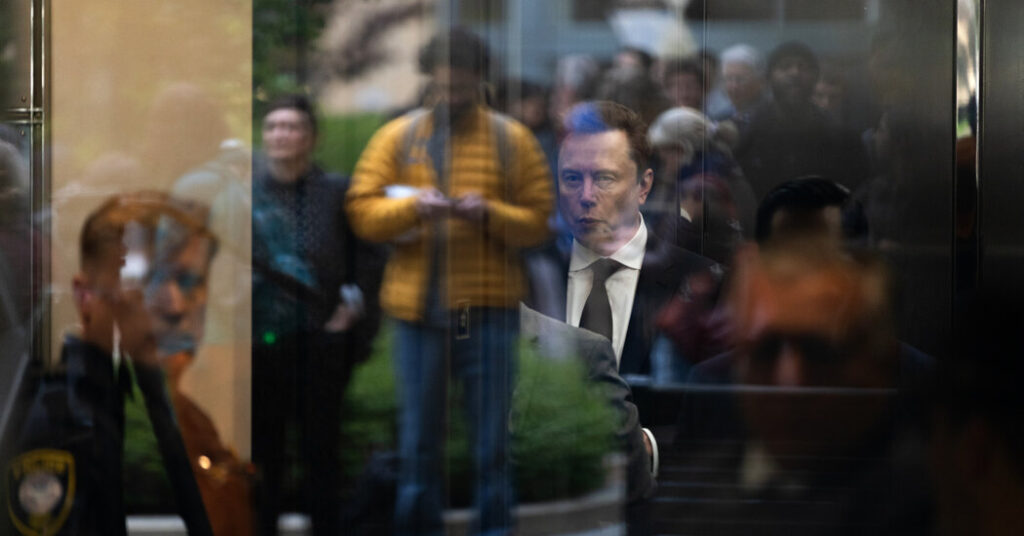
Mr. Musk and Mr. Altman were each whisked through a private entrance to the Ronald V. Dellums U.S. Courthouse as a line of lawyers and reporters waited to enter. Security had become more of a concern after a man, believed to be angry about A.I., was recently arrested after the authorities say he threw a firebomb at Mr. Altman’s San Francisco home.
It was clear in the courtroom that the feud between Mr. Musk and Mr. Altman has become deeply personal. As Judge Gonzalez Rogers broke for a brief recess on Monday before welcoming prospective jurors, Mr. Altman approached a New York Times reporter and said, “I hope you enjoy this.” And before lawyers made their opening statements on Tuesday, the judge admonished Mr. Musk about his prolific social media postings targeting OpenAI and mocking Mr. Altman as “Scam Altman.”
“How can we get things done without you making things worse outside the courtroom?” she asked. Mr. Musk said he was just responding to things OpenAI had said online. The judge asked him — and Mr. Altman — to start with a “clean slate” and “keep things to a minimum” on social media. They agreed.
In his opening statement, Mr. Musk’s lead counsel, Steven Molo, accused Mr. Altman and his fellow OpenAI executives of “stealing a charity.”
After Mr. Musk helped found OpenAI as a nonprofit, Mr. Molo said, Mr. Altman and others unjustly enriched themselves by transforming the charitable organization into a moneymaking enterprise. He compared today’s OpenAI to a museum store that has taken over the museum. “A museum store can’t loot the muse, steal all the Picasssos and use them to turn a profit,” he told the jury.
William Savitt, OpenAI’s lead counsel, said in his opening statement that was “sour grapes.”
“We are here because Musk didn’t get his way at OpenAI,” he said. “My clients had the nerve to go on and succeed without him. Mr. Musk did not like that.”
OpenAI’s lawyers (as well as a lawyer from Microsoft, which is an OpenAI investor and partner that was also named in the suit) argued that Mr. Musk didn’t seem to care that much about OpenAI after he left in 2018. He didn’t say anything when Microsoft invested $1 billion in the lab a year later. But when OpenAI’s chatbot ChatGPT became a hit in 2022, he started to pay attention.
“That’s when the sour grapes kick in,” Mr. Savitt said.
Mr. Musk, the first witness called by his lawyers, recounted his formative years leading to the creation of OpenAI, including a stint as a young lumberjack — a surprise to many in the courtroom — and his belief that he could help shape the future through technology.
Thirty minutes into this trip through his career, Mr. Musk said the goal of Neuralink, his start-up that aims to implant computer chips in people’s heads, is “A.I. safety.”
“If we can achieve an A.I.-human symbiosis,” he said. “We can achieve an A.I. that is better for humanity.”
Throughout his testimony, Mr. Musk said his various companies were efforts to benefit humanity. He said he created OpenAI after a chat with the Google co-founder Larry Page, who called Mr. Musk a “specieist,” meaning a person who favors humans over the digital life-forms of the future.
“I wanted a company to be a counterweight to Google — to be the opposite of Google,” he said. This company would not have a “profit motive,” he added, and would freely share its technology with the rest of the world. He painted himself as the driving force behind building the nonprofit A.I. lab before it was taken away from him.
“I came up with the name, recruited the key people, and raised the funding,” Mr. Musk said. He acknowledged that he was part of discussions to create a for-profit part of the enterprise but he wanted to keep the for-profit small. A for-profit was fine, he added, “as long as the tail did not wag the dog.”
Before the judge ended testimony for the day, Mr. Musk said he ultimately quit OpenAI because the other founders demanded too much equity in the for-profit company and the process of creating a for-profit had become too annoying. He is expected to continue his testimony on Wednesday morning.
(The Times has sued OpenAI and Microsoft, claiming copyright infringement of news content related to A.I. systems. The two companies have denied the suit’s claims.)
Mr. Musk filed his lawsuit in 2024, nine years after he and Mr. Altman and Greg Brockman, the company president also named in the suit, founded OpenAI with several A.I. researchers.
They soon realized that a nonprofit could not raise the enormous amounts of money they needed. Mr. Musk proposed folding OpenAI into his electric car company, Tesla, according to emails admitted into evidence in the court case. But he eventually left in a power struggle with Mr. Altman.
Mr. Altman and OpenAI raised $1 billion from Microsoft and agreed to license OpenAI’s technologies to the tech giant. Mr. Musk eventually founded his own A.I. company, xAI.
Last year, OpenAI restructured its for-profit company to prepare for a possible initial public offering on Wall Street, but the original nonprofit maintained control over the company.
Mr. Musk folded xAI this year into his rocket company, SpaceX, which is expected to go public as soon as this summer in an offering that could be worth as much as $1.75 trillion. In fact, Mr. Musk is in court just as SpaceX was set to make its case to existing and prospective investors this week at its facilities in Hawthorne, Calif.
If the jury finds in Mr. Musk’s favor, Judge Gonzalez Rogers will decide on monetary damages and other remedies.
Cade Metz is a Times reporter who writes about artificial intelligence, driverless cars, robotics, virtual reality and other emerging areas of technology.
The post OpenAI Trial Starts With Two Very Different Tales of a Company’s Early Years appeared first on New York Times.