King Charles III quoted Oscar Wilde, joking that the British have everything in common with America “except, of course, language.” President Trump said the morning’s gloomy rain reminded him of a “beautiful British day” and noted that his mother thought young Prince Charles was “so cute.” Both men waxed poetic about the bonds between their countries.
And yet, on the first full day of a state visit focused on the shared history between the United States and Britain, the king sprinkled in some ever-so-subtle rebuttals to Mr. Trump. He spoke on Tuesday of the value of the trans-Atlantic alliance, environmentalism and even his time in the Royal Navy, which Mr. Trump has belittled in recent weeks.
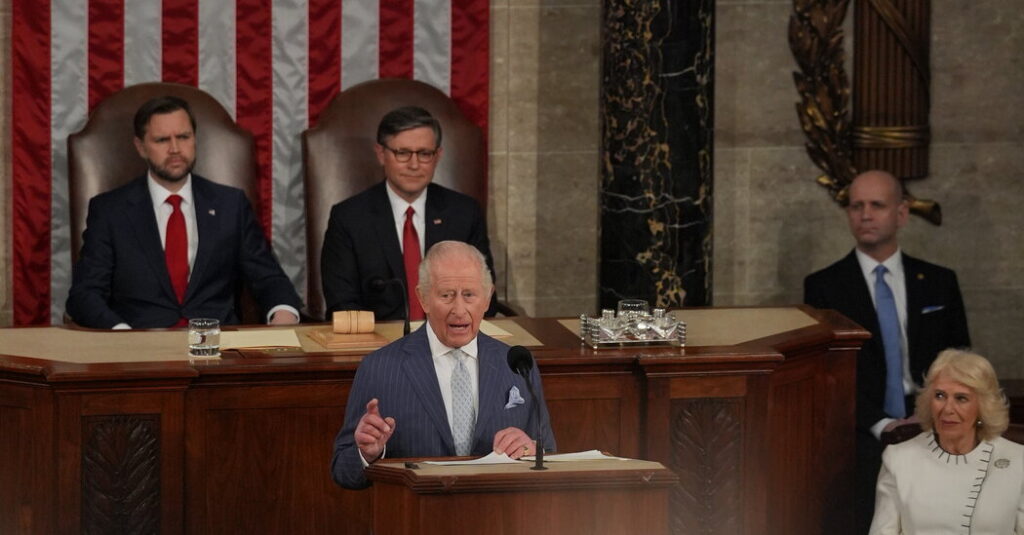
The king tucked his rejoinders into a mostly lighthearted speech to Congress, which drew both applause and laughter from the audience of Democrats and Republicans. It was only the second time a British monarch had addressed Congress.
“Please rest assured I am not here as part of some cunning rear-guard action!” the king said.
The disciplined and careful public appearances by both Charles and Mr. Trump came at a dire moment in American-British relations, arguably at their lowest point in decades over the war in Iran and Mr. Trump’s scathing attacks on NATO.
But for a day (and maybe just a day), the special relationship that has developed over the past 250 years seemed — on the surface at least — special.
In a rarity for the Trump era, the president did not veer wildly off script during the day’s mostly ceremonial events. He did not invite a horde of reporters into the Oval Office just before their meeting to field questions on Iran, the ballroom or Greenland in the presence of his visiting foreign dignitary. He did not lash out at another global ally.
Instead, Mr. Trump lavished the king with praise.
“Before we ever proclaimed our independence, Americans carried within us the rarest of gifts — moral courage — and it came from a small but mighty kingdom from across the sea,” Mr. Trump said on Tuesday morning as he welcomed Charles to the White House.
There is little evidence in more recent history that an era of good feeling will last much beyond the departure of the royal couple’s jet from American shores on Thursday, particularly as Mr. Trump’s well-known affection for the royals does not extend to the British government.
Mr. Trump is furious at Britain for its refusal to join the fight against Iran, and his administration continues to accuse the British government of denying free speech to conservative voices. In London, Prime Minister Keir Starmer vows not to be dragged into another war of America’s choosing, and bristles at the president’s description of their aircraft carriers as nothing more than “toys.”
Those differences were never likely to be erased by the king’s first visit to the United States as the British monarch. By law and tradition, the king is supposed to rise above the daily back-and-forth of politics and the disputes that often bedevil the leaders of both governments.
Mr. Trump was a guest of the royal family for a state dinner at Windsor Castle last September, an experience he described as “one of the highest honors of my life.” Months later, he belittled Mr. Starmer as a coward for not entering the U.S.-Israeli war with Iran.
“That was not very long ago and look where we are in terms of the bilateral relationship,” said Philippe Dickinson, deputy director at the Atlantic Council’s Transatlantic Security Initiative. “It can be cited as evidence by those who are going to make the case that it’s nice words one day and then forgotten the next day.”
The king at one point did appear to address, obliquely, the Jeffrey Epstein scandal that has caused political headaches for the Trump administration and caused a rupture in the Royal family.
“In both of our countries, it is the very fact of our vibrant, diverse and free societies that gives us our collective strength, including to support victims of some of the ills that, so tragically, exist in both our societies today,” Charles said.
Mr. Trump welcomed the king to the White House with a ceremony known as reviewing the troops, the highest diplomatic honor that can be extended by the United States to a visiting head of state, as well as the 21-gun salute by an honor guard.
In a speech that largely stuck to his prepared remarks, Mr. Trump praised the Anglo-American relationship in lofty terms, describing it as having birthed a “revolution in human freedom” that was “never, ever extinguished, but carried forward across centuries, across oceans and across history, until it became a fire that lit the entire world.”
And while Charles did not directly reference tensions between Britain and the United States — and no part of the king or president’s day of conversations were made public — he at times appeared to be in conversation with Mr. Trump and other doubters of the Western alliance during his speech to Congress.
“The very principle on which your Congress was founded — no taxation without representation — was at once a fundamental disagreement between us, and at the same time a shared democratic value which you inherited from us,” the king said during his speech to Congress on Tuesday afternoon. “Ours is a partnership born out of dispute.”
He also spoke of “the natural wonders” of the United States and “our shared responsibility to safeguard nature, our most precious and irreplaceable asset.” Charles is a passionate environmentalist; Mr. Trump, by contrast, pulled out of the Paris agreement on climate change, making the United States the only country in the world to abandon the international commitment to slow global warming.
Charles also seemed to take note that Mr. Trump has repeatedly belittled Mr. Starmer as a coward and mocked British military might.
The king spoke of his own service in the Royal Navy more than a half-century ago and repeated Mr. Starmer’s assertion that Britain had “committed to the biggest sustained increase in defense spending since the Cold War.”
He also pushed back, ever so gently, against Mr. Trump’s attacks on Britain and on the NATO alliance for not joining in the Iran war. After the Sept. 11, 2001, attacks, the king told lawmakers, “We answered the call together — as our people have done so for more than a century.”
While it was unclear whether the king’s appeal would be enough to mend the wounds in the trans-Atlantic relationship, Mr. Dickinson said the British were likely hoping the visit created a pathway to recovery.
“That’s why the government values the royal family as a diplomatic ace in the hand,” he said. “It’s not a magic wand but it helps.”
Michael D. Shear is the chief U.K. correspondent for The New York Times, covering British politics and culture and diplomacy around the world.
The post Beneath King Charles’s Jokes and Decorum, a Subtle Rebuttal to Trump appeared first on New York Times.