When the start-up Fermi America announced plans to build the Donald J. Trump Advanced Energy and Intelligence Campus near Amarillo, Texas, last year, investors clamored for a chance to cash in on the artificial intelligence boom sweeping through the U.S. economy.
Fermi’s co-founders include Rick Perry, energy secretary during President Donald Trump’s first term, and his son Griffin. The company said construction of the world’s largest data center would begin at the site by the end of 2025. It aimed to break ground on four nuclear plants bearing Trump’s name, it said in a news release last month, “on July 4th — with the President.” Investors valued the company at more than $13 billion after its initial public offering in October, making the stakes owned by Griffin Perry and the family of chief executive Toby Neugebauer each worth billions.
But stock traders have been fleeing Fermi since and dumped more shares last week after Neugebauer was forced out by the board. Construction appears to have stalled in Texas, and Fermi, which said in federal filings that it has never generated any revenue, has been unable to secure a tech company tenant for its planned data center. Griffin Perry and other company executives have cashed out tens of millions of dollars in Fermi stock in recent weeks, according to regulatory disclosures. Shareholder lawsuits accuse the company of overhyping its prospects for success, and its stock price ended Monday 81 percent below its public debut.
Fermi’s fall and its largely barren site near Amarillo, according to satellite photos, are now raising questions not just about the venture’s former management but also the sustainability of a nationwide rush of new projects and businesses designed to cater to the immense energy demands of major tech firms.
Scores of energy campuses and new power plants are planned to be built quickly across the United States, aiming to provide the energy that companies such as Google, Microsoft and OpenAI say will be needed to power the data centers underpinning their future AI services. Yet companies like Fermi are running into the same challenges that have long stymied more experienced developers trying to build new U.S. power generation, despite vowing novel approaches that would bring power online at warp speed. (The Washington Post has a content partnership with OpenAI.)
“This is starting to look like the dot-com bubble when everyone moved to the Bay Area looking to get rich,” said Iggy Ioppe, a former portfolio manager at Credit Suisse who tracks AI power projects as head of the investment desk for the platform Theo. “When you have a frenzy, you wind up with this kind of thing,” he said of shareholders alleging they were misled by Fermi.
Fermi declined interview requests and did not answer detailed questions from The Post about leadership changes at the company, the shareholder suits or its timeline for building nuclear plants or other energy infrastructure in Texas. Rick and Griffin Perry did not respond to requests for comment.
Neugebauer, Fermi’s former CEO, declined to answer detailed questions but said in a brief interview with The Post that the company was “riding high” after acquiring key equipment and preliminary construction work. “When you go look at the pace of accomplishment at Fermi, any contractor will say no one’s ever done it this fast,” he added.
He had previously said Fermi could build out its campus and nuclear reactors at unusual speed in part because their remote Texas panhandle location would accelerate permitting. The company spent heavily to acquire initial permits and highly sought generating equipment for the gas plants initially planned for its site, according to company filings. And Fermi worked to associate its project with Trump, who has cut nuclear energy regulation and urged new power generation from fossil fuels, naming its campus after him in federal filings, using his image in videos and adopting the slogan “Make America Nuclear Again.”
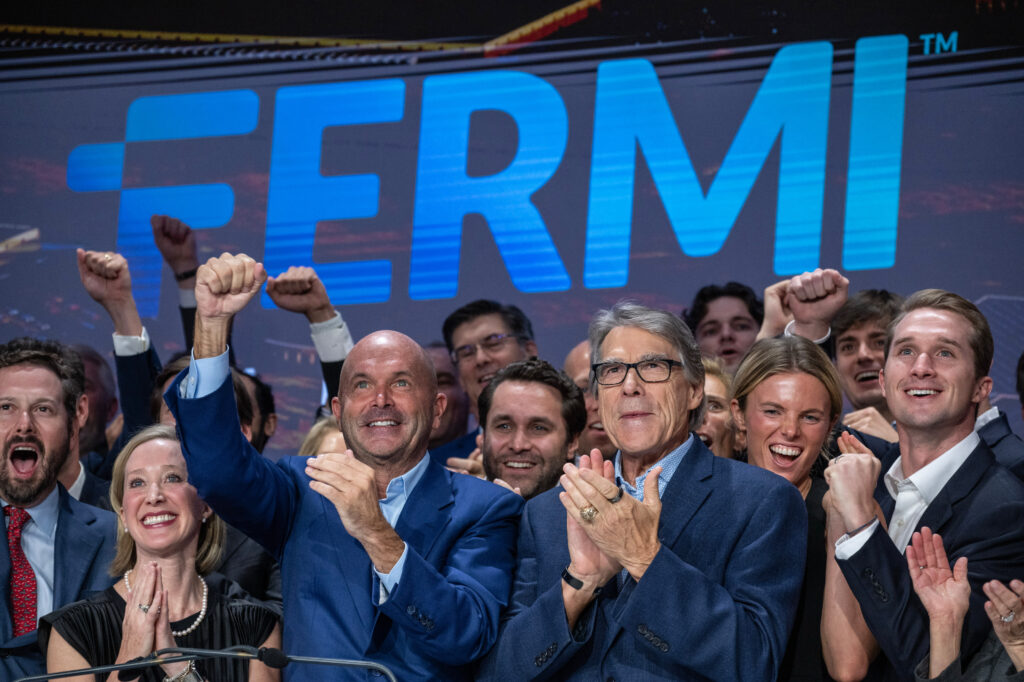
Neugebauer appeared alongside Commerce Secretary Howard Lutnick in an August photo Fermi distributed to celebrate signing a memorandum of understanding with Doosan Enerbility, a South Korean supplier of nuclear power plant components. Months later, South Korea struck a trade deal with Trump and pledged to invest $350 billion into the U.S.
Neugebauer later said that he sought help from Lutnick securing funding from South Korea for Fermi’s project. He told Politico this year that he spoke to Lutnick about being “frustrated” at a lack of progress on a deal with “Koreans ready to partner” with Fermi, and gave a tour of Fermi’s Amarillo site to the commerce secretary’s son Kyle.
Kyle Lutnick is executive vice chairman at Cantor Fitzgerald, an investment firm formerly led by Howard Lutnick. Regulatory filings show Cantor and a subsidiary were paid $6 million in cash for work on Fermi’s IPO. Another of Lutnick’s sons, Brandon, is Cantor’s chief executive.
A Commerce Department official said Neugebauer has not submitted a proposal for a share of the $350 billion in U.S. investment South Korea pledged in the trade deal and has not met Lutnick to discuss it. The official, speaking on the condition of anonymity because they were not authorized to comment publicly, said that money will be restricted to projects on federal land. Fermi is not building on federal land.
Jesse Jenkins, an associate professor at Princeton University’s Andlinger Center for Energy and the Environment, said some plans to quickly cash in on AI’s insatiable appetite for electricity are confronting the realities of physics, supply chain disruptions, energy markets and labor shortages.
“These mega-scale data centers amount to some of the largest and most complex infrastructure projects of our day,” Jenkins said, adding that leading figures at Fermi had little track record developing such major energy projects. “The idea that a few politically connected people with little experience could pull off a many billion dollar, many gigawatt, fully off the power grid project is quite a gamble.”
Fermi has said it plans to ultimately generate 17 gigawatts — roughly the amount of power generated by the entire state of Colorado at times of high demand.
Cantor Fitzgerald declined to comment. Kyle and Brandon Lutnick did not respond to a request for comment.
“President Trump pledged to cement America’s dominance in the cutting-edge technologies of the future, and the Trump administration is delivering with a whole-of-government effort that goes beyond working with any one or even [a] handful of companies,” White House spokesman Kush Desai said.
A Fermi spokesperson referred The Post to recent news releases and corporate filings that suggest the company’s struggles were rooted in leadership challenges that have been resolved. “Fermi is evolving from an entrepreneurial start-up culture into a public-company-caliber professional enterprise,” a company release said. The management shakeup and the firm’s rebranding last week as “Fermi 2.0” have “received significant and positive feedback from multiple potential tenants” for its data centers, the company said.
Despite that rosy messaging, Fermi remains tied to its former management and still faces the challenge of delivering on the ambitious plans it touted to shareholders and the world.
Neugebauer, who owns a 17,000-square-foot Dallas mansion modeled after the White House, and is the son of former congressman Randy Neugebauer (R-Texas), still sits on Fermi’s board. His family and other Fermi insiders fired in the shakeup that began on April 17 still own 40 percent of Fermi stock, Neugebauer said in a public statement last Monday. The former CEO said his priority is making money for all shareholders and called on the board to sell the firm immediately. The board said in its own statement that there would be no sale.
Neugebauer previously founded an “anti-woke” bank called GloriFi that offered credit cards made out of bullet casings. It went bankrupt months after opening in 2022. In bankruptcy litigation, Neugebauer was accused by GloriFi’s court-appointed trustee of spinning a “fairytale” to deflect blame for the bank’s demise and “complete disregard and disdain for corporate governance.” Neugebauer has denied the allegations in court and said misconduct by others caused the bank to fail. The case is ongoing.
Outside Amarillo, satellite imagery reviewed by the research firm Cleanview this month showed little evidence of the rapid construction that Fermi promised.
“They started clearing land, but then from February to April the images don’t show any significant progress,” said Michael Thomas, founder of Cleanview, which tracks data center energy projects. “It is clear they are behind,” he said of Fermi’s plan to have a 1 million square-foot data center and its first gigawatt of power generation up and running by the end of this year.
Fermi’s plunge underscores a growing tension inside the race to build AI infrastructure: While demand for computing power is real and tech firms have pledged to spend hundreds of billions of dollars on the infrastructure needed to get it, the practicality of delivering that power in just a few years is uncertain.
A shadow power grid of energy generation projects built solely to supply data centers is taking shape across the U.S. But few of the projects are complete, and the concept of powering data centers without tapping the existing network is largely unproven. Fermi’s plan was particularly ambitious because of its immense size.
“This is a reckoning,” said Jigar Shah, an energy entrepreneur who helped manage federal energy investments for the Biden administration. The idea that it would be easy to “bypass these old dinosaur utilities that are moving too slow” ignores realities about power generation, he said.
Some major AI companies have signaled that they are skeptical of taking data centers off the power grid. Last month, Google’s global head of data center energy, Amanda Peterson Corio, expressed doubts about energy projects completely “islanded” from the grid during a roundtable event in Houston where Neugebauer argued it was the best solution for major tech firms.
“When you’re building islands, you have to overbuild the system for the same amount of reliability,” the Google executive said at the event, part of S&P Global’s CERAWeek conference. “That’s a lot of investment in gas that is used just a few hours a year and otherwise is sitting idle.” Amazon officials have expressed similar concerns. (Amazon founder Jeff Bezos owns The Washington Post.)
Despite those debates, the huge scale of energy demand from tech companies leads some analysts to argue that any developers who have already locked down scarce equipment, access to gas pipelines and key environmental permits — as Fermi has — will ultimately have customers or become valuable acquisition targets for other companies.
“Fermi got a crazy valuation based on promises that they have not been able to keep,” said Raphaëlle d’Ornano, an analyst who follows AI-related startups, of the timeline Fermi presented to investors. Her firm, Decoding Discontinuity, warned in a report just after Fermi’s IPO that its stock was buoyedby investors making a risky bet that its apparent political connections would pay off. “But on paper, it is still a brilliant idea,” she said. “Now, the valuation has gone to a more reasonable level.”
The post A Trump-branded nuclear power project thrilled investors. Then came the crash. appeared first on Washington Post.