For more than a century, the world has run on coal.
When Thomas Edison’s Pearl Street electrical station in Lower Manhattan fired up in 1882, it ran on coal. Coal survived the oil era, the nuclear era, the dash for natural gas, and decades of back-and-forth climate policy. From the 1970s through the mid-2010s, coal supplied somewhere between 35 and 40 percent of the planet’s electricity, a steady if sooty presence powering modern life.
Then last year, it lost the lead. According to Ember’s Global Electricity Review 2026, recently released in time for Earth Day, renewable sources produced 33.8 percent of the world’s electricity last year, compared to 33 percent for coal. It was the first time those two lines had crossed since 1919, when the global grid was still small enough to run mostly on hydropower.
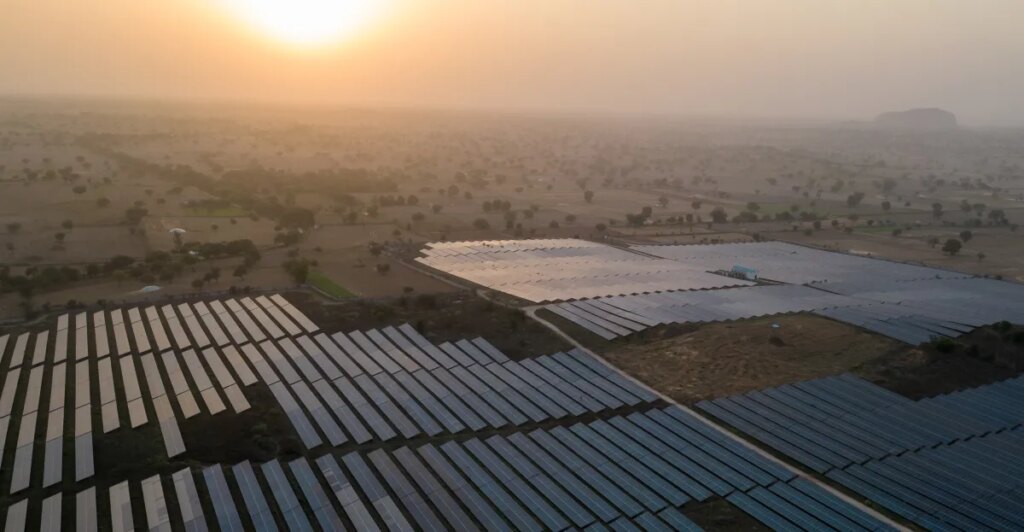
As coal has declined — at least on a relative basis — the sun has risen. When the Paris climate agreement was signed in 2015, solar produced just 256 terawatt hours of electricity globally. Nuclear power plants, at the time, were pumping out about 10 times that, while wind was responsible for three times as much electricity as solar.
A decade later, solar is producing 10 times more power: 2,778 TWh, roughly what the entire European Union consumes in a year. Its production has doubled in the past three years alone. For 21 years running, solar has been the fastest-growing source of electricity on the planet. In 2025 it surpassed wind for the first time, and is now on pace to pass nuclear this year.
While the world still burns a huge amount of coal — some 8.8 billion tonnes in 2024, according to the International Energy Agency (IEA) — solar alone covered 75 percent of the rise in global electricity demand. Put wind and solar together, and you’ve met 99 percent of it. Fossil fuel power generation — coal, oil, and gas combined — fell 0.2 percent in 2025, the first decline since the pandemic and only the fifth year this century that fossil generation didn’t rise.
Clean sources are now growing fast enough, on their own, to absorb just about everything the world is adding to its grid. And there’s a decent chance that, thanks in part to what’s happening right now in the Middle East, that transition may speed up.
Why solar is no fluke
It all starts with cost.
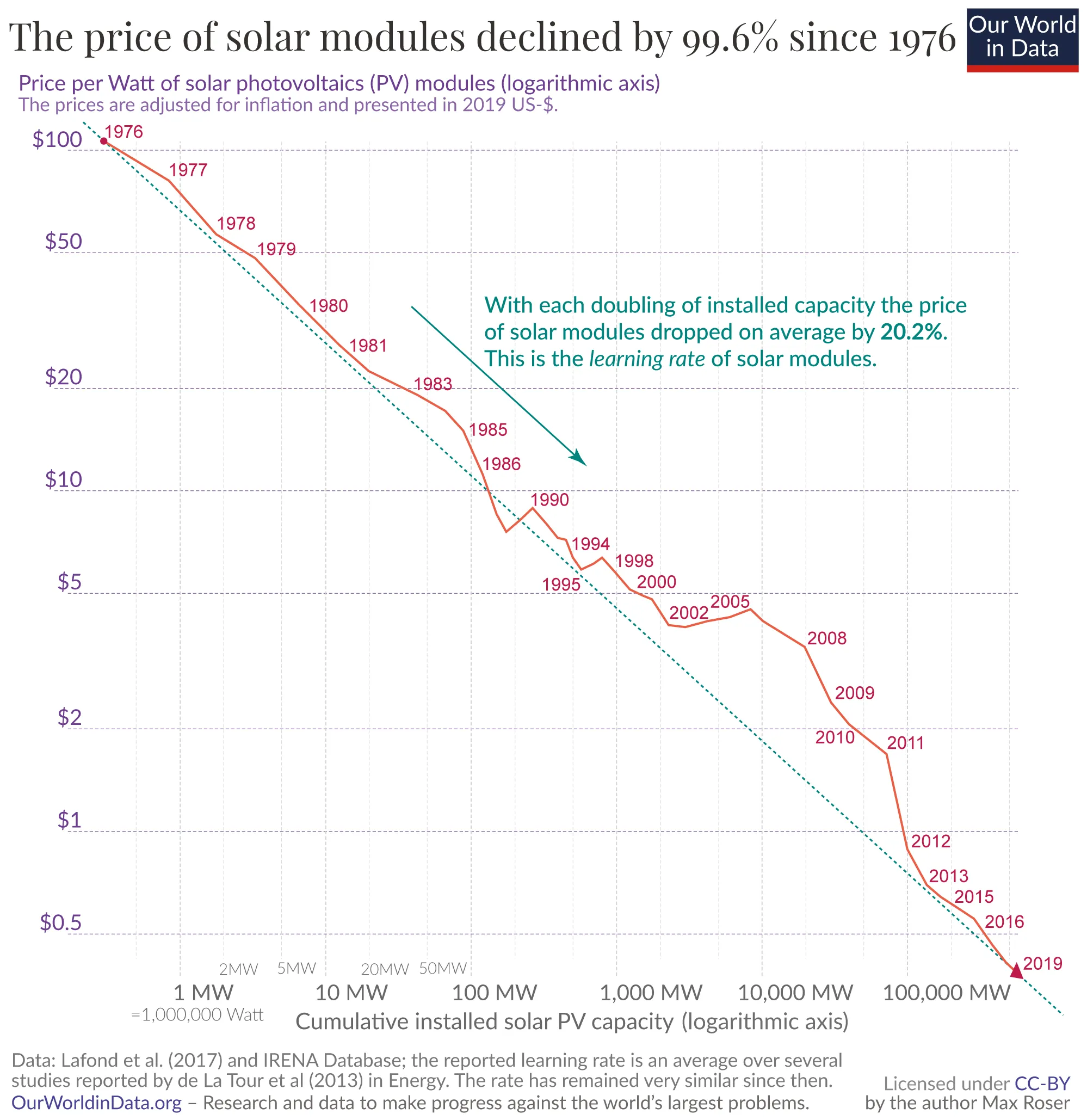
Solar module prices have fallen roughly 75 percent every decade for more than 40 years, a pattern so durable it has its own name, Swanson’s law, the observation that the price tends to drop by 20 percent every time the total number of solar panels ever built doubles. This rule has held through supply gluts, trade wars, and pandemics. In the mid-1970s, a solar module cost more than $100 per watt. In late 2025, one panel cost about 10 cents per watt. No other major energy source in modern history has gotten that cheaper, that fast.
The oldest objection to solar — that it goes dark when the sun goes down — is becoming obsolete because we can increasingly store the daytime electricity solar units generate. Battery costs dropped 20 percent in 2024 and another 45 percent in 2025. Global battery deployment grew 46 percent last year, to 250 gigawatt-hours. Solar plants built with enough batteries to deliver power round the clock now sell electricity in the US for around $76 per megawatt hour, cheaper than building new natural gas capacity.
The China story
The world’s long-time manufacturing powerhouse — China — has made this shift possible. Chinese factories now make around 80 percent of the world’s solar panels and an even larger share of the polysilicon, wafers, and cells that feed into them, a dominance built over two decades of state-backed investment, enormous scale, and ferocious price competition. The result is the cheapest energy technology in human history, produced at a pace the rest of the world has not matched.
Chinese dominance has also made clean power a geopolitical story: tariffs, trade disputes, arguments in Washington and Brussels about whether to build parallel supply chains. For the climate, though, the math is simple. Cheap panels built anywhere cut emissions everywhere.
The demand side has moved too. For most of the last two decades, the global coal story has been a Chinese story. When China’s electricity demand surged, so did coal. When it slackened, so did coal. That relationship cracked in 2025: China’s fossil generation fell 0.9 percent, its first decline since 2015, even as the country’s electricity demand rose 5 percent. India’s fossil fuel generation fell as well, by 3.3 percent, while its renewables grew 24 percent year over year. In both cases, new clean energy capacity outran new demand. Ember found that renewables in China now produce more electricity than every household and service-sector business in the country, combined.
Don’t get carried away — yet
A flat year for coal is not the same as a falling one. Power-sector emissions in 2025 were still close — within a rounding error — of 2024’s levels, which set a record high. In its report, Ember calls this moment “the era of clean growth,” which should be understood as the start of real decarbonization, rather than a final state of decarbonization.
Coal’s share is shrinking — from a peak of 41 percent of global generation in 2013 to 33 percent today — but the fleet itself isn’t going away. China approved more than 40 gigawatts of new coal capacity in just the first three quarters of 2025. Thanks to growth in renewables, these plants are increasingly becoming a backup source, rather than a primary one. But those plants exist, they burn coal when they run, and they’ll burn coal for years.
Then there is the US. The Trump administration’s One Big Beautiful Bill Act ended the residential solar tax credit in December and tightened eligibility for commercial projects. Rhodium Group, a research institute, projects the law will cut US clean-capacity additions through 2035 by more than half. America is in danger of getting left behind.
That sounds bad, and in the short run it is. But policy can slow a market; it has a harder time stopping one when the economics have already shifted. BloombergNEF reported that global energy-transition investment hit a record $2.3 trillion in 2025, up 8 percent from 2024. China alone put roughly $800 billion into clean energy last year; India’s clean-energy spending climbed 15 percent to about $68 billion; the EU has been accelerating renewables spending ever since Russia’s invasion of Ukraine cut its pipeline gas. Even if Washington slows down, the rest of the world is building solar farms and battery plants as fast as the supply chains allow. The US is trying to run against a market it no longer controls.
There is, however, the AI wild card. The IEA estimates global data-center electricity use rose 17 percent in 2025, with AI-specific demand growing faster. In the US, gas is currently the biggest single source of new data-center supply. Artificial intelligence is the one uncontrolled variable that could swamp clean-power gains in the back half of this decade.
Strait talk
The last big oil shock rewrote the global energy system. After the 1973 OPEC embargo, President Jimmy Carter put solar panels on the White House, founded the Solar Energy Research Institute in Golden, Colorado, and signed the country’s first appliance efficiency standards into law. Ronald Reagan undid much of that work, but the seed technologies — photovoltaic R&D, efficiency standards, CAFE rules for cars — kept developing in the background for decades.
This time, the shock is being felt by a system where clean alternatives are already the cheapest option in most places. The US-Iran war has led to the effective closure of the Strait of Hormuz, through which roughly a quarter of seaborne oil and a fifth of global LNG normally flow. The IEA called it the largest supply disruption in the history of the global oil market.
The response has been exactly what cheap clean power makes possible. In March, global solar generation grew 14 percent year over year and wind grew 8 percent; solar alone saved European buyers some $3.5 billion in gas costs for the month. Countries that might have responded to an oil crisis in 2006 by drilling faster are instead moving up construction for solar farms, offshore wind, and grid-scale storage. Where the 1970s planted seeds that took 40 years to sprout, 2026’s shock is meeting an industry already at commercial scale.
The climate case for clean power has always rested on a simple bet: that the technologies would keep getting cheaper faster than the politics got worse. Today, solar is the fastest-growing source of electricity in the history of electricity, while coal looks to be on a terminal decline. Batteries are starting to make it a 24-hour fuel. What comes next is a question of speed — and speed, mostly, is a question of choice.
A version of this story originally appeared in the Good News newsletter. Sign up here!
The post Renewable energy just broke a 100-year-old streak appeared first on Vox.