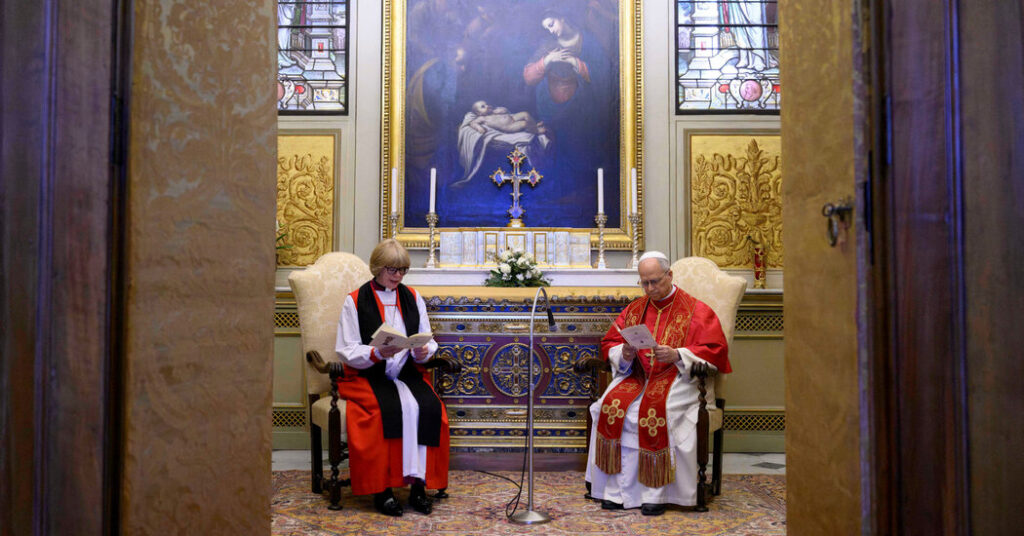
The Most Rev. Sarah Mullally, the first woman to lead the Anglican Communion, prayed at the Vatican on Monday with Pope Leo XIV, the leader of the Roman Catholic Church, projecting a powerful image of female ecclesiastical authority within an institution that maintains a male-only priesthood.
The historic meeting was both an expression of unity between two of the largest Christian denominations, which split nearly 500 years ago, as well as a reminder of one of their deepest contemporary differences.
The Church of England has allowed women to become priests since the 1990s, culminating in Archbishop Mullally’s appointment last year as archbishop of Canterbury, the most senior religious role within the Anglican faith. The Vatican, on the other hand, permits only men to be ordained and discussions about whether women can be ordained have been repeatedly tabled, most recently in December.
Without referring to specific issues, Leo acknowledged in an address to the archbishop on Monday that there were “continuing challenges” in the relationship between the two denominations. He said that while “much progress has been made on some historically divisive issues, new problems have arisen in recent decades,” adding that it would be “a scandal if we did not continue to work towards overcoming our differences, no matter how intractable they may appear.”
In her address to Leo, Archbishop Mullally said she was grateful that they had prayed together and pledged that in the years to come, “I will remain united with you in prayer: prayer for peace in our world; prayer for justice, and prayer that every person may come to discover the fullness of life that God offers.”
For Catholics campaigning to allow the ordination of women, the sight of a woman being received as the pope’s equal was a potent image that offered an example of what could be achieved within the Catholic church.
Tina Beattie, a Catholic theologian based in Britain, said campaigners might see the archbishop’s presence as “a catalyst for something very exciting”: symbolic change in the Catholic leadership’s language and attitudes to the question of female priesthood.
“The Catholic Church has to accept that the closest counterpart to the Pope in the Christian Church is now a woman,” she added.
Others said change was unlikely, given that Pope Leo has shown no sign of forcing a shift since his election last year. In interview last year with a Vatican reporter, he said he had no intention of changing church teaching on the question of ordination.
Some scholars and supporters of a male-only Catholic priesthood cite scripture and tradition to note that Jesus Christ conferred priesthood to the Twelve Apostles, all of whom were male.
“The Catholic Church teaches women and men are equal in their dignity but that doesn’t have to mean sameness,” said Teresa Tomeo, an American Catholic talk show host who opposes the ordaining of women.
The meeting between the two clerics was the latest example of the deepening relationship between Roman Catholicism and the Church of England. The day after Archbishop Mullally’s installation in March, a commemoration was held to mark the 60th anniversary of the first formal ecumenical statement between the Anglican and Roman Catholic churches.
When Queen Camilla and King Charles III, who is the titular head of the Church of England, met with Pope Leo at the Vatican last October, it was the first time that the heads of the two Christian churches had publicly prayed together since the Reformation.
Relations between Leo and Archbishop Mullally have been cordial so far. They exchanged friendly letters expressing their commitment to dialogue and Christian unity when she was installed, and Catholic prelates attended her installation ceremony.
Archbishop Mullally, who is a vocal proponent of the rights and role of women in the Church of England, has in some ways been accepted more willingly by the pope than some Anglican bishops, some of whom rejected her appointment. The Anglican Communion, which is estimated to have at least 85 million members around the world, has also been cleaved between reformers and traditionalists on issues like the role of women, as well as same-sex marriage.
By making Rome her first overseas destination as archbishop, Archbishop Mullally may have intended to project a sense of influence and authority amid efforts within the Anglican world to undermine her legitimacy, analysts said.
The pope’s willingness to meet with her “in effect shows some level of endorsement of her,” Catherine Pepinster, a church expert, wrote in an analysis in the National Catholic Reporter.
“Before Mullally ventures to Africa in July — a continent where some Anglican bishops do not accept her as the church’s primate because she is a woman — images will appear of her alongside the man who is arguably the world’s foremost spiritual leader,” Ms. Pepinster wrote.
Elisabetta Povoledo is a Times reporter based in Rome, covering Italy, the Vatican and the culture of the region. She has been a journalist for 35 years.
The post Female Anglican Leader Prays With Pope, Signaling Unity and Recalling Divide appeared first on New York Times.