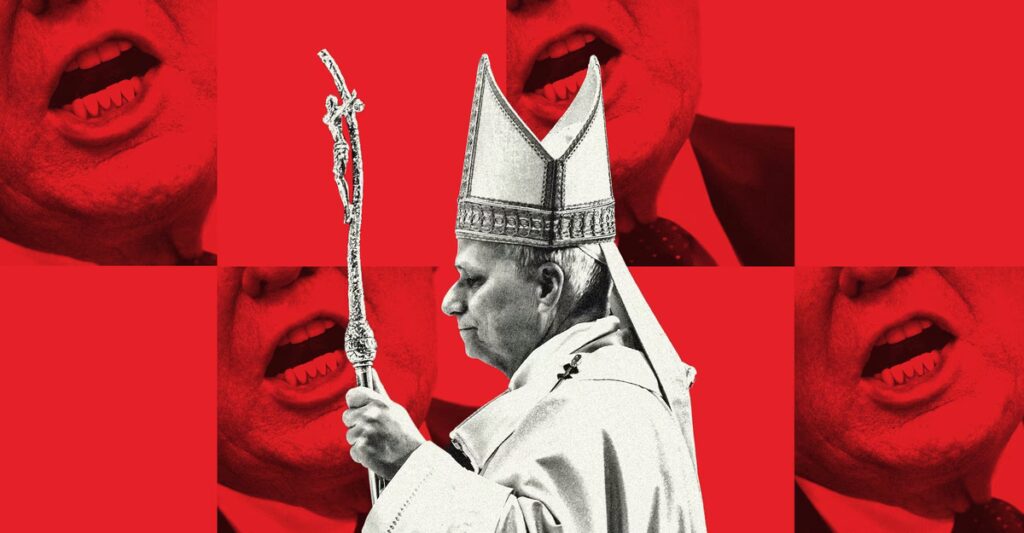
American presidents and popes have clashed before, but the battle of words and wills between Donald Trump and Pope Leo XIV is unprecedented.
The distinctiveness of their clash is not due mainly to the fact that Robert Francis Prevost is the first American-born pope, though that is significant. After all, Leo can’t be dismissed as a foreigner who is speaking about a country and culture he doesn’t understand. When he is critical of America, on matters ranging from war to mass deportation to those who “manipulate religions and the very name of God,” it comes from a place of love and devotion.
Nor does it have to do solely with the nature of the disagreements, most specifically the war waged by Trump against Iran. Past popes have criticized past presidents for going to war. What makes the Trump-Leo collision most unusual is the manner of the disagreement, not on the part of the pope—whose criticisms have been direct but restrained—but on the part of the president.
[Elizabeth Bruenig: A blasphemous president]
No president has ever attacked the spiritual leader of the Catholic Church so directly and so personally. Trump called Leo “WEAK on Crime” and “terrible for Foreign Policy.” He attacked the pontiff for opposing his Iran-war policy, labeling him a “very liberal person” who is “catering to the radical left.” He also said Leo owed his papacy to Trump. It’s unusual, to say the least, for a head of state—in this case, of the most powerful nation in the world—to treat the bishop of Rome as a bitter political rival.
But beyond that, this conflict has a dramatic, even archetypal, quality to it, pitting polar opposites against each other. One is a religious man in the deepest sense; the whole of his life has been shaped by religious disciplines and a theological tradition. He is inseparable from his faith.
The other is completely secular—thoroughly of this age, thoroughly of this world. He measures success by wealth, by power, by sexual conquest. He admitted that he’s never asked God for forgiveness. He has no ties to any church and is in many ways contemptuous of the core teachings of the Christian faith.
Leo is disciplined, mild-mannered, calm, and deliberative. He is an Augustinian, part of an order founded in the 13th century. Augustinians are known as “active contemplatives” who combine a deep inner spiritual life with service to others. Members of the order commit to live together in harmony, “intent upon God in oneness of mind and heart.” Augustinians also take vows of poverty, chastity, and obedience.
From Augustine, Leo learned to be deeply skeptical of worldly power. He speaks about the “delusion of omnipotence” and is alert to the danger of pride and grandiosity. The Augustinian tradition emphasizes fraternity, humility, and reflection on our disordered desires. Shaped by the Latin American church’s social vision—he served two decades as a missionary and Augustinian priest in Peru—Leo believes “the preferential choice for the poor is a source of extraordinary renewal both for the Church and for society.”
“Wanting to inaugurate a kingdom of justice, fraternity and solidarity,” Leo said in his first major papal document, “God has a special place in his heart for those who are discriminated against and oppressed, and he asks us, his Church, to make a decisive and radical choice in favor of the weakest.”
“A Church that sets no limits to love, that knows no enemies to fight but only men and women to love,” Leo continued, “is the Church that the world needs today.”
Leo’s commitments and life story are alien to Trump. Everything Leo cherishes, Trump holds in contempt.
But what has made the confrontation most electrifying is the way in which the pontiff is not just standing up to the president but transcending him. Leo has said he has “no fear” of the Trump administration, and no one can doubt him. He speaks as a liberated, confident man whom the president cannot intimidate. The pope is setting the terms of debate by relying on moral language and moral reasoning; on Catholic social teaching, the Church fathers, and the scriptures.
Leo has not lashed out, or gotten defensive, or allowed himself to be pulled down into the gutter. When the president goes low, the pope goes high. But going high doesn’t mean going silent. He said he will continue to speak out on matters of justice and against the war.
Even if one is not entirely convinced by Leo’s arguments, one can appreciate that he is speaking uncynically and without ulterior motives. He’s not playing political games, or trying to improve his poll ratings, or running for office. He’s not looking for access to power or seeking self-enrichment. Nor is the bishop of Rome trying to humiliate or dehumanize his opponent.
The things Leo appears to care about—faithfully serving God and the Church, caring for the vulnerable, speaking the truth as he understands it—are things Trump cannot touch, or even understand. There’s no target for Trump to hit, which is why his attack on the pope for being “WEAK on crime” was absurd even by Trump’s standards. Trump is quite skilled at knowing how to break politicians; he’s at a loss to know what to do with prophetic voices. He is punching at shadows.
I should add that, as a non-Catholic Christian, I have found what Leo has done vivifying. That reaction has less to do with the specific arguments Leo is making related to the war—though we should all welcome into the debate a discussion of just-war theory—than with his having reinjected serious moral arguments into our political discourse. Leo has shown that the Christian Church can once again be, as Martin Luther King Jr. put it, not the master or the servant of the state but the conscience of the state, its guide and critic and never its tool.
That so many people of the Christian faith, especially white evangelicals and prominent figures within that movement, have weaponized their faith to win the favor of an American president is among the most grievous things to have occurred during the Trump era. And they have sought the favor of not just any American president but one who is mendacious, lawless, cruel, and thoroughly corrupt. These courtiers have defamed Jesus while pretending they are acting in his name. The damage they have inflicted on the Christian faith is incalculable.
[Tom Nichols: Pope James David Vance the first]
In a different category are evangelical ministers and faith leaders who know better, who see exactly the harm Trump is doing to the Christian witness, and yet have, for a variety of reasons, chosen silence.
Into all of this cometh the bishop of Rome. He is unwilling to subordinate his faith to politics, or to adjust his commitment to the Gospel in exchange for access to power. A man who served the poor in Peru during the Shining Path insurgency—he stayed when others left—is not particularly fearful of critical posts on Truth Social or of those within his church who might disapprove of his public stand in defense of justice and a Christian ethic. He’s a person with deep moral convictions but who holds them with grace and ease. He comes across as calm, centered, and unhurried. He believes he answers to a higher authority; this allows him to offer a true Christian witness. This is a gift to the whole Church, and to the whole world.
“Even now, in sordid particulars,” T. S. Eliot wrote in Murder in the Cathedral, “the eternal design may appear.” What Eliot meant by this is that in the midst of a broken, chaotic world, where despair often abounds, there is an eternal design at play, even if we may not quite see it while we’re living through it. Nor is the divine set apart from human suffering. Christians believe that God entered into the suffering and violence of this world, redeeming even the “sordid particulars.” But that doesn’t happen on its own.
“Love obligates us to stay in the world,” the political philosopher Glenn Tinder wrote in The Political Meaning of Christianity, “where most of our fellow human beings are compelled by circumstances to stay.” A “prophetic stance,” he said, “can show us how to live in temporal society as citizens of an eternal society.”
Such a prophetic stance is rare in any time; for the past decade it has been almost entirely missing. Thankfully a native of the South Side of Chicago, who now resides in Vatican City, has shown us what a prophetic stance can look like.
The post The American Pope vs. the American President appeared first on The Atlantic.