“Intel is where good reputations go to die,” the veteran Silicon Valley investor, Michael Marks, once said. Founded in the 1960s in Santa Clara, California, it was the classic tech manufacturing story of rags to riches and then drift—its technology business challenged by Nvidia, AMD, and Arm. AI appeared to be yet another insurmountable hurdle for a company built for an era when personal computers still seemed pretty neat.
On Friday, Intel’s shares hit a record high after announcing revenue forecasts described as “blockbuster”. New customers for its AI-chips, including Tesla, and June quarter revenue estimates of $14.8bn saw its share price jump 24%. The stock is now up 120% this year.
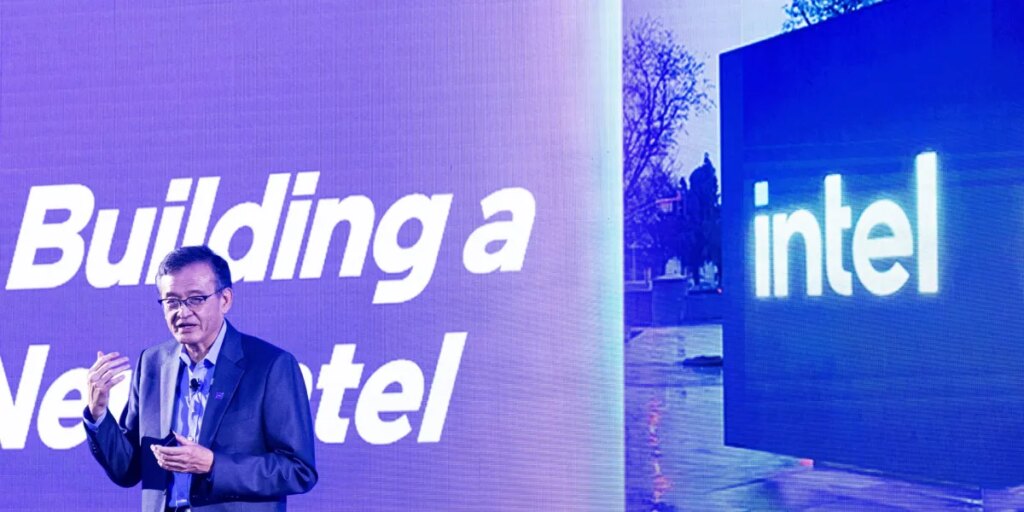
The AI boom has found another darling. Far from faltering, Lip-Bu Tan, who became Chief Executive of Intel in March 2025, is flourishing. Investors are grateful.
Greg Ernst is Intel’s Chief Revenue Officer. Speaking to Fortune at Mobile World Congress in Barcelona last month, he said that the strategy put in place then was now working, despite initial skepticism from some investors (Tan made it clear when he took over that laboring Intel faced tough challenges).
“The good news is the demand for server CPUs [central processing units] has never been higher,” Ernst said. “In the last six months, companies like Anthropic, Gemini, OpenAI, really moved to true agentic-model architecture, where it’s not just this one big LLM, but hundreds of smaller models and agents.”
“All of a sudden, the demand for CPUs has gone through the roof because all of these models need to communicate with each other. And what is the CPU really great at? It’s good at orchestration and managing the communication and tracking the data that’s going back and forth between these models.” Demand is so high that supply is struggling to keep pace.
Added to the market opportunity is the second leg of the strategy—deep partnerships.
“We decided we’re going to enter some deep partnerships and then we would get the option to issue stock,” Ernst said. “As you can imagine, that could go either way for a company, because you’re diluting existing shareholders by issuing new stock. But our thesis was: if there’s true technical partnership, investors would be inspired by it and they would instantly see the value.”
“So, we had a short list. Softbank was one. Nvidia was one. The US government at the time was not a plan—that came together quickly later.”
The final part of Ernst’s answer hides controversy. Donald Trump initially demanded Tan resign due to his early-career links to the Chinese semiconductor industry (Tan, from Malaysia, was an investor). A meeting between the President, Howard Lutnick, the commerce secretary, and Tan followed, and the ever-mercurial Trump announced that Tan had an “amazing story”. In August it was announced that the federal government would take a 10% stake in Intel for $8.9bn, a valuation that has leapt to $36bn.
“Their investment has been great,” Ernst said. “They have been very hands off. We do give them updates on our progress. Another piece for us is that we have a lot of great customers in China. So, we are constantly also being transparent with the companies in China, the Chinese government, and [about] what that investment means in the US. We’re an American company.”
I asked if there has any been any pressure from the US government to divest interests in China. “No, there has been none.”
In 2007, Intel turned down the chance to be the main provider of chips for a new mobile phone which was about to enter the market. “I couldn’t see it,” Intel CEO at the time, Paul Otellini, said later. Intel may have missed the chance to be the technological partner of the Apple iPhone. Tan does not want to make the same mistake with agentic AI.
The post Intel’s share price just blew the doors off. One man thinks he knows the reason why appeared first on Fortune.