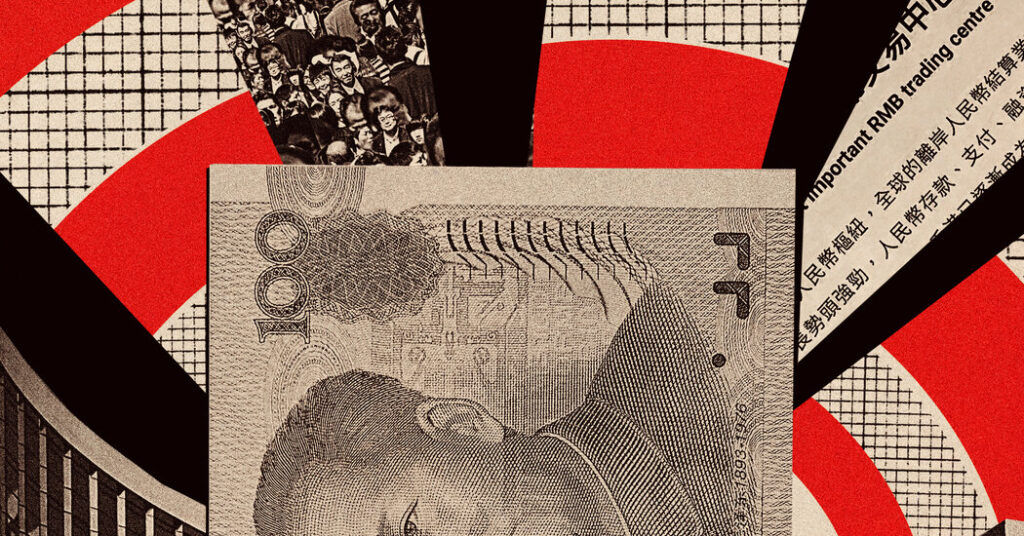
Neat rows of Chinese currency bills sit behind glass at the center of the national security gallery inside Hong Kong’s Museum of History, along with model fighter jets, attack helicopters and vials of rare-earth metals.
Set with instruments of war and trade, the display underscores a central idea: The internationalization of its currency, the renminbi, is considered a pillar of China’s national security.
Despite its rise as an economic superpower, China remains reliant on a global financial system anchored by the dollar. Turning the renminbi into a globally accepted currency would let Beijing conduct more trade on its own terms and blunt a longstanding source of American leverage.
That push has gained momentum from the wars in Ukraine and Iran, as sanctions drive American adversaries toward the renminbi to bypass the Western financial system. In effect, China’s 20-year project to build the international financial ties and technological infrastructure for a globally accepted currency is paying off, even if others are the ones sidestepping the dollar.
China’s financial positioning is “meeting the demand for de-dollarization” from countries seeking to trade with restricted nations like Iran, said Alisha Chhangani, an associate director at the Atlantic Council, a Washington think tank.
Since the end of World War II, when 44 countries agreed to make the dollar the world’s reserve currency, most global trade has run on it. That dominance has given the United States powerful leverage, allowing it to impose sanctions that can all but ensure financial ruin.
Recent conflicts have shown how a Chinese alternative can offer a way around the system. At least two ships have paid Iran in renminbi to secure safe transit through the Strait of Hormuz, according to Lloyd’s List Intelligence, a maritime information service.
Payments using China’s network rose nearly 50 percent last month as countries bought Iranian oil, according to data from the Atlantic Council. Russia, cut off from the dollar after invading Ukraine, now settles most of its trade with China in renminbi.
In March, Qiushi, the Chinese Communist Party’s ideological journal, resurfaced a 2024 speech by Xi Jinping, China’s leader, calling for the renminbi to be “widely used in international trade” and to “attain reserve currency status.”
The dollar is still the top currency of choice in international trade, valued for its liquidity and ease of use. The euro, yen and British pound are distant runners-up. Even transactions that do not involve the United States are often done with dollars, including most of China’s own trade. The renminbi accounts for just 3 percent of global transactions, roughly the same as the Canadian dollar.
China’s tight financial controls have long held back the renminbi’s global use, making it less attractive to hold. Capital flows are tightly managed. Citizens can move only limited sums abroad each year, and foreign investors face strict quotas and must obtain approvals to buy Chinese stocks and bonds.
But China doesn’t need to displace the dollar to move closer to escaping America’s financial grip, said Edward Fishman, a fellow at the Council on Foreign Relations. Simply having an alternative system in place for emergencies is enough to weaken Washington’s chokehold on global finance.
Beijing has gone to extraordinary lengths to insulate itself from geopolitical shocks, building stockpiles of oil, gas and critical materials. It even maintains a strategic reserve of pork, a staple of the nation’s diet. In the same vein, China has spent decades developing a parallel financial infrastructure that operates outside the dollar system.
Beginning in the 2000s, China signed currency-swap agreements with dozens of central banks, giving trading partners access to the renminbi without going through the dollar-based system. These so-called swap lines, totaling roughly $600 billion, provide emergency liquidity and could expand China’s influence in a financial crisis.
In 2015, China launched the Cross-border Interbank Payment System, or CIPS, allowing banks worldwide to settle payments in renminbi. The system offers an alternative to SWIFT, the Belgian-based messaging network that underpins most global transactions. Both Russian and Iranian banks have been kicked off SWIFT under U.S. pressure.
Since Russian banks were removed from SWIFT after its full-scale invasion of Ukraine in 2022, the number of institutions directly participating in CIPS has nearly tripled, rising to nearly 200 from 75, according to Chinese government data.
Money flowing through China’s financial plumbing has surged since the war in Iran forced the closure of the Strait of Hormuz, a vital shipping channel through which roughly 20 percent of the world’s oil flows, according to the Atlantic Council’s GeoEconomics Center. Countries desperate for oil are increasingly using the Chinese network to pay for internationally restricted crude outside the dollar system.
From February to March, the average daily payments rose to more than $131 billion a day from $86 billion, while the average transaction size increased over 8 percent, according to data from the Atlantic Council’s GeoEconomics Center. Shanghai Securities News, a state-owned newspaper, attributed the growth in use to “continued uncertainty in the Middle East.”
“The uptick has to be other countries in Asia that are switching to usage in this moment” to buy restricted oil, said Josh Lipsky, the director of the GeoEconomics Center at the Atlantic Council.
Major hurdles remain for the renminbi to challenge the dollar’s dominance, said Eswar Prasad, a professor of economics at Cornell University.
For the currency to play a larger global role, it must be easier to use outside China, which requires loosening Beijing’s tight capital flow controls. The government has been reluctant to take that step for fear of losing control of its exchange rate. Without that opening, there is not enough renminbi circulating abroad for trading partners to do much beyond buying Chinese goods, Mr. Prasad said.
When countries like Saudi Arabia sell their oil for dollars, they can easily recycle those proceeds into liquid assets such as U.S. Treasury bonds. With renminbi, there is no equivalent yet.
So far, China has taken small but meaningful steps toward strengthening its cross-border payment system. It is still unclear whether China is truly on a “durable path” to becoming a major global payments currency, Mr. Prasad said. But one thing is clear: “There is a desperate desire in the world to escape the clutches of the dollar-denominated system.”
Berry Wang contributed reporting from Hong Kong.
The post War and Sanctions Accelerate China’s Currency Push appeared first on New York Times.