Six hundred and eighty-eight.
That is the number of amendments that just seven members of Britain’s House of Lords have proposed to a bill that was meant to legalize assisted dying for the terminally ill.
So many amendments have been lodged — more than 1,280 in total — that the bill now seems doomed to fail, in a rare example of the Lords, Parliament’s unelected second chamber, blocking a bill approved by the House of Commons.
Critics say that if that happens, it would threaten the credibility of an institution that much of the British public already considers bloated and undemocratic, according to opinion polls. Surveys also show that a consistent majority of Britons think assisted dying should be allowed in cases where someone is dying from an incurable illness.
“It is a giant filibuster,” said Charles Falconer, a former Labour Party minister and a leading proponent of the bill in the Lords. It is “absolutely infuriating,” he added. “If all the Lords does is talk and come to no conclusions, which is what’s happening here, then what’s the point of the Lords?”
The House of Commons voted in a landmark decision in 2024 to allow assisted dying for some terminally ill, mentally competent adults.
The bill, which was scrutinized and amended in the months after, includes strict conditions. Only people who are over 18, and who have been given fewer than six months to live, would be eligible. Two doctors and a specialist panel would have to approve the decision, and patients would have to administer the lethal substance themselves.
Opponents in the Lords argue that the bill is poorly drafted and does not contain enough safeguards to protect vulnerable people from possibly being pressured into an assisted death. They have pointed to reservations expressed by some medical organizations, including the Royal College of Psychiatrists, the Royal College of Physicians and the Royal College of Pathologists. Proposing changes is their job, they say.
Given the lack of time now left on the parliamentary calendar, Mr. Falconer acknowledged that the bill is “not going to go through all its stages.”
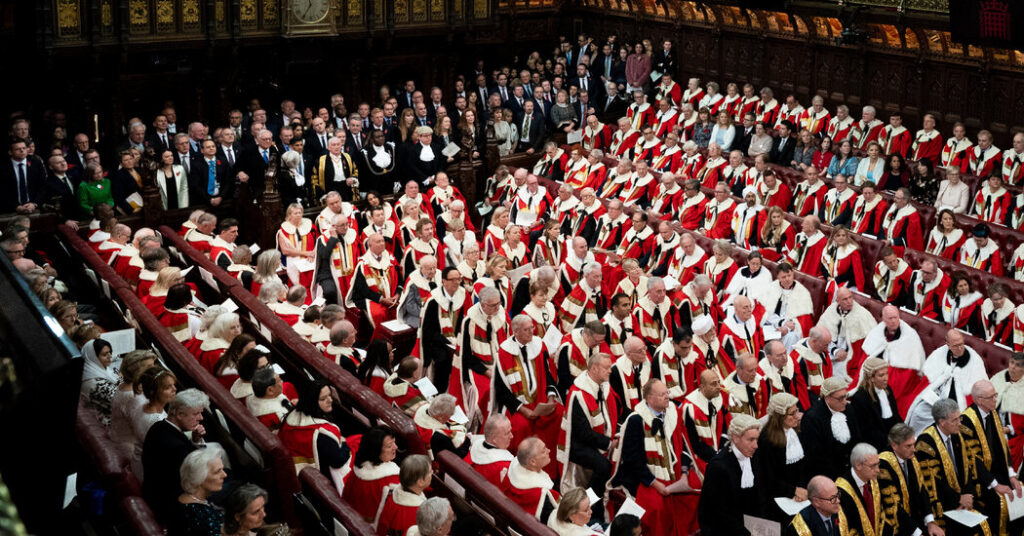
With its ornate, gilded chamber and archaic rules, the House of Lords scrutinizes, amends and often improves bills. But under Britain’s unwritten constitutional arrangements, it generally does not veto legislation and instead bows to the will of the country’s 650 elected members of the House of Commons.
The bill’s opponents know that the parliamentary gridlock has prompted questions about the role of the Lords. “I think that’s meant to encourage us to change our minds,” said Tanni Grey-Thompson, a Paralympic gold medalist, disability rights campaigner and one of the top seven amenders to the bill in the Lords, who have proposed more than half of the total amendments between them. “And it’s not working.”
She conceded that some amendments — including one she had proposed requiring that anyone seeking an assisted death provide “a negative pregnancy test” — could have been better drafted. Critics have pointed out that this would not be relevant for men, older women or people who can’t have children, but she said she wanted to address how to support terminally ill pregnant women.
Ms. Grey-Thompson, who has proposed a total of 130 amendments to the bill, rejected accusations of filibustering. She said that the bill leaves out vital detail and said she was determined to prevent disabled people being pressured into ending their lives. Coercion could, she said, be “very gentle” for disabled people who “are quite often made to feel they have no value to society anyway.”
Other opponents to the bill include those who believe palliative care should be improved to ensure terminally ill people have a real choice, and those who oppose assisted dying for religious reasons. A number of the 26 Church of England bishops who have an automatic right to sit in the House of Lords have expressed reservations.
Humanists U.K., a group that supports the legislation and has been tracking its progress, said the impasse reflects the fact that procedures in the Lords allow a small number of members “who are vehemently opposed to the bill to block its passage.”
Some experts believe that the problems arose because the legislation was drafted not by the government but by a lawmaker in the Commons, Kim Leadbeater, who won a ballot for non-government legislators to propose what is known as a Private Members’ Bill on a topic of their choosing. These lawmakers do not have the power to set up inquiries to consult the general public about potential changes of the law, which could have helped bolster the case for the bill.
By contrast, there was wide consultation on similar legislation passed in Jersey, an island in the English Channel that makes its own laws, said Rebecca McKee, a senior researcher at the Institute for Government, a London-based think tank.
Assisted dying was discussed by a “citizens jury” there before a bill went to Jersey’s legislators who “had a much better idea of what the public wanted” in terms of safeguards and trade-offs, Ms. McKee said. There was nothing similar before the legislation covering England and Wales went to Parliament, Ms. McKee added, and “not being a government bill, it didn’t have the pre-legislative legwork that I think something like this does need.”
A key question is what happens if, as expected, the bill fails.
It could be forced through under a procedure allowing the Commons — by voting a second time — to overrule the Lords. To do that the legislation could be reintroduced as a Private Members’ Bill in the next session. However, for that to happen, another lawmaker who supports assisted dying would have to come close to the top of the next ballot to propose a second Private Members’ Bill on the matter — by no means guaranteed.
Alternatively, the government could allot time for the bill in the next session, which begins in May. Ms. McKee believes, however, that this is unlikely because the cabinet is split on the issue of assisted dying (elected lawmakers were allowed to vote according to their conscience in the Commons rather than being obliged to follow a party line).
Mr. Falconer said the battle over the bill is not over. “Its drive is coming from people who have experience of the horrors that terminal illness can involve,” he said. “Although one should do everything one can to try to improve palliative care, for a group of people — no matter how good the palliative care is — that last period is not nice.”
In the meantime, in addition to the legislation passed in Jersey, there was a vote in favor of assisted dying in the Isle of Man, a crown dependency in the Irish Sea. Scotland’s Parliament, however, recently rejected a plan.
Ms. Grey-Thompson is undeterred by the criticism. But she acknowledged that the Lords had pushed itself into the unfamiliar glare of public scrutiny.
“Most people,” she said, “don’t pay much attention to us until we either do something they like — or hate.”
Stephen Castle is a London correspondent of The Times, writing widely about Britain, its politics and the country’s relationship with Europe.
The post In Britain, 7 Unelected Lords Are Helping to Block an Assisted Dying Bill appeared first on New York Times.