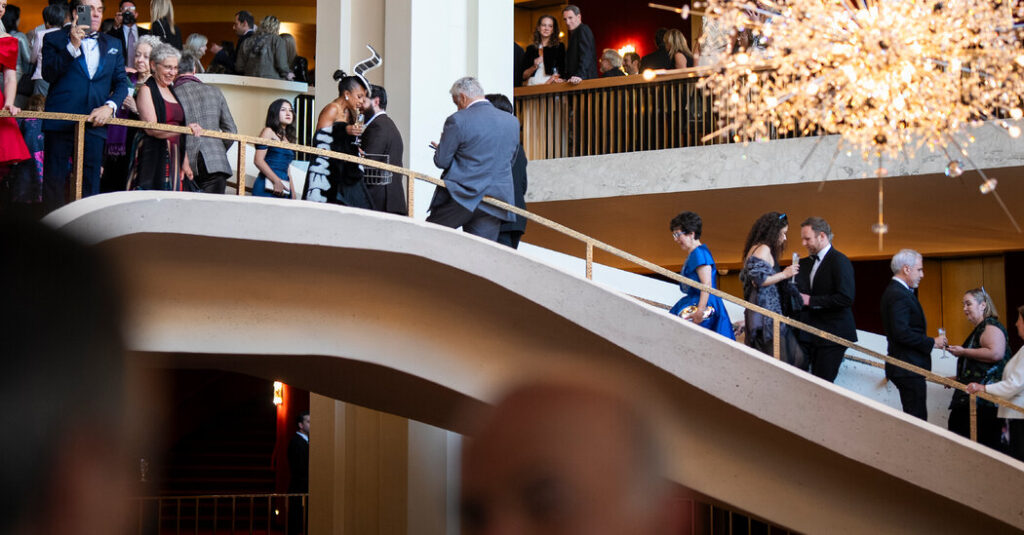
In a major blow to the Metropolitan Opera, the Saudi Arabian government has backed out of a deal that would have provided significant relief to the nation’s premier opera company as it struggles to recover from the most acute financial crisis in its history, Met officials announced on Thursday.
Peter Gelb, the Met’s general manager, said the Saudis cited damage to the country’s economy caused by the war in Iran and the blockading of oil passing through the Strait of Hormuz. Under the arrangement, announced in September, the Saudis were to have provided the Met with as much as $200 million over the next eight years — a major boon for the New York company as it tried to recover from a loss of revenue and audience during the Covid pandemic.
The deal called for the Met to decamp to Saudi Arabia for three weeks each February for a residency at the Royal Diriyah Opera House on the outskirts of Riyadh. In recent years, the Met has not staged performances in February.
In an interview, Gelb said the Saudi government told him it had pivoted away from many plans because of the war’s impact on its economy.
“They are only doing the projects that are essential,” he said recounting his conversation with Saudi officials, and the Met deal “falls outside what is essential.”
Paul Pacifico, a cultural official for the Saudi government who helped negotiate the deal with the Met, did not respond to requests for comment.
The Met had been counting on money from the Saudis this year. With the collapse of the deal, Gelb said, the Met faces a $30 million shortfall that it needs to fill by the end of this fiscal year, on July 31, and potentially far greater shortfalls in the years ahead.
Gelb said he was informed of the decision during a Zoom call with Saudi officials on Tuesday.
“This is something we had been working on for several years,” he said. “It’s a very significant disappointment. We are determined to find a sustainable path forward.”
Though announced with great fanfare by the Met last year, the deal was described as a “memorandum of understanding” and never committed the Saudis to the funding arrangement. Gelb continued to profess optimism that it would fall into place, even as the money failed to start flowing. That said, in January, the Met announced a series of layoffs, temporary salary cuts and a reduction in next year’s performance schedule as a pre-emptive move in case the Saudis backed out.
There have been ominous signs in recent weeks, including reporting that the Saudi Arabian sovereign wealth fund, valued at $1 trillion, would withdraw its support from LIV Golf, the golf circuit it started four years ago to compete with the PGA Tour.
“In light of the world situation, I’m not surprised,” Marc Scorca, the former president of Opera America, said of the Saudis withholding money from the Met.
The decision to enter a deal with the Saudis, a government with a history of human rights abuses, including its role in the 2018 killing of the Washington Post journalist Jamal Khashoggi, a Saudi dissident, was evidence of the lengths the Met was willing to go to deal with its financial problems.
Gelb said he would now try to make a similar arrangement with other countries but declined to name which ones. He also said that a previously announced plan to sell naming rights for the Metropolitan Opera House was moving ahead, though no deal has been struck. The Met is still looking to sell the two Marc Chagall murals hanging in the opera house; the murals would be sold to a private donor on the condition that they be left in place during the opera season.
The Met is also expecting to receive a bequest in excess of $100 million, but the settling of that estate and the disbursement of the money appears to be at least one year away, Met officials said.
Gelb said he hoped not to dip further into the Met’s endowment, which the organization began pulling from in 2022. Endowments are created to produce a steady stream of investment income, and withdrawing cash from them, even for emergency expenditures, is highly unorthodox.
The Met’s endowment is now valued at $216 million, down from $340 million in 2022.
Gelb said that he did not intend to cancel any more productions, but that he could not rule out any options given the Met’s precarious financial situation. It will stage 17 operas next year, down from 25 several years ago.
Before the pandemic, the Met’s earned revenues — money from ticket sales and its live HD transmissions to cinemas across the country — had covered 50 percent of its annual budget. The other half, about $150 million, came from contributions.
When the Met reopened after the pandemic, the drop in ticket sales — at the opera house and, more dramatically, at movie theaters — meant that revenues accounted for only one-third of the operating budget, or about $50 million less. That increased the amount of money that needed to come from contributions and was one reason the deal with the Saudis was so critical.
The Met has a $62 million line of credit that is due in February 2027. And in March, Moody’s downgraded the opera’s credit rating, which is below investment grade, for the third time in the span of a year.
This latest round of financial disruptions comes at what has been, in some ways, a strong year for the Met. Two productions — “Tristan und Isolde” and “The Amazing Adventures of Kavalier & Clay” — sold so many tickets that extra performances were added. “Innocence,” which is currently onstage, received strong reviews from critics.
“The irony is we are experiencing some of our greatest artistic successes at a time when the economics are proving so difficult,” Gelb said.
“Opera when it works, when it is firing on all cylinders, is one of the most extraordinary experiences,” he said. “On the other hand it is the most expensive.”
Adam Nagourney is the classical music and dance reporter for The Times.
The post Met Opera’s Multimillion-Dollar Deal With Saudis Falls Through appeared first on New York Times.