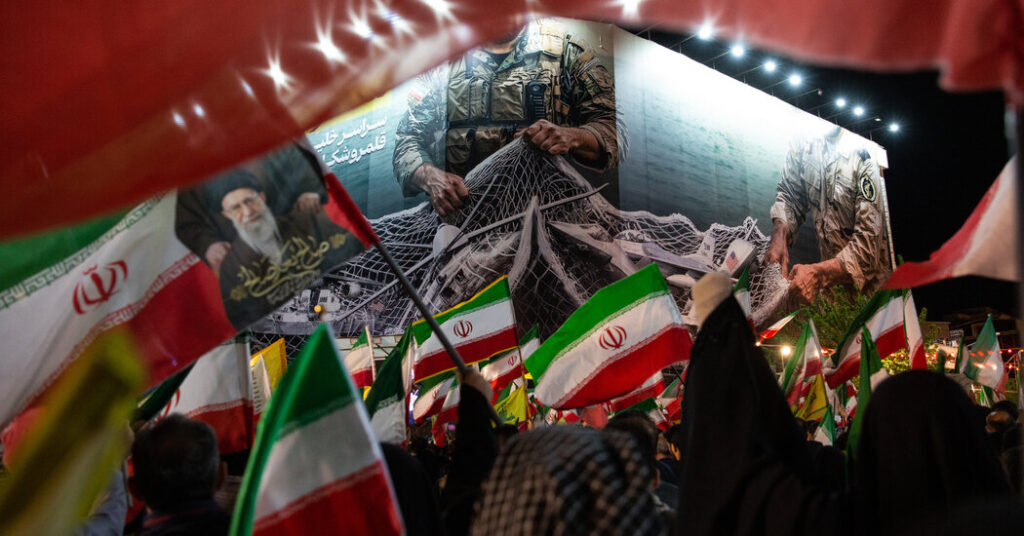
Before the war, it was clear who had the final say in Iran: The country’s supreme leader, Ali Khamenei, towered above everyone as the primary religious, political and military authority. After his death, his son was chosen to succeed him. But Mojtaba Khamenei is badly injured and in hiding, which raises a crucial question: Who is really in charge in Iran?
It turns out, it’s not one person. It’s a group of them. This week, my colleague Farnaz Fassihi has a remarkable story on how the war has empowered the Revolutionary Guards and is turning Iran’s theocracy into something more like a military regime.
Today I write about what that means for peace talks with the U.S. — and for Iran itself.
The rise of Iran’s generals
On Tuesday, as Vice President JD Vance prepared to fly to Islamabad, Pakistan, for a second round of peace talks, the Iranians pulled out.
The decision was made by the Islamic Revolutionary Guards Corps. They argued that President Trump’s blockade made talks futile. Iran’s president and foreign minister both disagreed. But the views of the Guards prevailed — as they tend to do in Iran these days.
When Ayatollah Ali Khamenei ruled Iran as the supreme leader, he exerted absolute control over all decisions about war, peace and negotiations with the U.S. But reporting by my colleague Farnaz Fassihi shows that his son and successor does not play the same role.
Mojtaba Khamenei is awaiting a prosthetic for his leg and is struggling to speak after suffering grave injuries in the strikes that killed his father. He has not been seen or heard from publicly since he was appointed in March. Instead, Farnaz explains in her gripping inside story of Iran’s new wartime leadership, it’s the commanders of the Revolutionary Guards who effectively run the country.
The Guards have long wielded power in Iran’s military, political and economic affairs. But under the elder Khamenei, they still reported to a religious figure who was also serving as the commander in chief of the armed forces.
Khamenei’s death in U.S.-Israeli strikes on the first day of the war created a vacuum and an opportunity, Farnaz writes. The Guards rallied behind Mojtaba, a longtime ally, and played an instrumental role in elevating him to the position of supreme leader.
They’ve been calling the shots ever since.
The Islamic republic is moving into a new era, Farnaz told me. It’s no longer a regime run by clerics, she said. What we’re seeing now are the early stages of a military regime.
Islamic republic 3.0
Trump likes to say that the war ushered in “regime change,” and that the new leaders are “much more reasonable.” In reality, the Islamic republic has not been toppled — but the regime has evolved. Whether it’s more reasonable probably depends on your perspective.
The Revolutionary Guards were the masterminds of Iran’s military response to the U.S.-Israeli strikes. They came up with the strategy of striking neighboring Gulf countries, and, crucially, to close the Strait of Hormuz.
They were the ones who agreed to a temporary cease-fire with the U.S. and who then tapped Mohammad Bagher Ghalibaf, the speaker of Parliament and a former Guards general, to lead the talks with Vance in Islamabad. After they pulled the plug on those talks this week, they seized two cargo vessels that had tried to pass through the Strait of Hormuz “without the necessary permits.”
They’ve also used their gains in the war as leverage to outmaneuver political rivals at home, Farnaz writes. The president and his cabinet have been sidelined from major decision-making, and the foreign minister, Abbas Araghchi, was marginalized in the peace negotiations, even though he led talks before the war.
The new supreme leader, meanwhile, is only the third since the Iranian revolution in 1979, and his ties to the Guards run deep. He fought in a Guards brigade in the Iraq-Iran war.
“Think of it as the Islamic republic 3.0,” Farnaz said. “Religion is fading. The generals are running the country. And the Supreme Leader is with them.”
Pragmatic repression
The Trump administration started the war with the idea that it might be able to find pragmatic factions within the ranks of the Guards Corps with whom it could cut a deal. There might be something to the pragmatic part.
“There’s a possibility that the Guards rule Iran more pragmatically than the clerics,” Farnaz told me. “They have economic interests, so they may be more prepared to open up the country economically and let foreign investors in as part of a deal.”
But the administration seems to have miscalculated on the factionalism. The new form of collective government led by the generals hasn’t resulted in the kind of disunity at the top that might help the U.S. in the next round of negotiations.
All parties are aligned on keeping the Strait of Hormuz closed until the U.S. lifts its blockade, Farnaz said. They know this is their biggest bargaining chip and won’t give it up before the two sides return to the negotiating table, she said.
The impact of Iran’s evolving leadership will be felt most by the Iranian people.
The social strictures formerly enforced by Iran’s religious leaders have already been dialed back. The demand that women cover their hair is barely enforced even now.
At the same time, the regime is continuing to execute protesters and has set up military checkpoints across the country.
“It’s possible that they’ll be less strict with social issues but more repressive politically,” Farnaz said.
Of course, we’re talking about a country that is still at war. These significant changes have unfolded over the course of less than two months; we still don’t know what kind of Iran will emerge when this is done.
Other developments in the war:
-
Israel and Lebanon are set to hold talks at the White House. Follow our live updates.
-
Trump said he had ordered the U.S. Navy to “shoot and kill any boat” laying mines in the Strait of Hormuz.
-
Israeli strikes killed one journalist and wounded another in southern Lebanon.
ASK A CORRESPONDENT
Do you have questions about the Trump-Xi summit?
Trump and China’s leader, Xi Jinping, are set to meet for a summit in Beijing next month. David Pierson, our correspondent who writes about China and how it engages with the world, will be covering the long-awaited summit.
Tell us what you’d like to know about U.S.-China relations and Chinese foreign policy. We’ll pick a few questions for him to answer in this newsletter. Send us your questions here.
MORE TOP NEWS
-
Oily toxins have been falling from the sky onto a Russian town after Ukrainian strikes on an oil refinery there.
-
The U.S. Navy secretary was fired after months of infighting with senior Pentagon leaders.
-
King Charles will not meet with victims of Jeffrey Epstein during his state visit to the U.S. next week.
-
The International Criminal Court will try Rodrigo Duterte, the former president of the Philippines, for crimes against humanity.
-
Meta plans to cut 10 percent of its work force, or roughly 8,000 employees, as the company spends heavily on developing A.I.
-
A preliminary report found that LaGuardia Airport’s failure to put transponders on emergency vehicles played a role in the fatal crash between an Air Canada plane and an airport fire truck.
-
On his Africa tour, Pope Leo made some of his most forthright comments to date as pope, but he didn’t always seem to like the way people interpreted what he said.
-
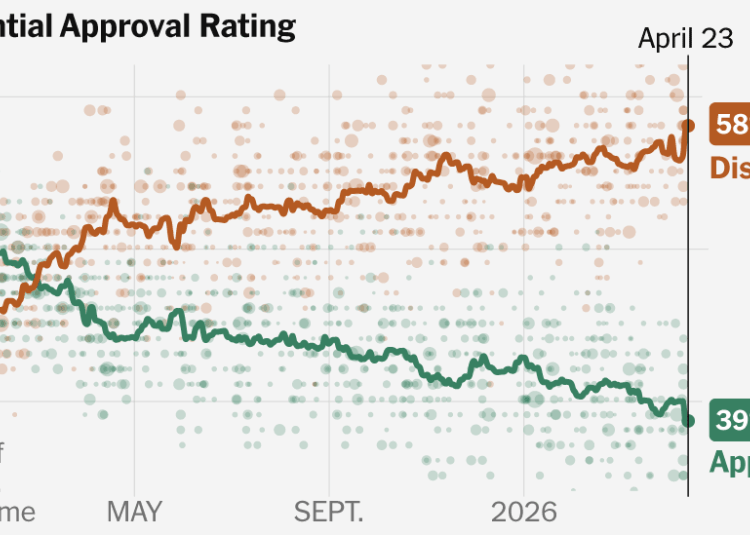
Disapproval of Trump has climbed to the highest level of his second term, according to The New York Times polling average.
-
Some Labubu dolls contain cotton from the Xinjiang region of China, which is banned by a U.S. forced labor law, testing showed.
TOP OF THE WORLD
The most clicked link in your newsletter yesterday was our quiz about British insults.
SPORTS
World Cup: A Trump official said he had asked FIFA to replace Iran with Italy in the tournament. But Italy fans don’t want a pity invite.
‘EXTRAORDINARY’ ART OF THE DAY
Meet the Turner Prize nominees
Take a look at works by the four artists shortlisted for this year’s Turner Prize. The director of the Tate Britain museum in London, who serves as the chair of the prize jury, said yesterday that the four artists had all taken viewers on “extraordinary journeys.”
MORNING READ
In Jakarta, Indonesia’s capital, compact Chinese electric cars weave through the streets. Chinese cosmetics crowd pharmacy shelves. And Chinese hot pot restaurants and milk-tea chains have sprouted in the city’s many, many malls.
Squeezed by cautious consumers at home, Chinese companies are fanning out across the globe. Indonesia, with its teeming young population, is an obvious target. There, brands like the fast-food chain Mixue and the automaker BYD are reshaping how Indonesians see Chinese products. Find out why some see China as “the future.”
AROUND THE WORLD
When your manager is a bot
A shop in San Francisco calls itself the world’s first retail boutique run by artificial intelligence. It has human workers, but they are all managed by an A.I. bot named Luna. The experiment was designed to see how far we are from a future where A.I. agents are running everyday companies.
It turns out that future may still be far away. Luna struggled with employee schedules, ordered 1,000 toilet seat covers for the employee bathroom and the business lost roughly $13,000. Read more.
RECIPE
Blotkake is a layered spongecake covered with whipped cream and fruit, and Norwegians are passionate about it. The dessert is decorated with cloudberries, which are a protected crop in Norway and might be hard to find in some countries, but raspberries are a good substitute.
WHERE IS THIS?
Where is this beach?
BEFORE YOU GO …
When I was a child, the sentence I most dreaded hearing from my parents was “let’s go to the museum.”
Maybe I was a particularly grumpy kid. Or maybe museums in Germany weren’t great for children in those days.
The first time I was truly gripped was when I went to the Holocaust Memorial Museum in Washington as a teenager. The staff gave me the passport of a Jewish girl who was killed by the Nazis, and for the duration of the visit, she was my alter ego. The experience was powerful, accessible and raw.
Good museums connect you with history in a visceral way. Last week, I took my 10-year-old son to the Churchill War Rooms in London, the underground site from where Britain’s prime minister masterminded the effort in World War II. My son loved it: the sand bucket where Churchill used to stub out cigars; the world map with thousands of push pins marking ships that had been taken or sunk. And of course, Churchill’s bed (complete with chamber pot).
Suddenly, the stories of his great-grandfather, a British officer who had been captured by the Germans, were less abstract. He’d worn the same uniform as the wax figure of an officer adjusting the pins on the map.
The other thing that brought the past to life was the recorded sound of someone whistling in the corridor (a wink from the curator, who told us Churchill hated whistling — it was the one thing he shared with Hitler).
The song I have for you today is “Summertime” by Ella Fitzgerald, whose career took off a few years before Churchill settled into his wartime bunker. Tomorrow is her birthday.
Have a great weekend! — Katrin
TIME TO PLAY
Here are today’s Spelling Bee, Mini Crossword, Wordle and Sudoku. Find all our games here.
We welcome your feedback. Send us your suggestions at [email protected].
Katrin Bennhold is the host of The World, the flagship global newsletter of The New York Times.
The post The Generals Running Iran appeared first on New York Times.