“Let’s celebrate an icon!”
So read the invitation for the Los Angeles premiere of “Michael,” a film about Michael Jackson’s life up to 1988 — before the first child molestation accusations surfaced. Many of the 3,000 attendees (including Jackson’s family) were happy to oblige. They turned up at the Monday event in fedoras and sequins, and sang along to “Billie Jean” and “Bad.” During several scenes, the cheering inside the theater was so loud that it drowned out the film’s dialogue.
It was a perfectly executed marketing moment, but moviegoers will have the final word. Are they ready to celebrate Jackson, too?
Reviews have been brutal. (“Can’t be taken seriously.” “Disconnected from reality.” “Frustratingly shallow.”) Yet box office expectations are stratospheric. The film, which arrives in theaters on Thursday night, comes from the producer behind “Bohemian Rhapsody,” the Queen biopic that collected $911 million worldwide in 2018, or roughly $1.2 billion after adjusting for inflation.
Here’s what you need to know.
A-list film artists worked on it.
At Monday’s premiere, the lead producer Graham King dated the project to 2019. He had just delivered “Bohemian Rhapsody,” and its success sent a torrent of other biopic opportunities his way. He decided to tackle Jackson in cooperation with the estate. (Jackson died at age 50 in 2009 of acute propofol intoxication.)
King, who won an Oscar in 2007 for producing “The Departed,” knew studios would be reluctant. Jackson remained a huge star, but he was also radioactive, in part because of “Leaving Neverland,” the 2019 HBO documentary in which two men recounted what they said was years of sexual abuse by Jackson when they were boys. (The Jackson estate called the men liars and sued HBO, resulting in the removal of the documentary from HBO’s streaming service.)
So King lined up a director and screenwriter for “Michael” that studios would have no choice but to take seriously: Antoine Fuqua, the filmmaker known for “Training Day” (2001), and John Logan, an Oscar-nominated writer whose credits include “The Aviator” (2004) and “Gladiator” (2000). Colman Domingo, a two-time Oscar nominee (“Sing Sing,” “Rustin”), agreed to play Joe Jackson, the abusive family patriarch.
The original script grappled with sex abuse claims.
“Michael” was never going to be a warts-and-all look at the superstar — not with lawyers for his estate riding shotgun. But the version of the project that was shopped to studios depicted a police investigation into child molestation claims. The movie’s third act hinged on accusations by a 13-year-old boy named Jordan Chandler; Jackson agreed to pay him roughly $23 million in 1994 to settle a lawsuit, effectively ending a criminal investigation. (Jackson always denied any wrongdoing.)
Janet Jackson wanted nothing to do with it.
King asked Jackson’s surviving siblings (Tito died in 2024) for permission to depict them in the film. There was one important holdout: Janet Jackson. Her reasons are unknown, and a spokeswoman did not respond to a request for comment.
The film’s solution? It’s as if she never existed. Not so much as a passing mention.
“I wish everybody was in the movie,” Michael’s sister La Toya Jackson told Variety at the premiere. “She kindly declined so you have to respect her wishes.” La Toya is depicted throughout the movie; she also received an executive producer credit.
Jackson’s sons, Prince and Bigi (formerly known as Blanket), have supported “Michael.” His daughter, Paris, has not. In an Instagram video posted in September, she said her notes on what she considered “dishonest” about an early script were rejected. “A big section of the film panders to a very specific section of my dad’s fandom that still lives in the fantasy,” she said in the video.
Hollywood’s biggest studios passed.
In quick order, studio executives showed King the door. “Michael” was too risky, they said, even with the standout creative team.
But a small studio, Lionsgate, was intrigued. “Michael” could be the kind of film that makes Hollywood insiders cringe and mainstream audiences cheer — a subject the cultural elite finds toxic but that rank-and-file moviegoers, given the chance, would turn into a hit. Maybe other studios were underestimating the emotional response that older moviegoers would have in remembering Jackson’s early albums. Maybe the right marketing message — a young man with a dream — could hook teenagers.
Lionsgate stepped in.
Lionsgate agreed to make “Michael” for $150 million. In keeping with its practice, the studio sold overseas rights to lessen risk; Universal paid about $75 million to release “Michael” outside North America, except in Japan, where Kino Films paid a hefty sum for the rights.
The upshot: Lionsgate needs “Michael” to gross just $150 million domestically to generate substantial profit, analysts have estimated.
Production was a nightmare.
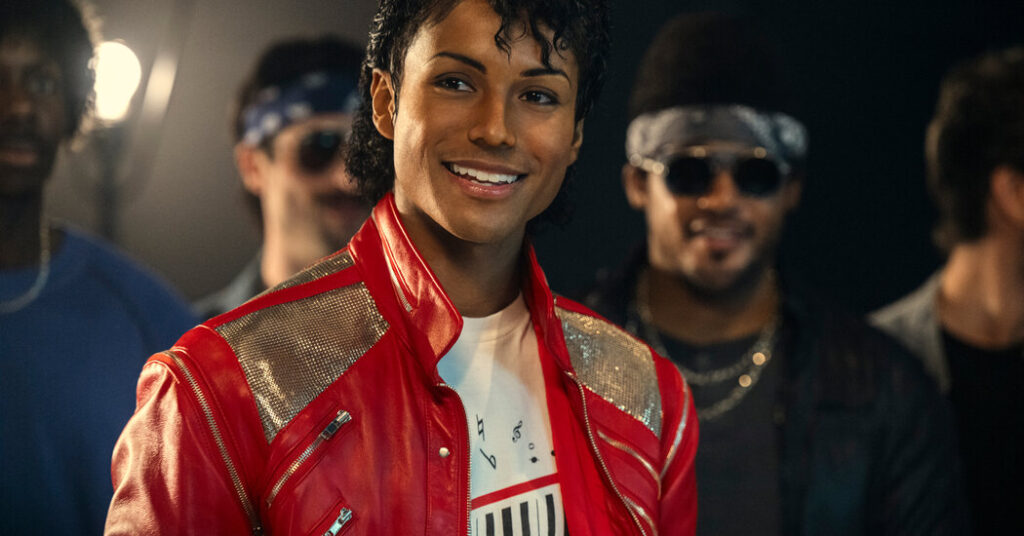
Finding the right actor to portray Jackson as a young adult was difficult. The filmmakers looked at nearly 200 actors, ultimately casting Jackson’s nephew, Jaafar, a first-time actor. (With makeup and hairstyling, he looks just like his uncle.)
Then came a twist that is hard to believe: After shooting was complete and editors were assembling the footage, the estate told King that it had made a colossal mistake. Lawyers had discovered that — as part of the 1994 settlement with Chandler and his parents — the estate was barred from ever mentioning him or his family in any movie.
As a result, swaths of the film’s third act were unusable. The filmmakers scrambled to excise the Chandler plotline, resulting in $40 million to $50 million in additional filming — and a finished movie that concludes in 1988, before the first child molestation accusations surfaced. The estate covered the bulk of the cost.
The marketing has emphasized joy and celebration.
Lionsgate has positioned “Michael” as an overdue cinematic tribute to an artistic genius. Think what you may of his later-in-life descent, but his impact on music, fashion, dance and popular culture cannot be overstated or denied, cast members have repeated in interview after interview.
This isn’t a gloomy movie — got it?
Several upbeat marketing stunts went viral, including one that became known as “don’t walk: moonwalk.” Dancers took over major crosswalks in New York and Los Angeles and performed Jackson’s famous backslide, encouraging fans to “swap their walk” for the move. In total, Lionsgate spent more than $50 million on its domestic marketing campaign.
‘Michael’ could be a megahit.
Based on advance ticket sales and surveys that track moviegoer interest, “Michael” is expected to collect at least $70 million from Thursday through Sunday at theaters in North America. “Straight Outta Compton” (2015) holds the musical biopic opening record. It collected $60 million, or about $85 million in today’s dollars, over its first few days and ultimately grossed $200 million (or an adjusted $285 million).
“Michael” is expected to be a juggernaut overseas. Analysts say that, all in, “Michael” could collect $100 million in Japan alone.
How much will negative reviews dent returns? Probably not very much. “Bohemian Rhapsody” spent most of its theatrical run as “rotten” on the review-aggregation site Rotten Tomatoes, and fans didn’t care. It ended up collecting $217 million in North America alone (or $289 million in today’s dollars).
If anything, the blast of negativity from critics could help the film, according to theater owners. They pointed to a surge of ticket sales since Tuesday morning, when reviews began to post, leading to fan blowback on social media platforms.
There will be a sequel.
Lionsgate has been coy about another installment, saying it will make a decision about a follow-up movie — or movies — in the coming weeks. But it is clear the studio will continue in the Jackson business: “Michael” is a Part 1.
The words “His story continues” appear onscreen at the end of “Michael.” Roughly 30 percent of the cut material from “Michael” could be used in a sequel, according to people involved with the production. And a detailed story “beat sheet,” or outline, for a sequel has already been completed.
Brooks Barnes is the chief Hollywood correspondent for The Times. He has reported on the entertainment industry for 25 years.
The post Explaining the Michael Jackson Biopic’s Rough Path to the Screen appeared first on New York Times.