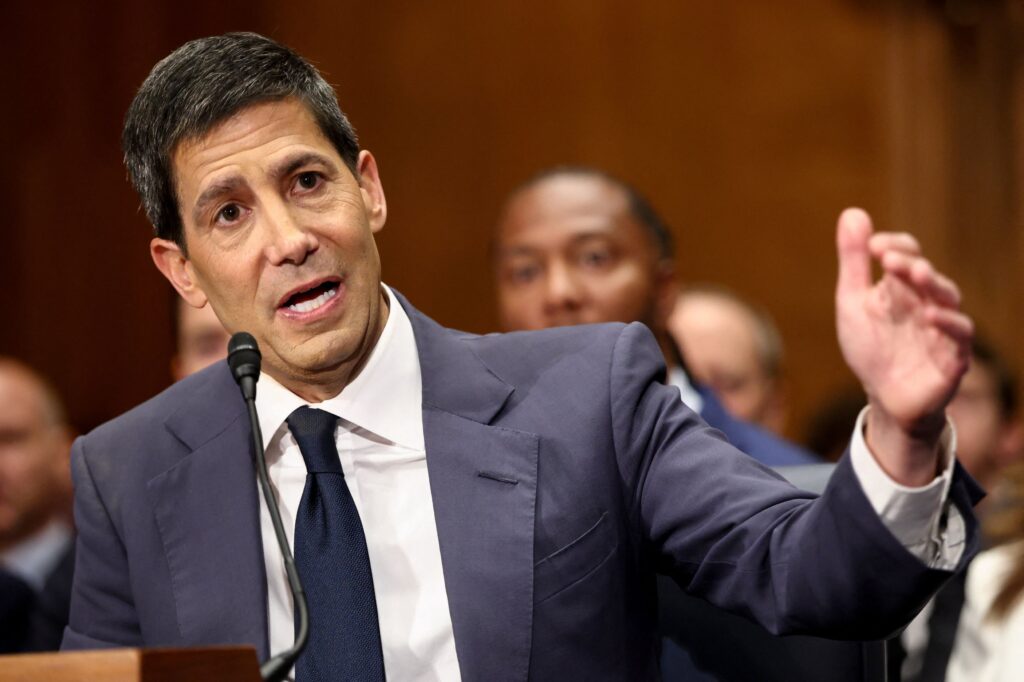
Kevin Warsh, President Donald Trump’s pick to lead the Federal Reserve, pledged independence from the White House, even as Trump said he would be disappointed if his Fed pick doesn’t immediately cut rates.
“The president never asked me to commit to interest rate cuts. He didn’t ask for it, he didn’t demand it, he didn’t require it, and nor would I have ever done so,” Warsh said during his confirmation hearing before the Senate Banking, Housing and Urban Affairs Committee.
Warsh, 56, is not expected to immediately advance through the Senate panel, because one Republican lawmaker, North Carolina’s Thom Tillis, is effectively blocking the nomination until the U.S. attorney in Washington drops a criminal investigation into the central bank.
Warsh is a former Morgan Stanley banker who served as a Fed governor during the 2008 financial crisis, acting as a liaison between the central bank and Wall Street. Trump settled on him in late January after a months-long selection process. Warsh would probably be the wealthiest Fed chair in modern times — financial disclosures show a fortune well in excess of $100 million, including holdings of cryptocurrency and artificial intelligence ventures.
In prepared remarks submitted ahead of the hearing, Warsh told lawmakers that the Fed’s independence in setting interest rates is “essential” but that the president should have more sway over other Fed decisions, such as bank regulation and supervision.
“I am committed to ensuring that the conduct of monetary policy remains strictly independent,” he said.
Warsh did not mention the investigation or Trump’s years-long attacks on the Fed in his prepared remarks. But he suggested he would not simply deliver the lower interest rates the president has demanded unless they are warranted by economic conditions.
“Inflation is a choice, and the Fed must take responsibility for it,” he said.
Trump told CNBC on Tuesday that he would be disappointed if Warsh is confirmed and does not immediately cut interest rates. The president also signaled little interest in having the Justice Department abandon its probe of renovations to the Fed’s headquarters, saying that “we have to find out” about the construction costs tied to the Fed’s $2.5 billion project.
Democrats on the panel pressed Warsh on the administration’s attempts to encroach on the Fed’s independence, amid the Justice Department’s criminal investigation into Fed Chair Jerome H. Powell and Trump’s effort to remove Fed governor Lisa Cook, whose lawsuit seeking to block her ouster is pending before the Supreme Court. They also highlighted perceived gaps in Warsh’s financial disclosures.
Early in the hearing, Sen. Elizabeth Warren (D-Massachusetts) characterized Warsh as a Trump “sock puppet” whose views on monetary policy have opportunistically shifted to favor lower rates once Trump returned to office.
She pressed Warsh to disclose the underlying assets in private funds listed on his financial disclosures, which Warsh has yet to reveal, citing confidentiality agreements. When Warren asked whether the private fund assets had any connection to Trump or Trump family businesses, Chinese-controlled businesses or investments set up by the late convicted sex offender Jeffrey Epstein, Warsh declined to answer directly, saying that he would agree to divest from the funds if confirmed.
Asked whether Trump had lost the 2020 presidential election, Warsh said Congress had certified the election in Joe Biden’s favor.
Later, Sen. John Neely Kennedy (R-Louisiana) asked Warsh whether he would be anyone’s “human sock puppet.”
“Absolutely not,” Warsh said. “I’ll be an independent actor if confirmed as chairman of the Federal Reserve.”
Tillis has vowed to block any Fed nominee from advancing to a full Senate vote until the Justice Department investigation into Powell is closed, characterizing the probe as an effort to undermine Fed independence. Despite that effective blockade in the Senate, the investigation escalated last week, when prosecutors from the U.S. attorney’s office in Washington appeared without warning at the Fed’s headquarters seeking a tour of an active construction site.
“The problem that I have here is that we had some U.S. attorney with a dream, or assistant U.S. attorney thinking it would be cute to bring Chair Powell under an investigation just a few months before the position was going to be open,” Tillis said Tuesday.
The episode last week, in which the prosecutors were turned away, came after a federal judge characterized that Justice Department investigation as a pretextual effort by the Trump administration to pressure Powell to lower interest rates or resign from the independent central bank.
Powell’s term as chair expires May 15. He has said he would remain as acting chairman if a successor is not confirmed. Trump last week threatened to try to fire him if he does not leave the Fed “on time.”
On Tuesday, Warsh said he would work for a smaller Fed balance sheet “slowly and deliberatively,” in coordination with the Treasury Department.
Separately, he said he would scale back the Fed’s practice of signaling its rate intentions in advance, contending that such guidance can leave policymakers anchored to outdated forecasts.
The Fed tends to broadcast its economic projections to the world and then stick with them longer than the data warrants, Warsh told Sen. Tim Scott (R-South Carolina).
The post Trump’s Fed pick grilled by Senate panel, with confirmation still in limbo appeared first on Washington Post.