Republicans have built a small structural advantage in the monthslong redistricting war being waged across the country as both parties seek an edge in their efforts to win control of Congress in the midterm elections.
An important election on Tuesday in Virginia could upend that advantage.
The state is holding a Democratic-backed referendum on whether to redraw its congressional map to give the party as many as four House seats that are now held by Republicans. Democrats now occupy six of Virginia’s 11 seats; the new map could give them 10.
The Virginia vote is the latest chapter of a rare mid-decade cartographic arms race that Texas Republicans started last year when, urged on by President Trump, they drew a map intended to yield five more Republican seats.
The fight soon spread to a range of red and blue states, including California, which overwhelmingly passed a statewide ballot measure meant to eliminate five Republican seats. Florida is the last remaining state with potential plans to redraw its map this spring.
The one-question election in Virginia has drawn more than $75 million in spending and intense interest from national party leaders. Representative Hakeem Jeffries, the Democratic minority leader, has helped fund the Democratic “Yes” side of the referendum, while Speaker Mike Johnson, defending House Republicans’ slim majority, has backed the “No” effort.
On Monday night, Mr. Trump called into a Virginia radio host’s streaming channel and appeared on a conference call with supporters from the state. He warned that if House Democrats won a majority in the midterm elections, “it’s going to be a disaster.”
“I don’t know if you know what gerrymandering is, but it’s not good,” he said on the call.
The remarks were the first time the president had addressed the Virginia referendum. Earlier in the day, Mr. Jeffries told reporters at the Capitol that Democrats would gladly pay to broadcast the president’s statement opposing the referendum to all Virginia voters.
“The voters of Virginia have the opportunity to ensure that there is a fair national congressional map,” Mr. Jeffries told reporters on Monday at the Capitol. “Not Donald Trump and his extreme MAGA sycophants.”
In their advertising, both supporters and opponents have turned to the same pitchman: former President Barack Obama. He has appeared in ads supporting the Democratic redistricting effort, but the Republican side has highlighted his past comments opposing partisan gerrymandering.
Observers in both parties will be closely watching the Virginia outcome — and its margin — for what it suggests about the national political environment months before the midterm elections.
How could this change the national state of play?
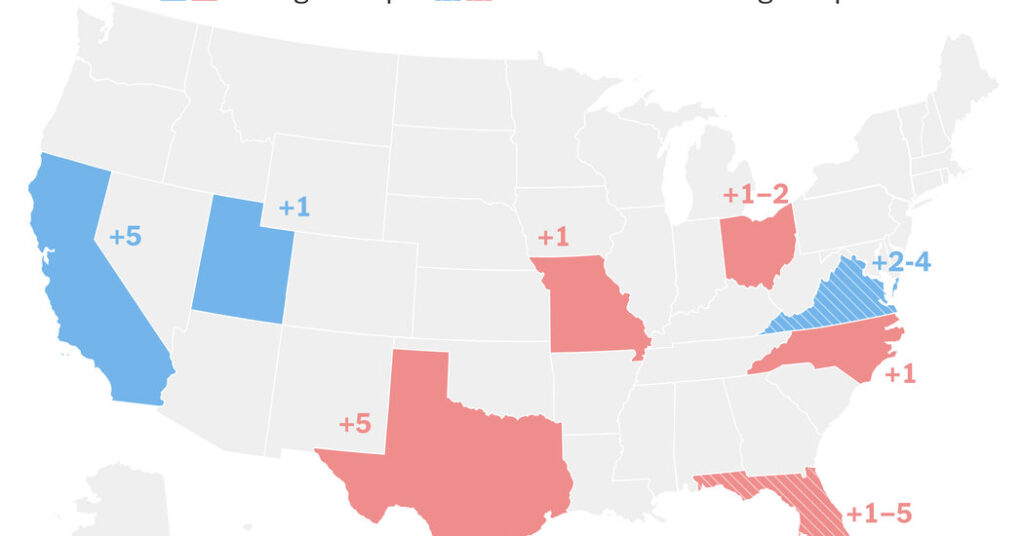
Republicans have picked up more seats in Texas, North Carolina, Missouri and Ohio, while Democrats have gained seats in California and courts in deep-red Utah gave the party an unexpected new district.
As things currently stand, there are eight or nine new Republican-leaning districts and six new Democratic-leaning districts, giving Republicans a two- or three-seat advantage.
Virginia could wipe that out. Democrats’ potential four-seat gain in the state could leave the national redistricting war at roughly a draw, although Republicans may regain a slight edge if Florida pushes through a new map, as Gov. Ron DeSantis has promised.
There is a wild card: In the coming months, the Supreme Court may strike down a critical provision of the Voting Rights Act that effectively bans racial gerrymandering. If that happens, a range of Republican-led states, largely in the South, may try to push through new maps before the midterms, which could give the party an added edge.
Any slight advantage heading into November could be critical for either party. Campaigning in swing congressional districts can cost millions of dollars, and Republicans hold control of the House by just a handful of seats.
While a Democratic wave election might overcome any advantage that Republicans are able to build through new maps, in a close election the outcome of the redistricting battles could make the difference.
What would Virginia’s new map look like?
If the referendum passes, Virginia’s new House map will contain eight safely Democratic districts, two competitive districts that lean Democratic and just one safely Republican district.
The map would be one of the most aggressive political gerrymanders in the country, carving up Democratic communities in the Washington suburbs to pair them with large areas of Republican-leaning, less populated rural stretches of the state.
Perhaps the most extreme new district would be the Seventh, which begins at the Potomac River and stretches to the west and south in a manner that resembles lobster claws. Republicans have argued that the proposed map would concentrate the state’s political power with Democrats in Northern Virginia, but in recent elections those voters have outnumbered Republicans who live in the rest of the state.
What will the results say about Democratic and Republican enthusiasm?
Virginia will serve as the latest test of energy for both parties.
In recent elections, Democrats have far outperformed their showing in the 2024 presidential election, in some cases swinging the results 20 percentage points in their favor.
Virginia has a more recent example: In November, Abigail Spanberger, a Democrat, won the governor’s race by 15 points, well exceeding Kamala Harris’s six-point victory in the state in 2024.
Turnout in early voting for the referendum has been quite high. More than 1.34 million Virginians had voted through Friday, nearly as many as voted early in November for races for governor and other local offices.
If the referendum passes by a comfortable margin, Democrats will say that they are keeping up their momentum at a time when Mr. Trump’s approval ratings are slipping, the unpopular war with Iran continues and gas prices have risen.
But if it is close, Republicans may find reasons for hope — and if it fails, they are likely to argue that their electoral fortunes are turning around.
Will the Republican confusion tactics work?
Anyone looking at a screen or listening to a radio station in Virginia the past two weeks has been bombarded with advertising showing some of the referendum’s chief proponents speaking out against partisan gerrymandering.
The “No” campaign has used old footage of Mr. Obama and Ms. Spanberger describing the ills of gerrymandering, which they opposed when it was Republicans drawing the lines. Both are now supporting the referendum, and Mr. Obama is the star of the “Yes” campaign’s advertising.
Republicans opposing the referendum have tried to depress Black turnout by warning that the state’s two Black members of Congress will lose their districts (both are planning to run in proposed new districts) and airing footage of the Rev. Dr. Martin Luther King Jr. In heavily Democratic Arlington, “No” yard signs were blue and green — traditionally Democratic colors — and read “Don’t Divide Arlington.”
Democratic leaders in Virginia warned that some percentage of their voters would oppose the referendum on good-government grounds — they oppose political gerrymandering regardless of who is doing it. They also worried that other voters could be confused by the Republican messaging.
Can Republicans drive Election Day turnout?
The only time Virginia Republicans have won a statewide race since 2009 was when Glenn Youngkin was running for governor in 2021. That year, a late surge and huge Election Day turnout drove Mr. Youngkin and fellow Republicans to victory.
But while Republicans are energized in opposition to the referendum, the political environment is far different now from what it was when Mr. Youngkin won. In 2021, President Joseph R. Biden Jr. had grown unpopular and was fighting with Democrats about his domestic agenda. With Mr. Trump in office, Democrats require little effort to fire up their voters.
For Republicans to defeat the referendum, they will need a huge number of their voters to turn out on Tuesday to cast ballots against it.
Reid J. Epstein is a Times reporter covering campaigns and elections from Washington.
The post Virginia Voting Today on Map That Could Hand 4 House Seats to Democrats appeared first on New York Times.