Iraq maintains close ties to both Iran and the United States and has often found itself caught between them. Now, with its two partners at war, the government in Baghdad is coming under increasing U.S. pressure to choose a side.
Washington is demanding that Iraq distance itself from Iran and rein in the Iran-linked Iraqi militias that have been behind recent attacks targeting U.S. interests there. In the latest step to force Iraq’s hand, it has suspended U.S. cooperation with and funding for Iraq’s security services, two Iraqi officials said on Monday.
The State Department declined to comment specifically on the move, but said Washington has demanded the Iraqi government crack down on militias supported by Iran, including some with ties to officials in the Baghdad government.
“The United States will not tolerate attacks on U.S. interests and expects the Iraqi government to immediately take all measures to dismantle the Iran-aligned militia groups in Iraq,” Tommy Pigott, the State Department deputy spokesman, said in a statement.
The Pentagon did not reply to a request for comment on the halting of security cooperation, which includes counterterrorism actions against groups like Islamic State and training and other support for Iraq’s military forces.
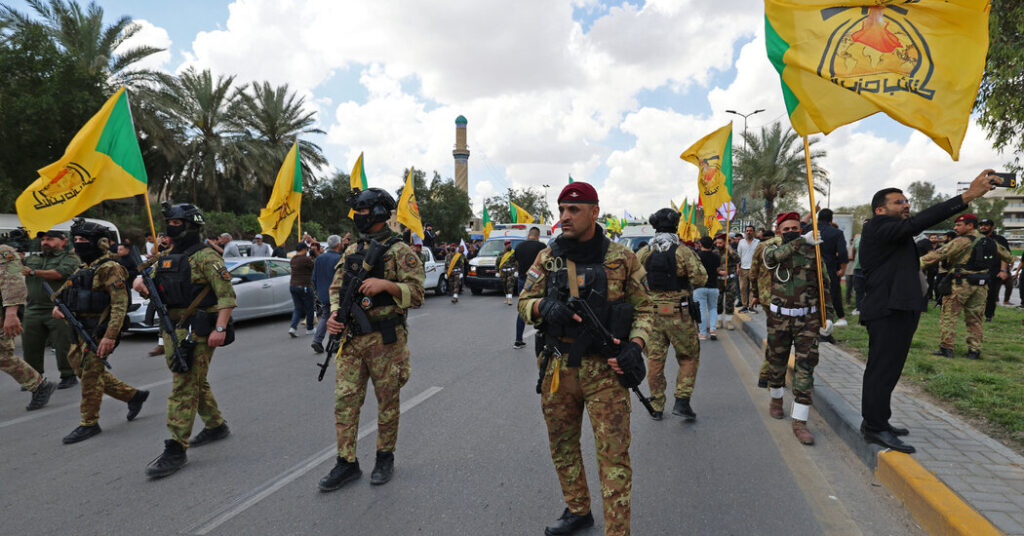
During the U.S.-Israeli war with Iran that began in late February, the U.S. Embassy in Baghdad, a U.S. base and an airport with U.S. air defenses near an American base in northern Iraq came under attack. Iran-backed militias claimed responsibility for several of the attacks, which came after an airstrike hit the headquarters of one of the militias and killed three people.
The militia blamed the airstrike on the United States and Israel.
On April 9, the U.S. deputy secretary of state, Christopher Landau, summoned the Iraqi ambassador in Washington, Nazar Al Khirullah, to the State Department and condemned recent attacks, including an assault the previous day that struck near U.S. diplomats in Baghdad, the State Department said in a statement at the time. The department said on Tuesday that a militia used multiple drones in that attack.
The formation of a new government in Iraq has drawn particular interest from both the United States and Iran.
In January, President Trump threatened to withdraw U.S. support for Iraq if Nuri Kamal al-Maliki, a leading Shiite politician, returned as the prime minister. Mr. al-Maliki was first elected prime minister in 2006, at the time with U.S. backing. But the relationship soured over his two four-year terms as he was increasingly seen as aligned with Iran.
In response to Mr. Trump’s threat, Mr. al-Maliki said in a social media post that Iraqis “categorically reject this blatant American interference.”
The United States suspended support for Iraq’s security services until a new government has been formed, Hussein Allawi, a security adviser to Iraqi Prime Minister Mohammed Shia al-Sudani, told The New York Times on Monday. A new government could be formed within days or weeks, though the timing remains uncertain.
Security aid for Iraq had already been reduced to $49 million last year and cutting it would have minimal impact, Mr. Allawi said, adding that he expected the cutoff to be temporary.
“The cooperation and coordination is something that needs to be continued,” he said.
An Iraqi Defense Ministry official, who spoke on condition of anonymity because he was not authorized to talk to the media, said U.S. cooperation and funding had been halted until further notice because of attacks on U.S. interests by the Iran-backed Iraqi militias.
The official added that losing U.S. support would affect logistical support for the Iraqi air force as well as training programs.
Iraq is one of the few Arab states in the Middle East which, like Iran, has a Shiite Muslim majority. The Shiite political parties closest to Iran have become the most powerful factions in the Iraqi government.
Iraqi Shiite militias formed after the U.S. invasion of Iraq in 2003 to attack American troops occupying Iraq, and some were trained and armed by Iran.
The militias later joined the U.S. led-coalition that fought the Islamic State terrorist group after it took over parts of Iraq, and most of them subsequently came under the formal supervision of the country’s national security forces. But a number of the more hard-line groups remained outside of state control and maintained close ties to Iran.
Ramzy Mardini, the founder of Geopol Labs, a geopolitical risk advisory firm based in the Middle East, said Iraqi leaders would risk triggering a state collapse if they moved now to force out the Iran-linked militias that had become intertwined with military, political, and economic institutions.
“The issue isn’t simply a lack of willpower or capacity — it’s that the boundaries of the Iraqi state itself are blurred,” he said. “American coercion, in this case, rests on the flawed assumption that the Iraqi government can act as a unified, autonomous actor,” he added.
“What exactly constitutes ‘the state’ in Iraq when independent armed actors are embedded within it? It’s a reality that the Trump administration has repeatedly failed to grasp,” Mr. Mardini said.
In a further sign of strains in the U.S.-Iraqi relationship, the U.S. Embassy in Baghdad posted a warning on social media on Monday that Iran-backed militias in Iraq were planning attacks on U.S. citizens and other targets connected to the United States. The Embassy reiterated its warning to U.S. citizens against traveling to Iraq and it has suspended all consular services in the country.
Earlier this month, an American journalist was kidnapped in Baghdad by an Iraqi militia allied with Iran and freed after a week in captivity. The militia, Kataib Hezbollah, said it had released the journalist, Shelly Kittleson, “in appreciation of the patriotic positions” of Iraq’s prime minister, who had been negotiating for her freedom.
Two senior Iraqi security officials said the April 8 drone attack near a U.S. Embassy delegation escorting Ms. Kittleson during her release angered the Americans, who described it as an ambush. The two officials argued that the attack, inside Baghdad’s international airport, was not targeted at Ms. Kittleson and her escorts.
The suspension of U.S. support came days after a visit to Iraq by Gen. Esmail Ghaani, the commander of Iran’s Quds Force.
The Quds Force is an arm of Iran’s powerful Islamic Revolutionary Guards Corps. It is tasked with overseeing Iran’s foreign operations and providing support for allied militias across the Middle East, including Hezbollah in Lebanon, Hamas in Gaza and the Houthis in Yemen.
“The selection of the prime minister is carried out solely based on an Iraqi decision,” Mr. Ghaani said in a statement on Monday. He added that outsiders, “especially criminals against humanity,” should not interfere in Iraq’s affairs, a clear reference to the United States.
For his part, Mr. Ghaani said that he was in Iraq to convey his appreciation and gratitude for the solidarity of the Iraqi people, the country’s religious authority and its officials.
Following the 2003 U.S. invasion and occupation of Iraq, which catalyzed a civil war, the country remains deeply scarred and afflicted by almost constant upheaval. The country never fully stabilized, and the U.S. intervention left the Iraqi state weakened and vulnerable to powers in the region and beyond, including the United States, that wanted to pursue their own geopolitical ambitions.
But it was Iran that proved most adept at exploiting the power vacuum left by the U.S. removal of the dictator Saddam Hussein and exerting its influence inside Iraq.
Raja Abdulrahim reports on the Middle East and is based in Jerusalem.
The post U.S. Turns Up Pressure on Iraq to Distance Itself From Iran appeared first on New York Times.